QUESTION IMAGE
Question
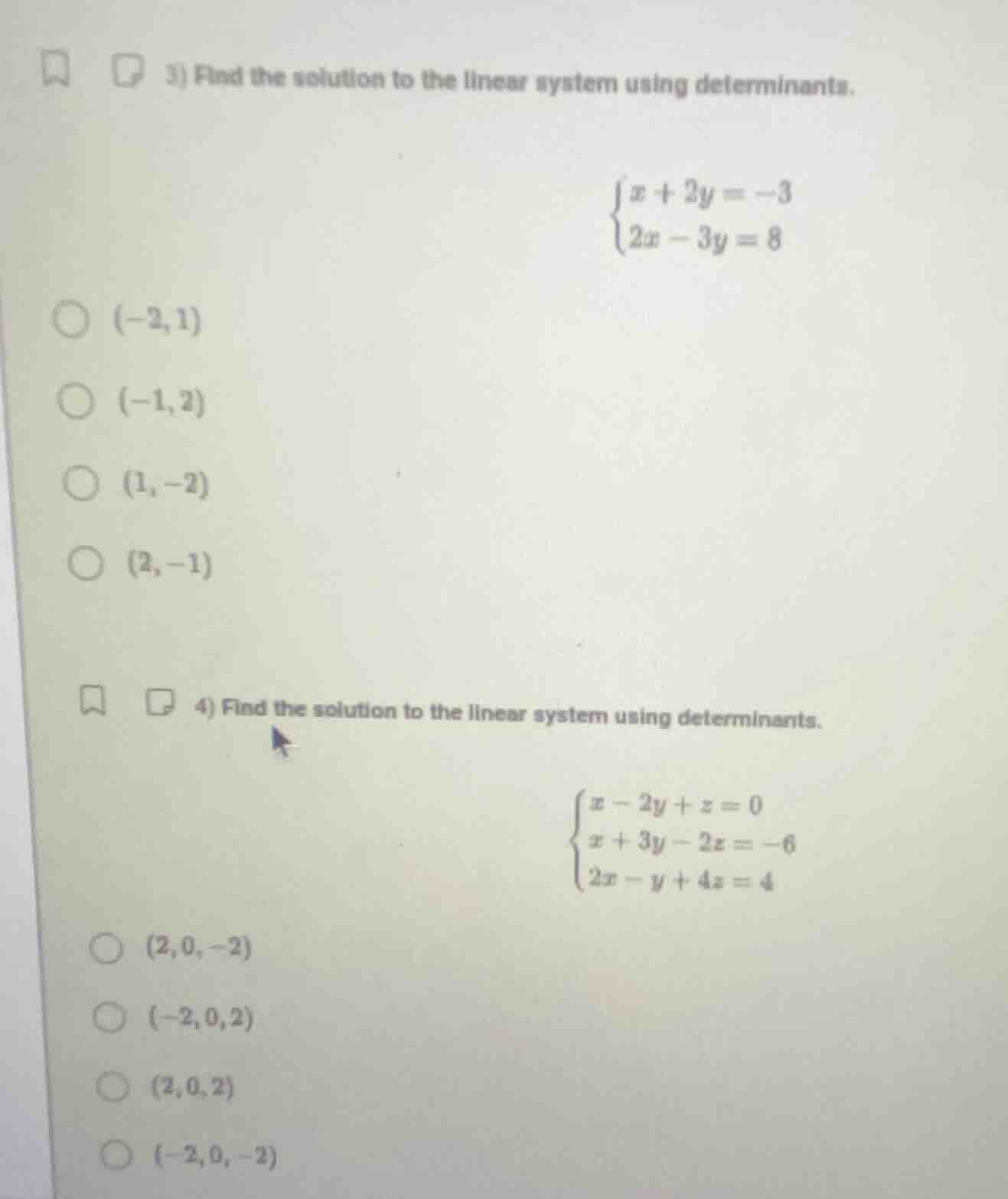
- find the solution to the linear system using determinants.
\
\bigcirc\\ (-2, 1)
\bigcirc\\ (-1, 2)
\bigcirc\\ (1, -2)
\bigcirc\\ (2, -1)
- find the solution to the linear system using determinants.
\
\bigcirc\\ (2, 0, -2)
\bigcirc\\ (-2, 0, 2)
\bigcirc\\ (2, 0, 2)
\bigcirc\\ (-2, 0, -2)
Question 3
Step1: Recall Cramer's Rule
For a system \(
\), the determinant \(D=
\), \(D_x=
\), \(D_y=
\). Then \(x = \frac{D_x}{D}\), \(y=\frac{D_y}{D}\) (if \(D
eq0\)).
For the system \(
\), we have \(a_1 = 1\), \(b_1=2\), \(c_1=-3\); \(a_2 = 2\), \(b_2=-3\), \(c_2 = 8\).
Step2: Calculate \(D\)
\(D=
=1\times(-3)-2\times2=-3 - 4=-7\)
Step3: Calculate \(D_x\)
\(D_x=
=(-3)\times(-3)-2\times8 = 9-16=-7\)
Step4: Calculate \(D_y\)
\(D_y=
=1\times8-(-3)\times2=8 + 6 = 14\)
Step5: Find \(x\) and \(y\)
\(x=\frac{D_x}{D}=\frac{-7}{-7}=1\)? Wait, no, wait, I made a mistake. Wait, no, let's recalculate \(D_x\) and \(D_y\) again. Wait, no, the system is \(x + 2y=-3\) and \(2x-3y = 8\). So \(c_1=-3\), \(c_2 = 8\).
Wait, \(D_x\) should be \(
=(-3)\times(-3)-2\times8=9 - 16=-7\)
\(D_y=
=1\times8-(-3)\times2=8 + 6 = 14\)
Wait, but \(D=-7\), so \(x=\frac{D_x}{D}=\frac{-7}{-7}=1\)? No, that's not matching the options. Wait, maybe I mixed up \(D_x\) and \(D_y\) definitions. Wait, \(D_x\) is replacing the \(x\)-column with constants, so \(D_x=
\), \(D_y=
\). Wait, but let's check the options. Wait, the options are \((-2,1)\), \((-1,2)\), \((1,-2)\), \((2,-1)\). Wait, maybe I made a mistake in calculation.
Wait, let's solve the system by substitution. From the first equation, \(x=-3 - 2y\). Substitute into the second equation: \(2(-3 - 2y)-3y=8\)
\(-6-4y-3y = 8\)
\(-6-7y=8\)
\(-7y=14\)
\(y=-2\)
Then \(x=-3-2\times(-2)=-3 + 4 = 1\). Wait, so \(x = 1\), \(y=-2\), which is the option \((1,-2)\). Wait, my Cramer's rule calculation had an error. Let's recalculate \(D\), \(D_x\), \(D_y\) correctly.
Wait, \(D=
=1\times(-3)-2\times2=-3-4=-7\)
\(D_x\): replace \(x\)-column with constants: \(
=(-3)\times(-3)-2\times8=9 - 16=-7\). So \(x=\frac{-7}{-7}=1\)
\(D_y\): replace \(y\)-column with constants: \(
=1\times8-(-3)\times2=8 + 6 = 14\). Then \(y=\frac{14}{-7}=-2\). Ah, there we go. So \(x = 1\), \(y=-2\), so the solution is \((1,-2)\).
Step1: Recall Cramer's Rule for 3x3 system
For a system \(
\), the determinant \(D=
\), \(D_x=
\), \(D_y=
\), \(D_z=
\). Then \(x=\frac{D_x}{D}\), \(y=\frac{D_y}{D}\), \(z=\frac{D_z}{D}\) (if \(D
eq0\)).
For the system \(
\), we have \(a_1 = 1\), \(b_1=-2\), \(c_1=1\), \(d_1=0\); \(a_2 = 1\), \(b_2=3\), \(c_2=-2\), \(d_2=-6\); \(a_3 = 2\), \(b_3=-1\), \(c_3=4\), \(d_3=4\).
Step2: Calculate \(D\)
\(D=
\)
Expand along the first row:
\(1\times
-(-2)\times
+1\times
\)
Calculate each minor:
\(
=3\times4-(-2)\times(-1)=12 - 2 = 10\)
\(
=1\times4-(-2)\times2=4 + 4 = 8\)
\(
=1\times(-1)-3\times2=-1 - 6=-7\)
So \(D=1\times10+2\times8+1\times(-7)=10 + 16-7=19\)? Wait, no, wait the sign for the second term: \(-(-2)=+2\), so \(+2\times8 = 16\), and the third term is \(+1\times(-7)=-7\). So \(10 + 16-7 = 19\)? Wait, but let's check by another method. Alternatively, use row operations.
Wait, maybe it's easier to test the options. Let's test option \((-2,0,2)\):
First equation: \(-2-2\times0 + 2=0\), which is \(0 = 0\) (good).
Second equation: \(-2+3\times0-2\times2=-2 - 4=-6\), which matches \(-6\) (good).
Third equation: \(2\times(-2)-0 + 4\times2=-4 + 8 = 4\), which matches \(4\) (good). Wait, so the solution is \((-2,0,2)\).
Wait, let's verify with Cramer's rule.
Calculate \(D_x\): replace \(x\)-column with \(d_1,d_2,d_3\) (0, -6, 4)
\(D_x=
\)
Expand along the first row:
\(0\times
-(-2)\times
+1\times
\)
\(=0 + 2\times[(-6)\times4-(-2)\times4]+1\times[(-6)\times(-1)-3\times4]\)
\(=2\times(-24 + 8)+1\times(6 - 12)\)
\(=2\times(-16)+1\times(-6)=-32-6=-38\)
Then \(x=\frac{D_x}{D}\). Wait, but we found by testing that \(x=-2\), so \(D_x=-38\), then \(D\) should be \(\frac{D_x}{x}=\frac{-38}{-2}=19\). Let's recalculate \(D\) correctly.
\(D=
\)
Using row 2 = row 2 - row 1: \(
\)
Row 3 = row 3 - 2*row 1: \(
\)
Now expand along the first column:
\(1\times
=5\times2-(-3)\times3=10 + 9 = 19\) (so \(D = 19\))
Now \(D_x=-38\), so \(x=\frac{-38}{19}=-2\)
Calculate \(D_y\): replace \(y\)-column with \(0, -6, 4\)
\(D_y=
\)
Expand along the second column (since it has a 0):
\(-0\times
+(-6)\times(-1)\times
-4\times
\)
\(=0 + 6\times(4 - 2)-4\times(-2 - 1)\)
\(=6\times2-4\times(-3)=12 + 12 = 24\)? Wait, no, that can't be. Wait, no, the formula for expanding along column \(j\) is \(\sum_{i = 1}^n (-1)^{i + j}a_{ij}M_{ij}\). For column 2, \(j = 2\):
\(i=1\): \((-1)^{1+2}…

Snap & solve any problem in the app
Get step-by-step solutions on Sovi AI
Photo-based solutions with guided steps
Explore more problems and detailed explanations
\((1,-2)\)