QUESTION IMAGE
Question
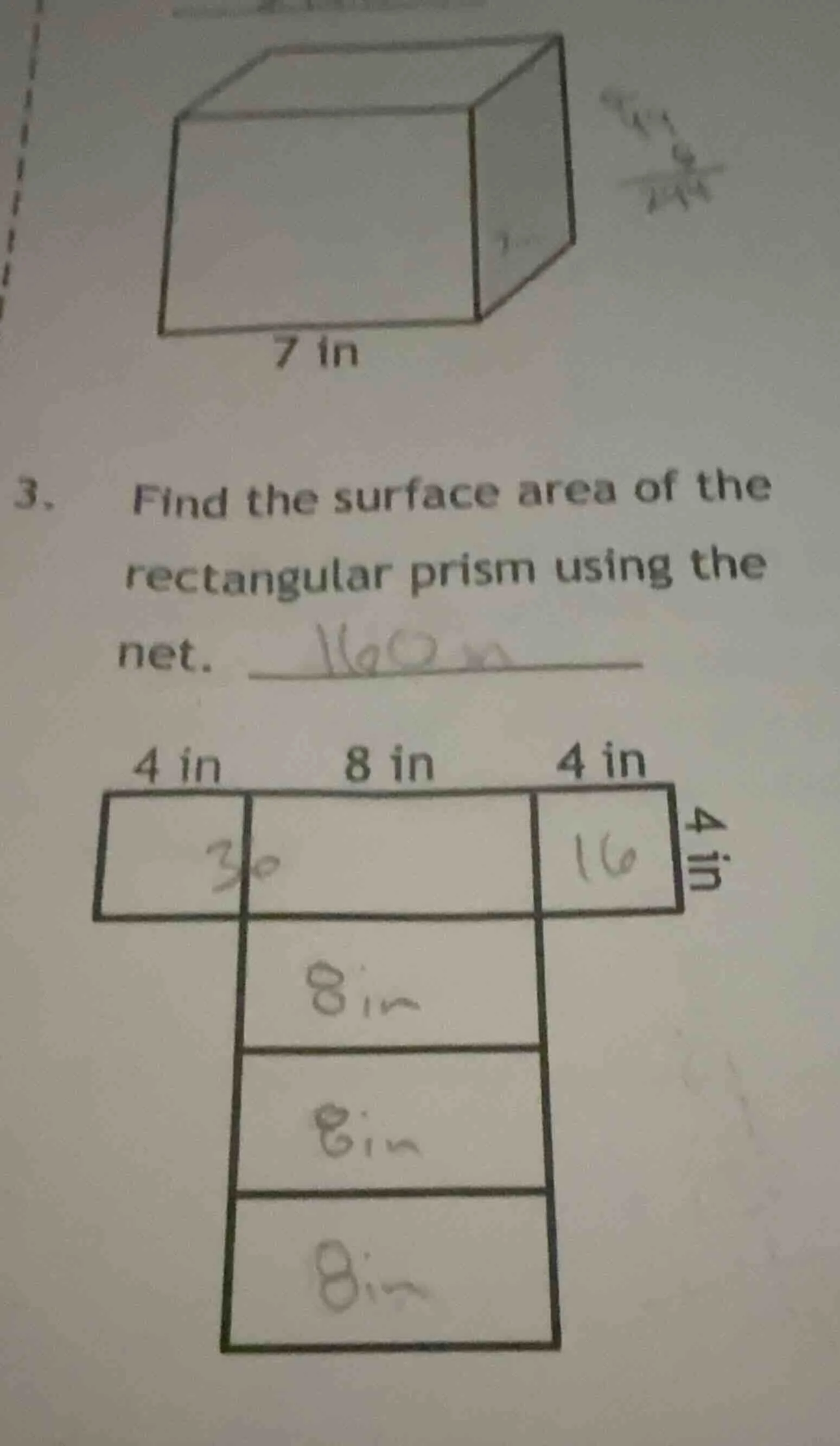
- find the surface area of the rectangular prism using the net.
4 in 8 in 4 in
4 in
Step1: Identify the faces of the rectangular prism from the net. The rectangular prism has three pairs of congruent faces. The dimensions are length \( l = 8 \) in, width \( w = 4 \) in, and height \( h = 4 \) in? Wait, no, looking at the net: the middle row has three rectangles? Wait, no, the net of a rectangular prism has 6 faces: 2 of each pair. Let's re - examine the net. The top row has three rectangles: the first is 4x4? Wait, no, the left - most rectangle in the top row: width 4 in, height 4 in? Wait, no, the middle rectangle in the top row is 8x4, the left - most is 4x4, the right - most is 4x4? Wait, no, maybe the length is 8, width is 4, height is 4? Wait, no, let's calculate the area of each face.
Wait, the formula for the surface area of a rectangular prism is \( SA=2(lw + lh+wh) \). From the net, we can see that there are two faces with dimensions 8x4, two faces with dimensions 4x4, and two faces with dimensions 8x4? Wait, no, maybe I misread. Wait, the net: the middle column has three rectangles? No, the net of a rectangular prism is composed of 6 rectangles: 2 of length × width, 2 of length × height, and 2 of width × height.
Looking at the net: the top row has three rectangles. The left one: width 4, height 4 (area \( 4\times4 = 16 \)), the middle one: length 8, height 4 (area \( 8\times4=32 \)), the right one: width 4, height 4 (area \( 4\times4 = 16 \)). Then the middle column (the vertical column) has three rectangles, each with length 8 and height 4? Wait, no, that can't be. Wait, maybe the correct dimensions are: length \( l = 8 \) in, width \( w = 4 \) in, height \( h = 4 \) in? No, that would make it a square prism. Wait, no, let's count the number of each type of face.
Wait, the surface area of a rectangular prism is calculated by adding the areas of all six faces. From the net, we can see that there are two faces with area \( 8\times4 \), two faces with area \( 4\times4 \), and two faces with area \( 8\times4 \)? No, that would be wrong. Wait, maybe the length is 8, width is 4, and height is 4? Wait, no, let's do it step by step.
First, identify the three different types of faces:
- Face 1: dimensions \( 8\times4 \). How many of these? Let's see, in the net, the middle rectangle in the top row is \( 8\times4 \), and the three rectangles in the middle column (vertical) are also \( 8\times4 \)? No, that's 4, which is wrong. Wait, I think I made a mistake. Let's look at the net again. The top row: left rectangle: 4 in (width) × 4 in (height), middle rectangle: 8 in (length) × 4 in (height), right rectangle: 4 in (width) × 4 in (height). Then the middle column (the column below the middle top rectangle) has three rectangles, each with length 8 in and height 4 in? No, that's not right. Wait, the correct way is: the rectangular prism has length \( l = 8 \), width \( w = 4 \), height \( h = 4 \). Wait, no, the formula for surface area is \( SA = 2(lw+lh + wh) \).
Wait, let's calculate the area of each pair of faces:
- Pair 1: length × width. Let's say length \( l = 8 \), width \( w = 4 \). Area of one face: \( 8\times4 = 32 \). Two of these: \( 2\times32 = 64 \).
- Pair 2: length × height. If height \( h = 4 \), area of one face: \( 8\times4 = 32 \). Two of these: \( 2\times32 = 64 \).
- Pair 3: width × height. Width \( w = 4 \), height \( h = 4 \). Area of one face: \( 4\times4 = 16 \). Two of these: \( 2\times16 = 32 \).
Now, sum them up: \( 64 + 64+32=160 \)? Wait, no, that can't be. Wait, maybe the dimensions are length \( l = 8 \), width \( w = 4 \), height \( h = 4 \)? Wait, no, maybe I misread th…

Snap & solve any problem in the app
Get step-by-step solutions on Sovi AI
Photo-based solutions with guided steps
Explore more problems and detailed explanations
The surface area of the rectangular prism is \(\boldsymbol{160}\) square inches.