QUESTION IMAGE
Question
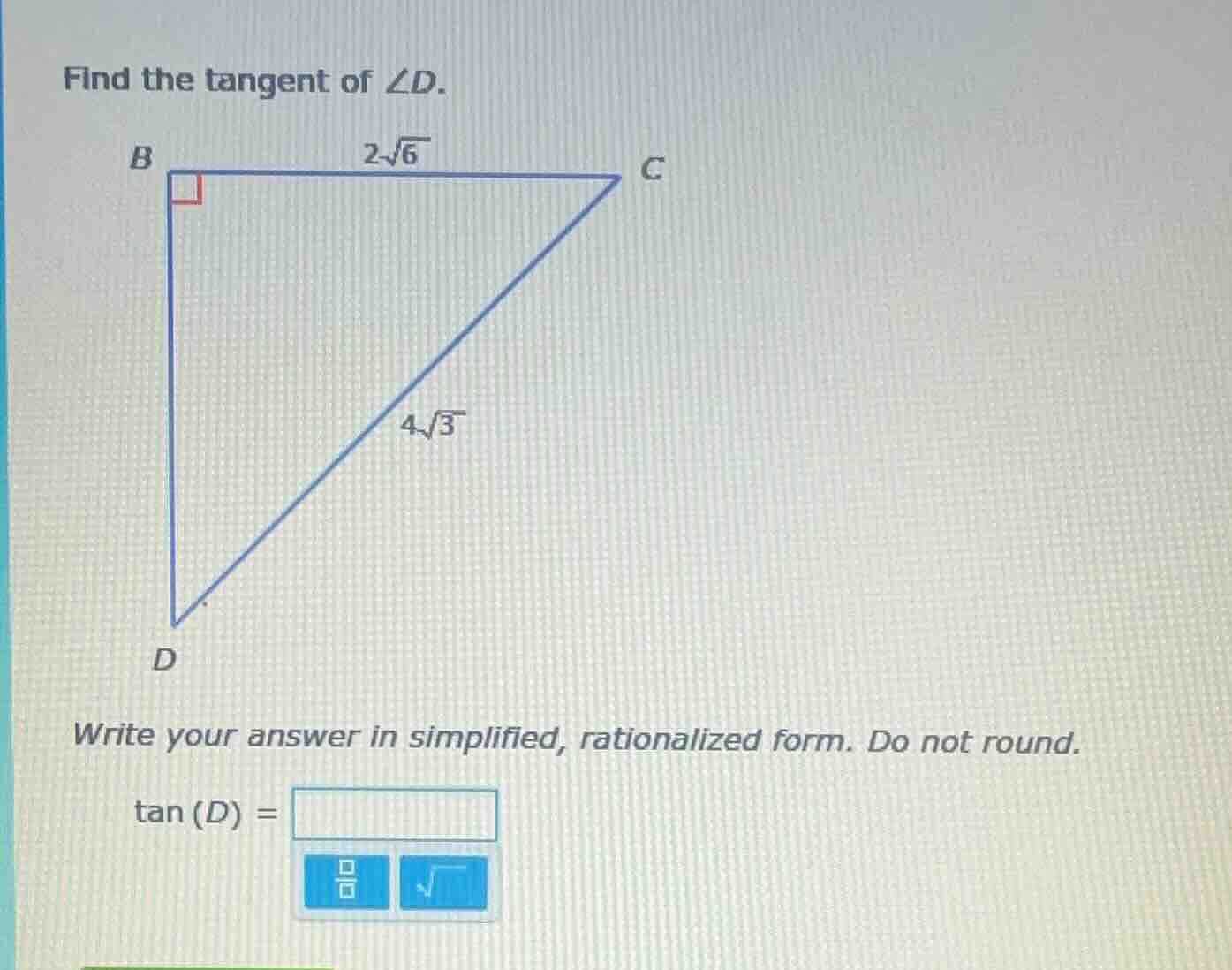
find the tangent of $\angle d$.
triangle with right angle at b, bc = $2\sqrt{6}$, hypotenuse dc = $4\sqrt{3}$
write your answer in simplified, rationalized form. do not round.
$\tan(d) = \boxed{\quad}$
Step1: Identify triangle type and sides
This is a right - triangle \( \triangle DBC \) with \( \angle B = 90^{\circ} \), hypotenuse \( DC=4\sqrt{3} \), and side \( BC = 2\sqrt{6} \). First, we need to find the length of \( DB \) using the Pythagorean theorem \( a^{2}+b^{2}=c^{2} \), where \( c \) is the hypotenuse and \( a,b \) are the legs. Let \( DB=x \), \( BC = 2\sqrt{6} \), \( DC = 4\sqrt{3} \). So \( x^{2}+(2\sqrt{6})^{2}=(4\sqrt{3})^{2} \).
Step2: Calculate length of DB
Expand the equation: \( x^{2}+24 = 48 \). Subtract 24 from both sides: \( x^{2}=48 - 24=24 \), so \( x = \sqrt{24}=2\sqrt{6} \) (since length is positive).
Step3: Recall tangent definition
In a right - triangle, \( \tan(\theta)=\frac{\text{opposite}}{\text{adjacent}} \). For \( \angle D \), the opposite side to \( \angle D \) is \( BC = 2\sqrt{6} \) and the adjacent side is \( DB = 2\sqrt{6} \).
Step4: Calculate \( \tan(D) \)
\( \tan(D)=\frac{BC}{DB}=\frac{2\sqrt{6}}{2\sqrt{6}} = 1 \)? Wait, no, wait. Wait, in right - triangle \( \triangle DBC \), \( \angle D \): the opposite side is \( BC \), adjacent side is \( DB \). Wait, let's re - check the Pythagorean theorem. \( (4\sqrt{3})^{2}=16\times3 = 48 \), \( (2\sqrt{6})^{2}=4\times6 = 24 \). Then \( DB^{2}=48 - 24 = 24 \), so \( DB=\sqrt{24}=2\sqrt{6} \). Then \( \tan(D)=\frac{BC}{DB}=\frac{2\sqrt{6}}{2\sqrt{6}} = 1 \)? Wait, that seems wrong. Wait, maybe I mixed up opposite and adjacent. Wait, \( \angle D \): the sides: \( DB \) is one leg, \( BC \) is the other leg. Wait, \( \tan(D)=\frac{\text{opposite to }D}{\text{adjacent to }D} \). The angle \( D \) is at vertex \( D \), so the side opposite to \( D \) is \( BC \), and the side adjacent to \( D \) is \( DB \). So \( BC = 2\sqrt{6} \), \( DB = 2\sqrt{6} \), so \( \tan(D)=\frac{2\sqrt{6}}{2\sqrt{6}}=1 \)? Wait, but let's check again. Wait, maybe I made a mistake in identifying the sides. Wait, the hypotenuse is \( DC = 4\sqrt{3} \), \( BC = 2\sqrt{6} \), right angle at \( B \). So \( DB \) is the leg, \( BC \) is the other leg. So by Pythagoras, \( DB=\sqrt{DC^{2}-BC^{2}}=\sqrt{(4\sqrt{3})^{2}-(2\sqrt{6})^{2}}=\sqrt{48 - 24}=\sqrt{24}=2\sqrt{6} \). Then \( \tan(D)=\frac{BC}{DB}=\frac{2\sqrt{6}}{2\sqrt{6}} = 1 \). Wait, that's correct? Because both legs are equal, so it's an isosceles right - triangle, so \( \angle D = 45^{\circ} \), and \( \tan(45^{\circ}) = 1 \).
Wait, maybe I was overcomplicating. Let's do it again. In right - triangle \( \triangle DBC \), \( \angle B = 90^{\circ} \). So for angle \( D \):
\( \tan(D)=\frac{\text{length of side opposite }D}{\text{length of side adjacent }D} \)
Side opposite \( D \): \( BC = 2\sqrt{6} \)
Side adjacent \( D \): \( DB \)
We find \( DB \) using Pythagoras:
\( DB=\sqrt{DC^{2}-BC^{2}}=\sqrt{(4\sqrt{3})^{2}-(2\sqrt{6})^{2}}=\sqrt{48 - 24}=\sqrt{24}=2\sqrt{6} \)
Then \( \tan(D)=\frac{BC}{DB}=\frac{2\sqrt{6}}{2\sqrt{6}} = 1 \)

Snap & solve any problem in the app
Get step-by-step solutions on Sovi AI
Photo-based solutions with guided steps
Explore more problems and detailed explanations
\( 1 \)