QUESTION IMAGE
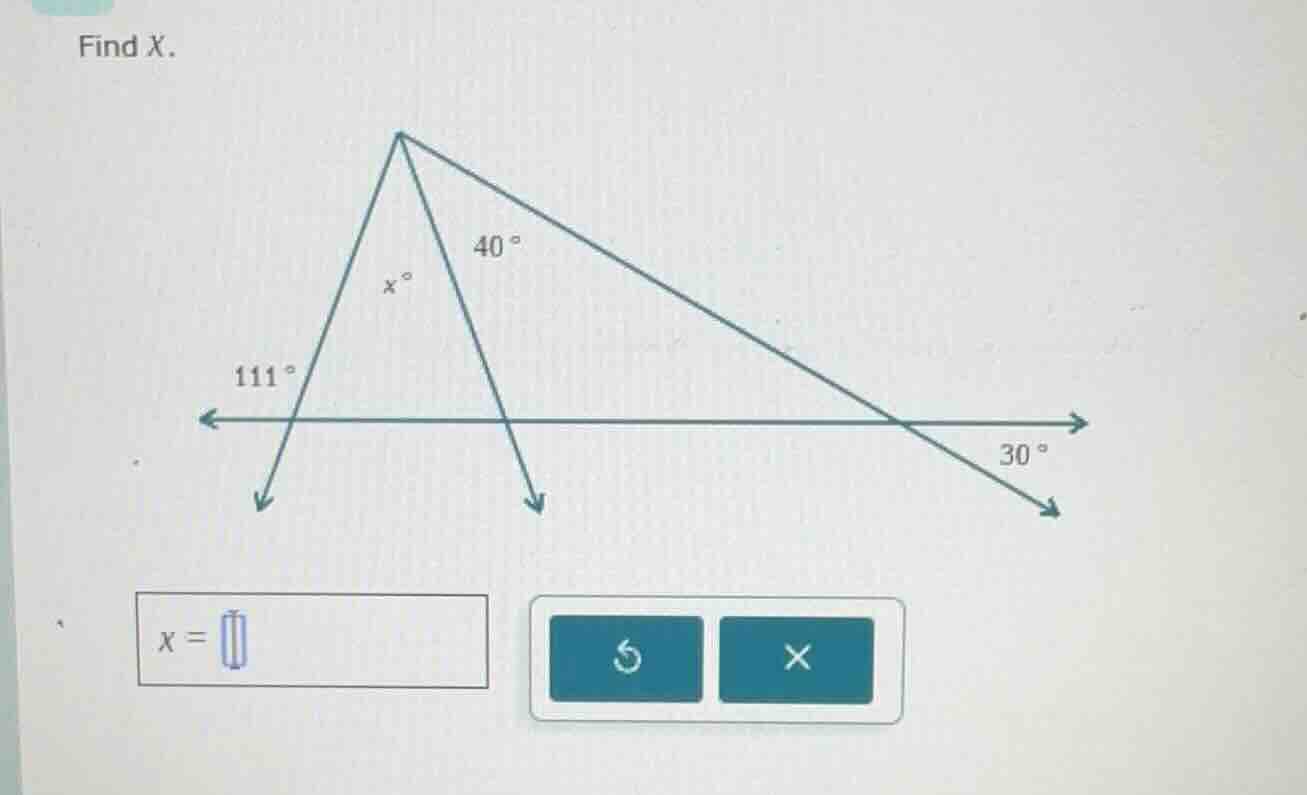
Question
find x.
(there is a geometric figure with angles 111°, 40°, 30° and x° as shown, and a box to fill x = and two buttons: a refresh button and a close button)
Step1: Find the adjacent angle to 111°
The adjacent angle on a straight line is \(180 - 111 = 69^\circ\).
Step2: Find the third angle in the right - most triangle
In the triangle with \(40^\circ\) and \(30^\circ\), the third angle (vertical angle to the angle adjacent to \(x\)) is \(180-(40 + 30)=110^\circ\)? Wait, no. Wait, the exterior angle at the right - most is \(30^\circ\), and the angle inside the triangle (non - \(40^\circ\)): Let's correct. The straight line angle: for the right - most triangle, the angle adjacent to \(30^\circ\) is \(180 - 30=150^\circ\)? No, wait, the sum of angles in a triangle is \(180^\circ\). The triangle with \(40^\circ\) and the angle opposite to the vertical angle: Wait, let's use the exterior angle theorem. The exterior angle at the left is \(111^\circ\), which is equal to the sum of the two non - adjacent interior angles of the left - most triangle. Wait, the left - most triangle has an exterior angle of \(111^\circ\), and one of the angles inside (the angle adjacent to \(x\)) and \(x\). Wait, no. Let's start over.
First, the angle adjacent to \(111^\circ\) (linear pair) is \(180 - 111=69^\circ\).
The angle at the right - most, the vertical angle to the angle in the triangle with \(40^\circ\): The triangle with \(40^\circ\) and \(30^\circ\) has angles. Wait, the angle at the right - most, the angle inside the big triangle (the one with \(x\)): The angle adjacent to \(30^\circ\) is \(180 - 30 = 150^\circ\)? No, the sum of angles in a triangle is \(180^\circ\). The triangle with angles \(40^\circ\), \(30^\circ\) and the third angle: \(180-(40 + 30)=110^\circ\). But that angle is vertical to the angle inside the triangle with \(x\). Wait, no. Let's use the exterior angle for the left - most.
Wait, the exterior angle of \(111^\circ\) is equal to the sum of the two non - adjacent interior angles of the left - most triangle. The left - most triangle has angles: \(x\), the angle we found as \(69^\circ\), and the angle which is vertical to the angle in the triangle with \(40^\circ\) and \(30^\circ\). Wait, the angle in the triangle with \(40^\circ\) and \(30^\circ\): Let's calculate the angle at the vertex where \(40^\circ\) and the other angle meet. The sum of angles in a triangle is \(180^\circ\). The angle adjacent to \(30^\circ\) (linear pair) is \(180 - 30 = 150^\circ\)? No, the angle inside the triangle (the one with \(40^\circ\)): Let's find the angle that is vertical to the angle in the triangle with \(x\).
Wait, the correct approach:
- The angle adjacent to \(111^\circ\) (linear pair) is \(180 - 111=69^\circ\).
- The angle at the right - most, the angle inside the triangle (the one with \(40^\circ\)): The triangle with angles \(40^\circ\) and \(30^\circ\) has a third angle of \(180-(40 + 30)=110^\circ\)? No, that's wrong. Wait, the \(30^\circ\) is an exterior angle? No, the \(30^\circ\) is an angle outside. Wait, the angle inside the triangle (the one with \(40^\circ\)) and \(30^\circ\) are supplementary? No, \(30^\circ\) is an exterior angle. Wait, the exterior angle theorem: the exterior angle is equal to the sum of the two non - adjacent interior angles. So for the triangle with \(40^\circ\), the exterior angle of \(30^\circ\) would be equal to the sum of the two non - adjacent interior angles, but that doesn't make sense. Wait, I think I made a mistake. Let's look at the linear pairs and triangle angle sum.
The sum of angles in a triangle is \(180^\circ\). Let's consider the three angles around the point where the lines meet: no, better to look at the left - most triangle.
The…

Snap & solve any problem in the app
Get step-by-step solutions on Sovi AI
Photo-based solutions with guided steps
Explore more problems and detailed explanations
\(41\)