QUESTION IMAGE
Question
find the third side in simplest radical form:
Step1: Identify the triangle type
This is a right triangle, so we use the Pythagorean theorem: \(a^2 + b^2 = c^2\), where \(c\) is the hypotenuse, and \(a\), \(b\) are the legs.
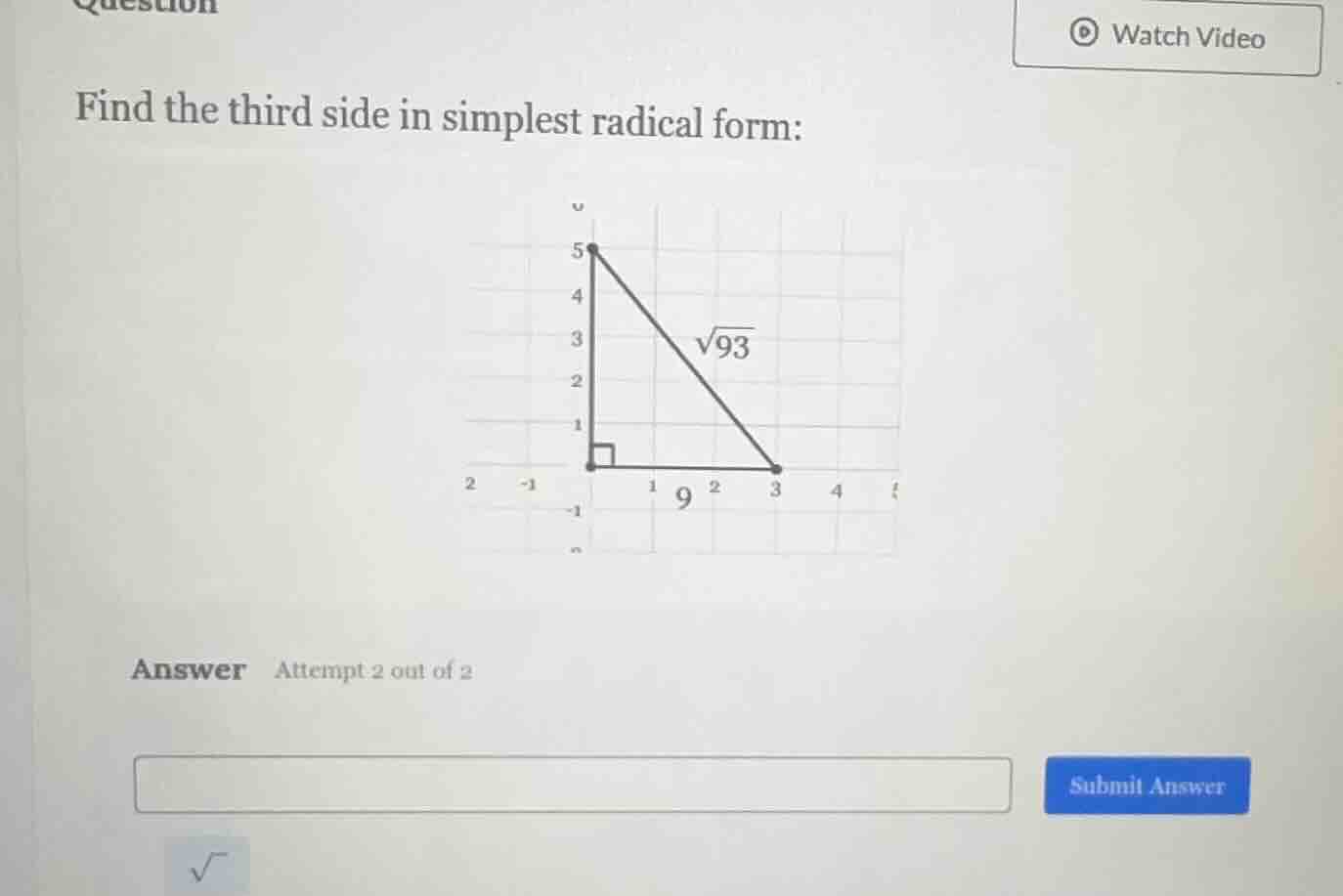
We know one leg \(a = 5\) (vertical side from \(y = 0\) to \(y = 5\)) and the hypotenuse \(c=\sqrt{93}\). Wait, no, wait—wait, the horizontal leg: from \(x = 0\) to \(x = 3\)? Wait, no, the grid: the horizontal side length: from \(x=0\) to \(x = 3\), so length is \(3 - 0 = 3\)? Wait, no, the label says "9"? Wait, maybe the vertical leg is \(5\) (from \(y=0\) to \(y = 5\)), and we need to find the other leg? Wait, no, the hypotenuse is \(\sqrt{93}\), and one leg is, let's check the coordinates. The right angle is at \((0,0)\), one vertex at \((0,5)\), another at \((3,0)\)? Wait, no, the horizontal distance from \((0,0)\) to \((3,0)\) is \(3\), vertical distance from \((0,0)\) to \((0,5)\) is \(5\). Wait, but the hypotenuse is labeled \(\sqrt{93}\). Wait, maybe I misread. Wait, let's apply Pythagorean theorem correctly. Let’s denote the legs as \(a\) and \(b\), hypotenuse \(c\). Suppose we know \(c=\sqrt{93}\) and one leg, say \(a = 5\) (vertical), find \(b\) (horizontal). Then \(a^2 + b^2 = c^2\). So \(5^2 + b^2 = (\sqrt{93})^2\). Wait, \(25 + b^2 = 93\). Then \(b^2 = 93 - 25 = 68\). Wait, no, that can't be. Wait, maybe the vertical leg is \(5\), horizontal leg is \(x\), hypotenuse \(\sqrt{93}\). Wait, \(5^2 + x^2 = (\sqrt{93})^2\) → \(25 + x^2 = 93\) → \(x^2 = 68\) → \(x = \sqrt{68} = 2\sqrt{17}\). But that doesn't match. Wait, maybe the horizontal leg is \(3\) (from \(x=0\) to \(x=3\)), vertical leg \(5\), then hypotenuse should be \(\sqrt{3^2 + 5^2}=\sqrt{9 +25}=\sqrt{34}\), but it's labeled \(\sqrt{93}\). Wait, maybe the horizontal leg is not \(3\), but the length is \(9\)? Wait, the label says "9" on the horizontal side. Oh! The horizontal leg is length \(9\)? Wait, the right angle is at \((0,0)\), one vertex at \((0,5)\), another at \((9,0)\)? Wait, the grid: maybe the horizontal distance is \(9\)? Wait, the problem says "Find the third side". Let's re-express. Let’s assume it's a right triangle with hypotenuse \(c = \sqrt{93}\) and one leg \(a = 5\) (vertical), find the other leg \(b\) (horizontal). Wait, no, if the horizontal leg is \(9\), then \(a^2 + b^2 = c^2\). Wait, \(5^2 + 9^2 = 25 + 81 = 106\), not 93. Wait, maybe the vertical leg is \(x\), horizontal leg \(9\), hypotenuse \(\sqrt{93}\). Then \(x^2 + 9^2 = (\sqrt{93})^2\) → \(x^2 + 81 = 93\) → \(x^2 = 12\) → \(x = \sqrt{12} = 2\sqrt{3}\). Wait, that makes sense. Let's check: \(9^2 + x^2 = (\sqrt{93})^2\) → \(81 + x^2 = 93\) → \(x^2 = 12\) → \(x = 2\sqrt{3}\). Yes, that works. So the vertical leg is \(2\sqrt{3}\)? Wait, no, the vertical leg is from \(y=0\) to \(y=5\)? Wait, maybe the diagram has the horizontal leg as length \(9\), and we need to find the vertical leg. So let's define:
Let the right triangle have legs \(a\) (vertical) and \(b = 9\) (horizontal), hypotenuse \(c = \sqrt{93}\). Then by Pythagorean theorem:
\(a^2 + b^2 = c^2\)
Substitute \(b = 9\) and \(c = \sqrt{93}\):
\(a^2 + 9^2 = (\sqrt{93})^2\)
\(a^2 + 81 = 93\)
Subtract 81 from both sides:
\(a^2 = 93 - 81 = 12\)
Take square root:
\(a = \sqrt{12} = 2\sqrt{3}\)
Yes, that's correct. So the third side (the vertical leg) is \(2\sqrt{3}\).
Step1: Apply Pythagorean theorem
The triangle is right-angled, so \(a^2 + b^2 = c^2\), where \(c = \sqrt{93}\) (hypotenuse), \(b = 9\) (one leg), find \(a\) (other leg).
\(a^2 + 9^2 = (\sqrt{93})^2\)
Step2: Simplify the equation
Calculate \(9^2 = 81\) and \((\sqrt{93})^2 = 93\):…

Snap & solve any problem in the app
Get step-by-step solutions on Sovi AI
Photo-based solutions with guided steps
Explore more problems and detailed explanations
\(2\sqrt{3}\)