QUESTION IMAGE
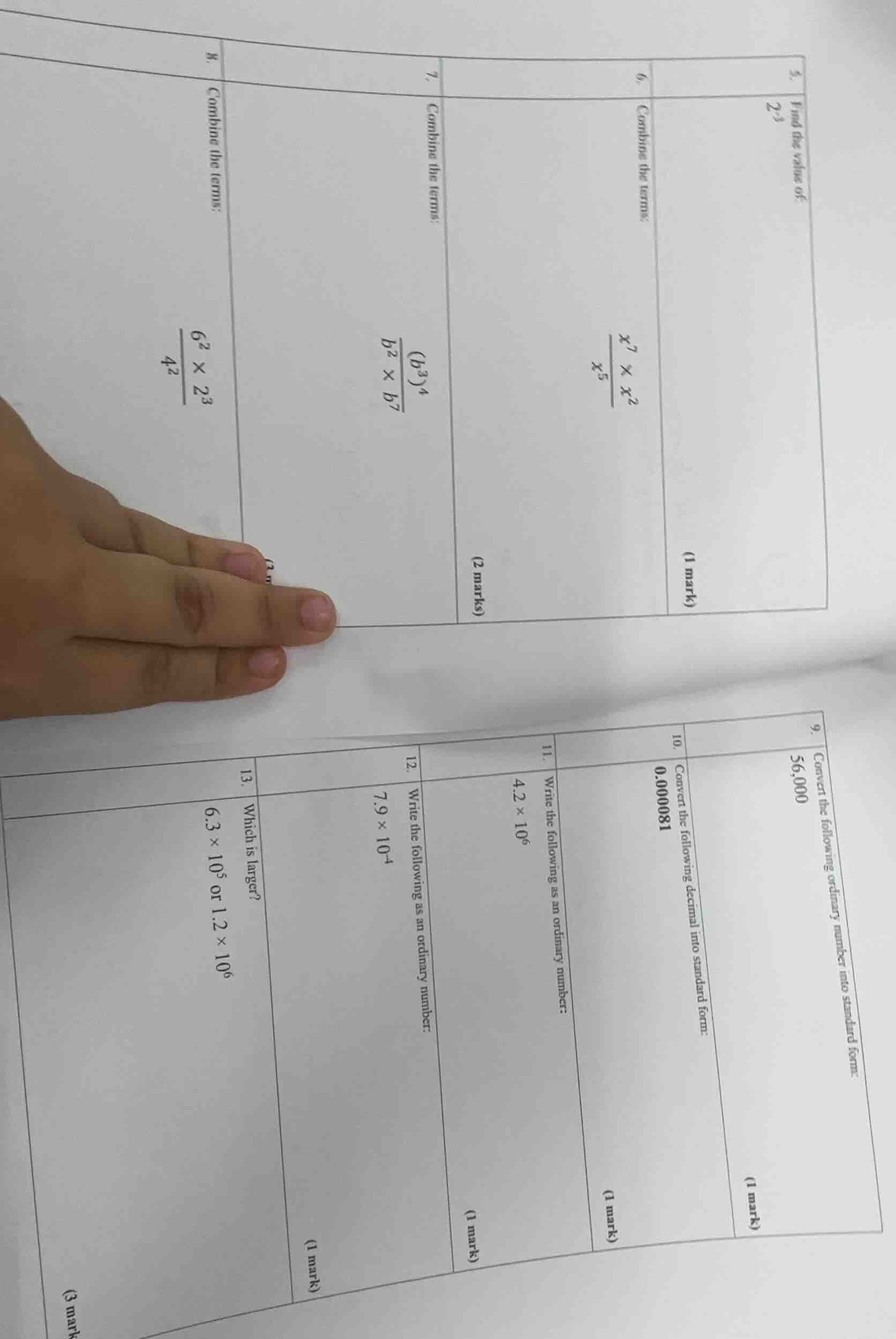
Question
- find the value of: \\(2^{-3}\\)\
- combine the terms: \\(\dfrac{x^7 \times x^2}{x^5}\\) (1 mark)\
- combining the terms: \\(\dfrac{(b^3)^4}{b^2 \times b^7}\\) (2 marks)\
- combine the terms: \\(\dfrac{6^2 \times 2^3}{4^2}\\)\
- convert the following ordinary number into standard form: 56,000 (1 mark)\
- convert the following decimal into standard form: 0.0000081\
- write the following as an ordinary number: \\(4.2 \times 10^6\\) (1 mark)\
- write the following as an ordinary number: \\(7.9 \times 10^{-4}\\) (1 mark)\
- which is larger? \\(6.3 \times 10^3\\) or \\(1.2 \times 10^6\\) (1 mark)
Question 5: Find the value of \(2^{-3}\)
Step 1: Recall the negative exponent rule
The rule for negative exponents is \(a^{-n}=\frac{1}{a^{n}}\) (where \(a
eq0\) and \(n\) is a positive integer). For \(a = 2\) and \(n=3\), we have \(2^{-3}=\frac{1}{2^{3}}\).
Step 2: Calculate \(2^{3}\)
We know that \(2^{3}=2\times2\times2 = 8\).
Step 3: Substitute back
Substituting \(2^{3}=8\) into \(\frac{1}{2^{3}}\), we get \(\frac{1}{8}=0.125\).
Step 1: Use the product rule of exponents in the numerator
The product rule of exponents states that \(a^{m}\times a^{n}=a^{m + n}\). For \(a=x\), \(m = 7\) and \(n = 2\), we have \(x^{7}\times x^{2}=x^{7 + 2}=x^{9}\). So the expression becomes \(\frac{x^{9}}{x^{5}}\).
Step 2: Use the quotient rule of exponents
The quotient rule of exponents states that \(\frac{a^{m}}{a^{n}}=a^{m - n}\) (where \(a
eq0\)). For \(a=x\), \(m = 9\) and \(n = 5\), we have \(\frac{x^{9}}{x^{5}}=x^{9-5}=x^{4}\).
Step 1: Use the power of a power rule in the numerator
The power of a power rule states that \((a^{m})^{n}=a^{m\times n}\). For \(a = b\), \(m = 3\) and \(n = 4\), we have \((b^{3})^{4}=b^{3\times4}=b^{12}\).
Step 2: Use the product rule of exponents in the denominator
Using \(a^{m}\times a^{n}=a^{m + n}\) with \(a = b\), \(m = 2\) and \(n = 7\), we get \(b^{2}\times b^{7}=b^{2 + 7}=b^{9}\). So the expression becomes \(\frac{b^{12}}{b^{9}}\).
Step 3: Use the quotient rule of exponents
Using \(\frac{a^{m}}{a^{n}}=a^{m - n}\) with \(a = b\), \(m = 12\) and \(n = 9\), we have \(\frac{b^{12}}{b^{9}}=b^{12-9}=b^{3}\).

Snap & solve any problem in the app
Get step-by-step solutions on Sovi AI
Photo-based solutions with guided steps
Explore more problems and detailed explanations
\(\frac{1}{8}\) (or \(0.125\))