QUESTION IMAGE
Question
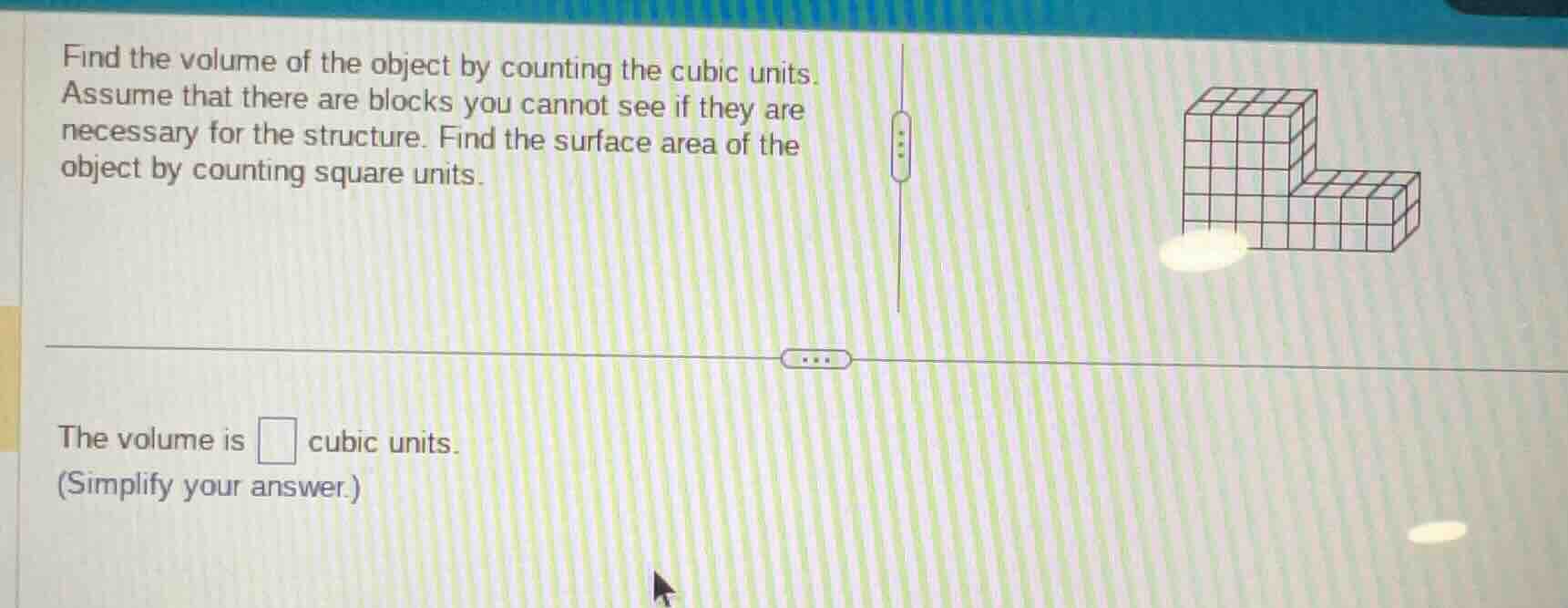
find the volume of the object by counting the cubic units. assume that there are blocks you cannot see if they are necessary for the structure. find the surface area of the object by counting square units. the volume is \\(\square\\) cubic units. (simplify your answer.)
Step1: Analyze the structure (front - back, left - right, top - bottom layers)
Looking at the figure, we can split it into two parts: the taller part and the shorter part. Let's assume the side length of each small cube is 1 unit.
For the taller part (let's say it's a rectangular prism with dimensions \(4\times2\times5\)? Wait, no, better to count layers. Wait, actually, let's see the number of cubes in each layer. Wait, maybe a better way: the left part (taller) has a base of \(4\times2\) (width 4, depth 2) and height 5? No, wait the figure: looking at the front view, the left part is 4 columns (width) and 2 rows (depth) and height 5? Wait no, the right part is shorter, height 2. Wait, let's count the number of cubic units (volume) by counting the number of small cubes.
Let's break the object into two rectangular prisms:
- The first prism (taller one): Let's say it has dimensions: length (along the depth) = 2, width (along the front - back) = 4, height = 5? Wait no, looking at the figure, the taller part is 4 units wide (horizontal), 2 units deep (into the page), and 5 units tall? No, wait the shorter part is 4 units wide (horizontal), 2 units deep, and 2 units tall? Wait, no, let's count the number of cubes:
Wait, the left (taller) section: in each layer (height), the number of cubes is \(4\times2\) (since width 4, depth 2). How many layers? 5? Wait no, the right (shorter) section: width 4, depth 2, height 2. Wait, no, maybe I got it wrong. Wait, looking at the figure, the taller part is 4 columns (x - direction) and 2 rows (y - direction) and 5 layers (z - direction)? No, the shorter part is attached to the taller part. Wait, actually, let's count the volume:
First, the taller rectangular prism: let's say its dimensions are length \(l_1 = 2\) (depth), width \(w_1 = 4\) (width), height \(h_1 = 5\)? No, that can't be. Wait, no, the shorter part: length \(l_2 = 2\), width \(w_2 = 4\), height \(h_2 = 2\). Wait, no, maybe the taller part is 4 (width) x 2 (depth) x 5 (height)? No, that would be \(4\times2\times5 = 40\). The shorter part is 4 (width) x 2 (depth) x 2 (height)? No, that would overlap. Wait, no, actually, the correct way is:
Wait, the object is composed of two parts:
- Part 1: A rectangular prism with dimensions: width = 4, depth = 2, height = 5. Wait, no, that's too big. Wait, no, looking at the figure, the taller part is 4 units wide (horizontal), 2 units deep (into the page), and 5 units tall? No, the shorter part is 4 units wide, 2 units deep, and 2 units tall, and it's attached to the taller part. Wait, no, maybe the taller part is 4 (width) x 2 (depth) x 5, and the shorter part is 4 (width) x 2 (depth) x 2, but they share a face, so we don't double - count. Wait, no, actually, the taller part is 4 (width) x 2 (depth) x 5, and the shorter part is 4 (width) x 2 (depth) x 2, but attached to the taller part, so the total volume is \(4\times2\times5+4\times2\times2\)? Wait, no, that would be if they are separate, but actually, the shorter part is attached to the taller part, so maybe the taller part is 4 (width) x 2 (depth) x 5, and the shorter part is 4 (width) x 2 (depth) x 2, but the overlapping area (where they are attached) is \(4\times2\times2\), so total volume is \(4\times2\times5 + 4\times2\times2\)? Wait, no, that's not right. Wait, no, actually, the taller part has height 5, and the shorter part has height 2, and they are attached along the height. Wait, maybe the correct dimensions:
Wait, let's count the number of cubes in each layer (z - direction, height):
- For height from z = 1 to z = 2 (lower 2…

Snap & solve any problem in the app
Get step-by-step solutions on Sovi AI
Photo-based solutions with guided steps
Explore more problems and detailed explanations
56