QUESTION IMAGE
Question
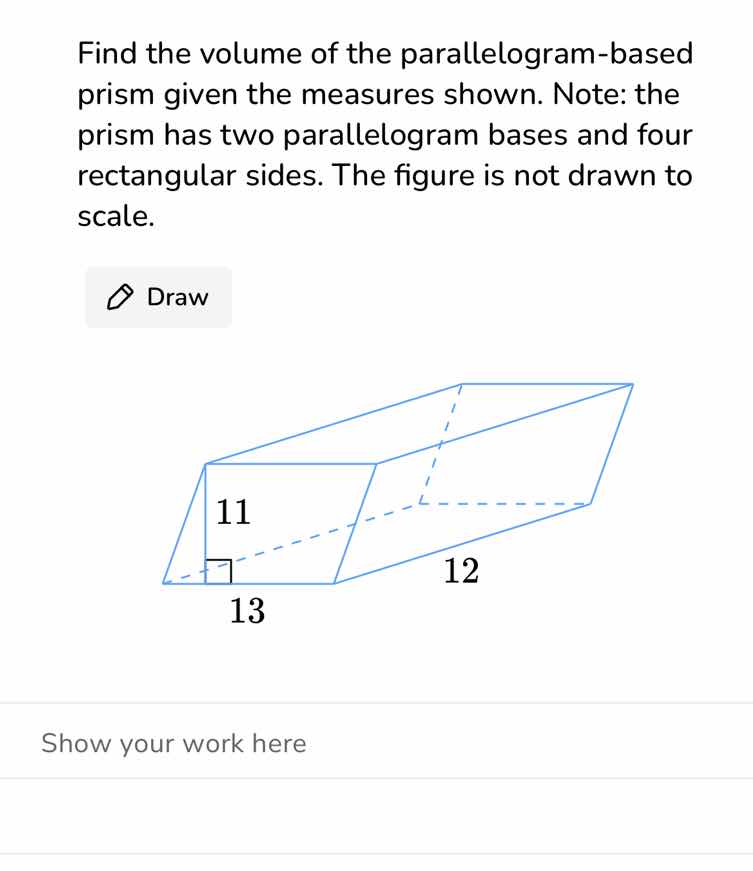
find the volume of the parallelogram - based prism given the measures shown. note: the prism has two parallelogram bases and four rectangular sides. the figure is not drawn to scale. 11 12 13 show your work here
Step1: Recall the formula for the volume of a prism
The volume \( V \) of a prism is given by the formula \( V = B \times h \), where \( B \) is the area of the base and \( h \) is the height (the distance between the two bases). For a parallelogram - based prism, the base is a parallelogram. The area of a parallelogram is \( A = \text{base of parallelogram} \times \text{height of parallelogram} \).
From the diagram, the base of the parallelogram (let's call it \( b \)) is \( 13 \), the height of the parallelogram (let's call it \( h_{1} \)) is \( 11 \), and the distance between the two parallelogram bases (the length of the prism, let's call it \( l \)) is \( 12 \).
First, calculate the area of the parallelogram base \( B \):
\( B=13\times11 \)
\( B = 143 \)
Step2: Calculate the volume of the prism
Now, use the volume formula for the prism \( V=B\times l \), where \( l = 12 \) (the distance between the two bases, which is the length of the rectangular sides).
Substitute \( B = 143 \) and \( l=12 \) into the formula:
\( V=143\times12 \)
\( 143\times12=(140 + 3)\times12=140\times12+3\times12=1680 + 36=1716 \)

Snap & solve any problem in the app
Get step-by-step solutions on Sovi AI
Photo-based solutions with guided steps
Explore more problems and detailed explanations
The volume of the parallelogram - based prism is \( 1716 \).