QUESTION IMAGE
Question
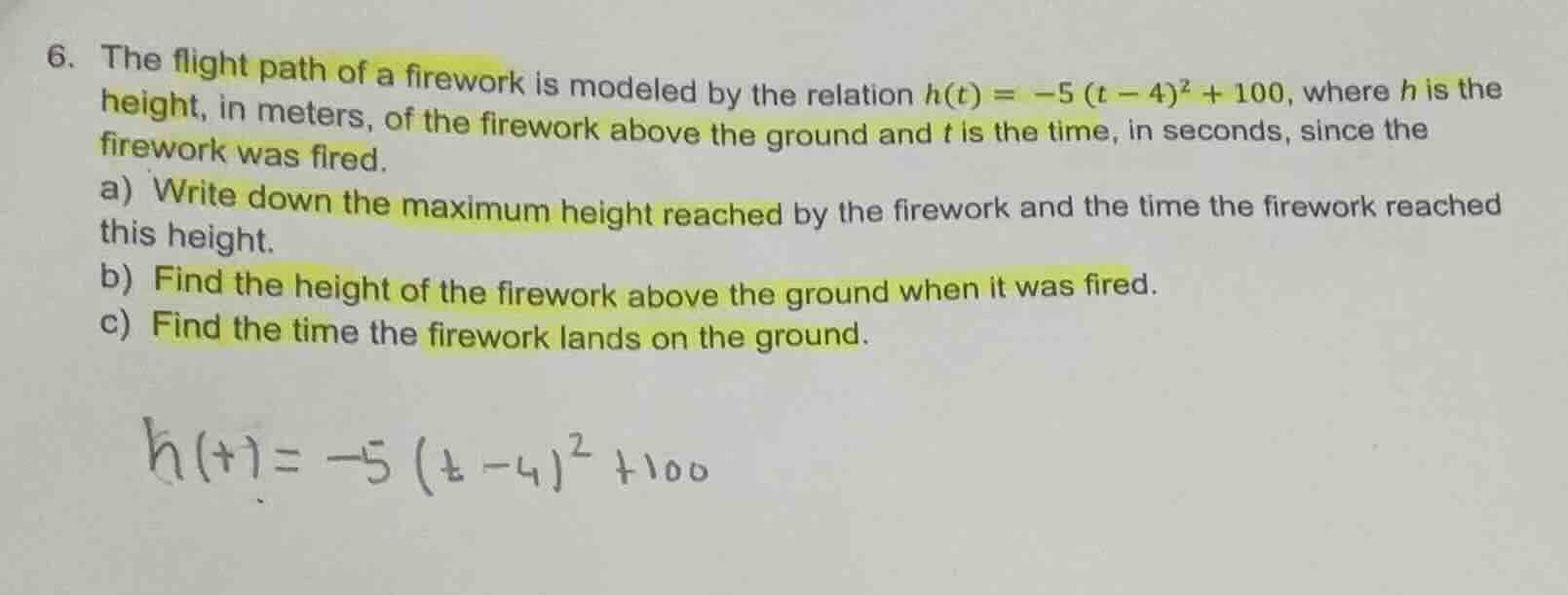
- the flight path of a firework is modeled by the relation $h(t) = -5(t - 4)^2 + 100$, where $h$ is the height, in meters, of the firework above the ground and $t$ is the time, in seconds, since the firework was fired.
a) write down the maximum height reached by the firework and the time the firework reached this height.
b) find the height of the firework above the ground when it was fired.
c) find the time the firework lands on the ground.
$h(t) = -5(t - 4)^2 + 100$
Part (a)
The given function is a quadratic function in vertex form \( h(t) = a(t - h)^2 + k \), where \((h, k)\) is the vertex of the parabola. For a quadratic function \( y = a(x - h)^2 + k \), if \( a < 0 \), the parabola opens downwards and the vertex \((h, k)\) is the maximum point.
Step 1: Identify the vertex form components
In the function \( h(t) = -5(t - 4)^2 + 100 \), we have \( a = -5 \), \( h = 4 \), and \( k = 100 \).
Step 2: Determine the maximum height and time
Since \( a = -5 < 0 \), the parabola opens downwards, so the vertex \((4, 100)\) represents the maximum point. This means the time \( t \) when the maximum height is reached is \( t = 4 \) seconds, and the maximum height \( h \) is \( 100 \) meters.
When the firework is fired, the time \( t = 0 \) seconds. We need to find the height \( h(0) \) by substituting \( t = 0 \) into the function \( h(t) \).
Step 1: Substitute \( t = 0 \) into the function
Substitute \( t = 0 \) into \( h(t) = -5(t - 4)^2 + 100 \):
\[
\]
The firework lands on the ground when its height \( h(t) = 0 \). So we need to solve the equation \( -5(t - 4)^2 + 100 = 0 \) for \( t \).
Step 1: Set up the equation
Set \( h(t) = 0 \):
\[
-5(t - 4)^2 + 100 = 0
\]
Step 2: Solve for \( (t - 4)^2 \)
Subtract \( 100 \) from both sides:
\[
-5(t - 4)^2 = -100
\]
Divide both sides by \( -5 \):
\[
(t - 4)^2 = 20
\]
Step 3: Solve for \( t \)
Take the square root of both sides:
\[
t - 4 = \pm \sqrt{20}
\]
Simplify \( \sqrt{20} = 2\sqrt{5} \approx 4.472 \)
So we have two solutions:
- \( t - 4 = \sqrt{20} \)
\[
t = 4 + \sqrt{20} \approx 4 + 4.472 = 8.472
\]
- \( t - 4 = -\sqrt{20} \)
\[
t = 4 - \sqrt{20} \approx 4 - 4.472 = -0.472
\]
Since time cannot be negative, we discard the negative solution.

Snap & solve any problem in the app
Get step-by-step solutions on Sovi AI
Photo-based solutions with guided steps
Explore more problems and detailed explanations
The maximum height reached by the firework is \( 100 \) meters, and it is reached at \( t = 4 \) seconds.