QUESTION IMAGE
Question
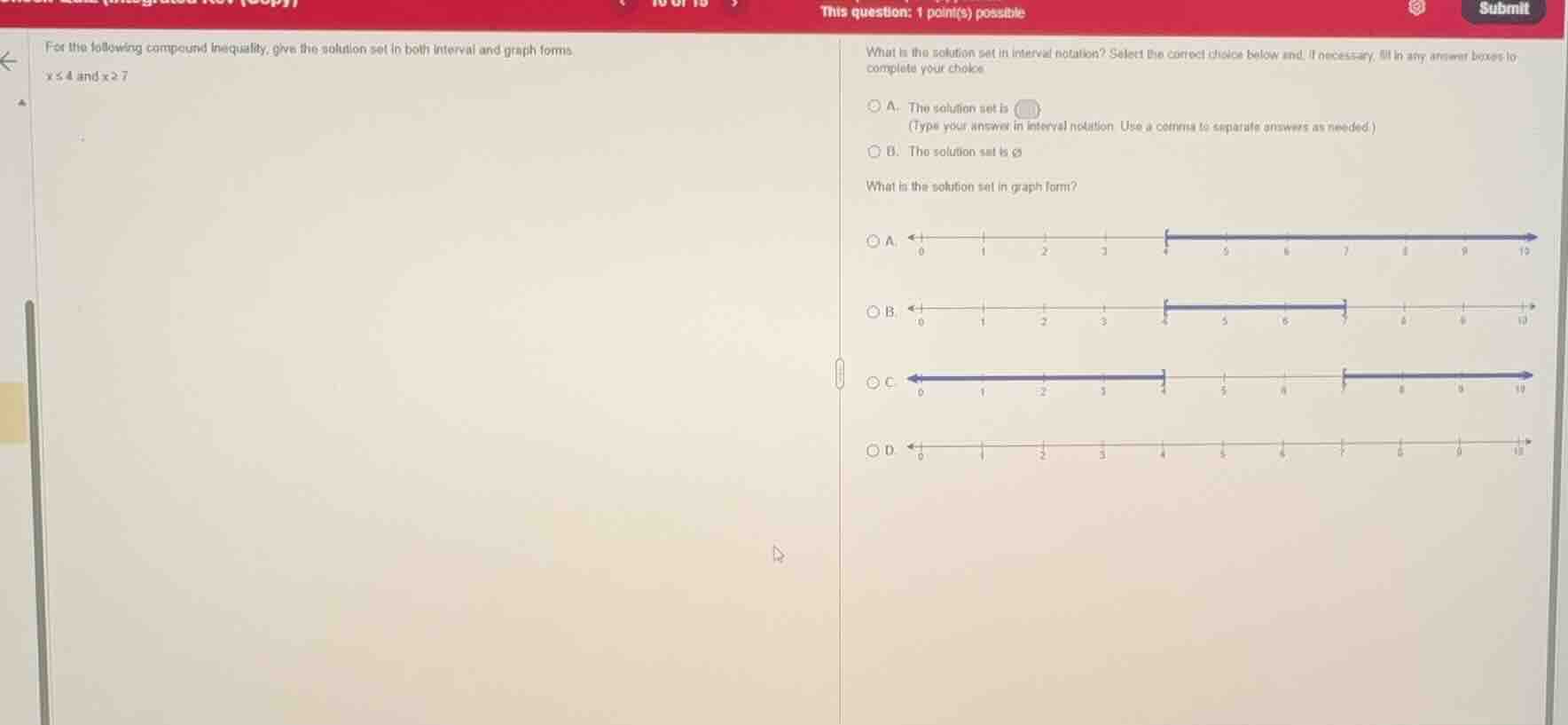
for the following compound inequality, give the solution set in both interval and graph forms.
( x leq 4 ) and ( x geq 7 )
what is the solution set in interval notation? select the correct choice below and, if necessary, fill in any answer boxes to complete your choice
a. the solution set is (\boxed{quad})
(type your answer in interval notation. use a comma to separate answers as needed.)
b. the solution set is (varnothing)
what is the solution set in graph form?
a. graph of a number line with a segment starting at 4 and extending to the right
b. graph of a number line with a segment from 4 to 7
c. graph of a number line with two segments, one from left to 4 and one from 7 to the right
d. graph of a number line with no segments (empty)
Step1: Analyze the compound inequality
We have the compound inequality \( x \leq 4 \) and \( x \geq 7 \). We need to find the values of \( x \) that satisfy both inequalities simultaneously.
Step2: Determine the solution set
A number cannot be both less than or equal to 4 and greater than or equal to 7 at the same time. So, there are no values of \( x \) that satisfy both inequalities.
For the interval notation:
Since there are no solutions, the solution set in interval notation is the empty set, denoted as \( \varnothing \) (or \( \{\} \)). So the correct choice for the interval notation is B (The solution set is \( \varnothing \)).
For the graph form:
A graph of the empty set means there are no points on the number line that represent the solution. Looking at the options, option D shows an empty number line (no shaded regions), which represents the empty set.

Snap & solve any problem in the app
Get step-by-step solutions on Sovi AI
Photo-based solutions with guided steps
Explore more problems and detailed explanations
- Interval notation: B. The solution set is \( \varnothing \)
- Graph form: D