QUESTION IMAGE
Question
4
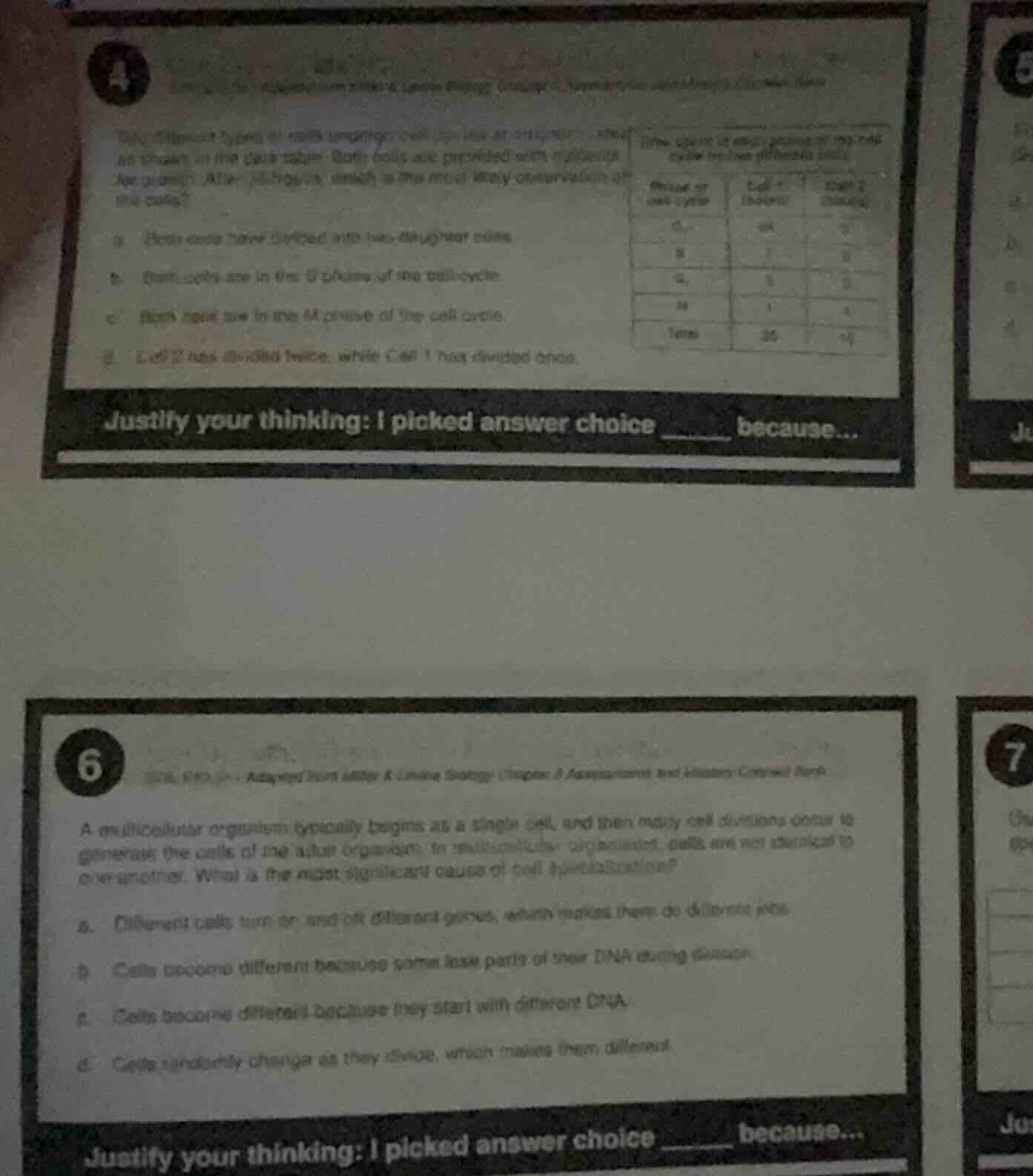
the following 2 types of cells undergoing cell division at different rates are shown in the data table. both cells are provided with nutrients and glucose. after 24 hours, which is the most likely observation of the cells?
a. both cells have divided into two daughter cells
b. both cells are in the s phase of the cell cycle
c. both cells are in the m phase of the cell cycle
d. cell 2 has divided twice, while cell 1 has divided thrice.
time spent in each phase of the cell cycle by two different cells
justify your thinking: i picked answer choice ______ because...
6
a multicellular organism typically begins as a single cell, and then many cell divisions occur to generate the cells of the adult organism. in multicellular organisms, cells are not identical to one another. what is the most significant cause of cell specialization?
a. different cells turn on and off different genes, which makes them do different jobs.
b. cells become different because some lose parts of their dna during division.
c. cells become different because they start with different dna.
d. cells randomly change as they divide, which makes them different.
justify your thinking: i picked answer choice ______ because...
Question 6
To determine the most significant cause of cell specialization, we analyze each option:
- Option A: Cell differentiation occurs due to gene regulation, where different cells express (turn on/off) different genes, leading to different functions. This is the correct mechanism of cell specialization.
- Option B: Cells do not lose parts of their DNA during division in a multicellular organism's development (this would be detrimental and is not how differentiation works).
- Option C: All cells in a multicellular organism (from the same zygote) start with the same DNA, so this is incorrect.
- Option D: Cell differentiation is a regulated process, not random changes during division.

Snap & solve any problem in the app
Get step-by-step solutions on Sovi AI
Photo-based solutions with guided steps
Explore more problems and detailed explanations
A. Different cells turn on and off different genes, which makes them do different jobs.