QUESTION IMAGE
Question
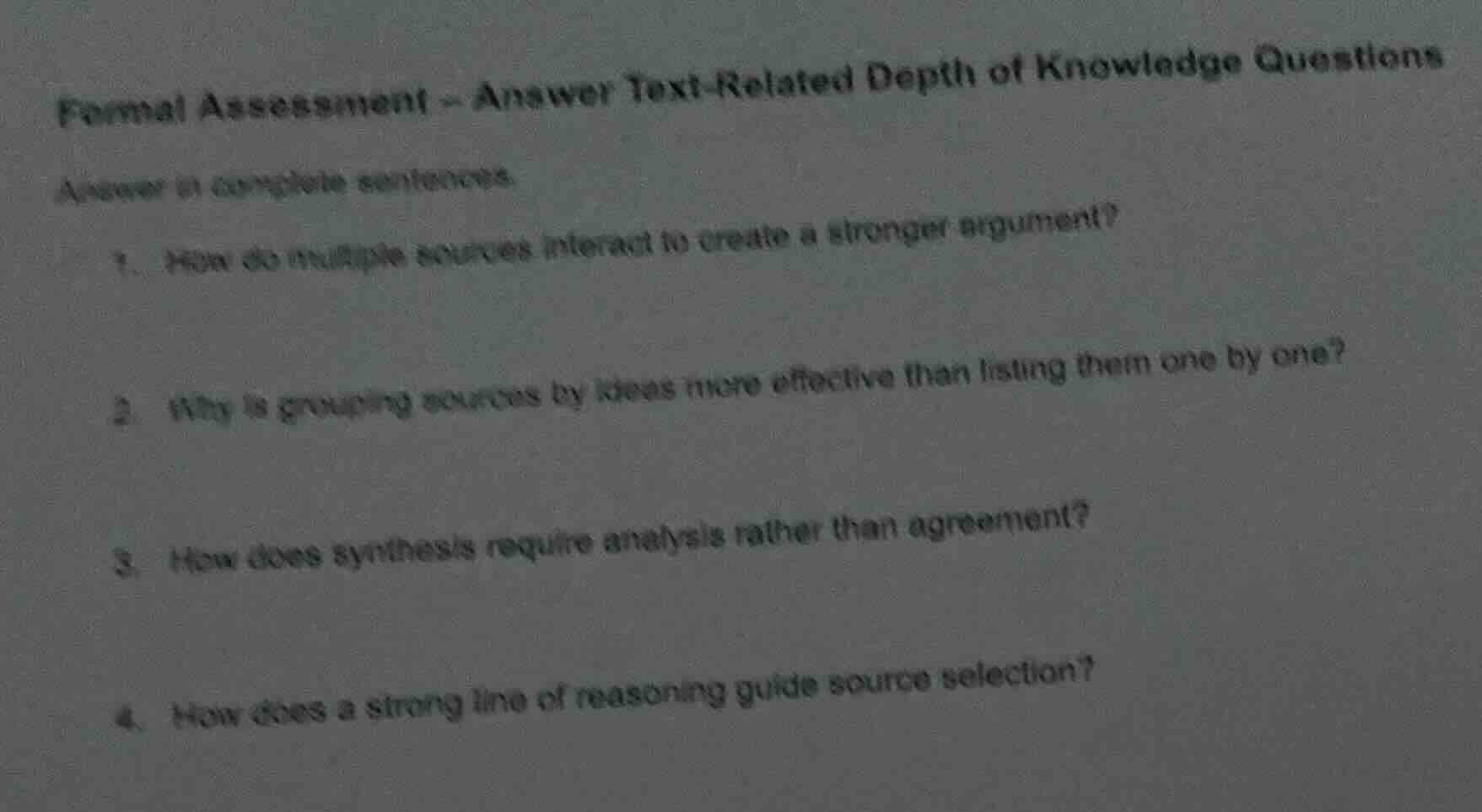
formal assessment - answer text-related depth of knowledge questions
answer in complete sentences.
- how do multiple sources interact to create a stronger argument?
- why is grouping sources by ideas more effective than listing them one by one?
- how does synthesis require analysis rather than agreement?
- how does a strong line of reasoning guide source selection?
Question 1
Multiple sources with different perspectives, evidence types (e.g., stats, anecdotes), or expertise can corroborate, fill gaps, or counter opposing views. For example, a study, expert quote, and real - life example on climate change can back each other, showing the argument’s validity from multiple angles, making it more persuasive as it’s not reliant on one source’s strength.
Grouping sources by ideas organizes them around themes (e.g., “causes of poverty” sources grouped by economic, social, political ideas). This shows how sources relate to a central idea, creating a cohesive, logical flow. Listing one by one is disjointed, as readers can’t see the thematic connections. Grouping also helps identify patterns or contradictions within an idea, strengthening analysis, while a list lacks this depth.
Synthesis is combining sources to create new meaning, not just agreeing. Analysis is needed to break down sources (identify claims, evidence, biases), compare/contrast them, and determine how they relate (e.g., do they support, oppose, or fill gaps?). Agreement just accepts sources as is, but synthesis requires analyzing their components to integrate them meaningfully (e.g., in a literature review, you analyze each study’s methods/results to synthesize trends, not just agree they exist).

Snap & solve any problem in the app
Get step-by-step solutions on Sovi AI
Photo-based solutions with guided steps
Explore more problems and detailed explanations
Multiple sources interact to create a stronger argument by providing diverse types of evidence (such as statistical data, expert opinions, and real - world examples), different perspectives, and the ability to corroborate or complement each other's claims. This reduces the reliance on a single source and makes the argument more comprehensive, well - supported, and resistant to counter - arguments.