QUESTION IMAGE
Question
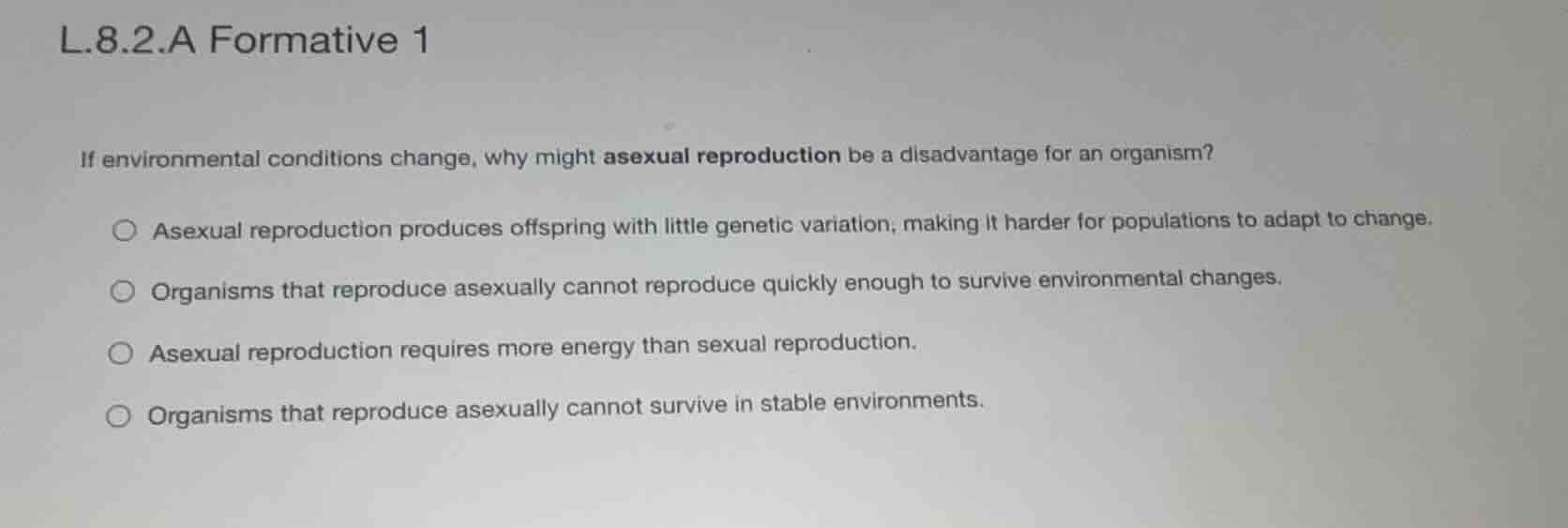
l.8.2.a formative 1
if environmental conditions change, why might asexual reproduction be a disadvantage for an organism?
asexual reproduction produces offspring with little genetic variation, making it harder for populations to adapt to change.
organisms that reproduce asexually cannot reproduce quickly enough to survive environmental changes.
asexual reproduction requires more energy than sexual reproduction.
organisms that reproduce asexually cannot survive in stable environments.
- Analyze Option 1: Asexual reproduction creates offspring with minimal genetic variation (since offspring are clones of the parent). When the environment changes, a lack of genetic diversity means there are fewer traits in the population that might be advantageous in the new conditions, so adaptation is harder.
- Analyze Option 2: Asexual reproduction (e.g., binary fission in bacteria) is often very rapid, so this statement is incorrect.
- Analyze Option 3: Asexual reproduction typically requires less energy than sexual reproduction (no need to find a mate, produce gametes with complex processes, etc.), so this is incorrect.
- Analyze Option 4: Asexual reproduction is actually well - suited for stable environments because the successful parent's traits are passed on. Organisms that reproduce asexually can survive in stable environments, so this is incorrect.

Snap & solve any problem in the app
Get step-by-step solutions on Sovi AI
Photo-based solutions with guided steps
Explore more problems and detailed explanations
Asexual reproduction produces offspring with little genetic variation, making it harder for populations to adapt to change.