QUESTION IMAGE
Question
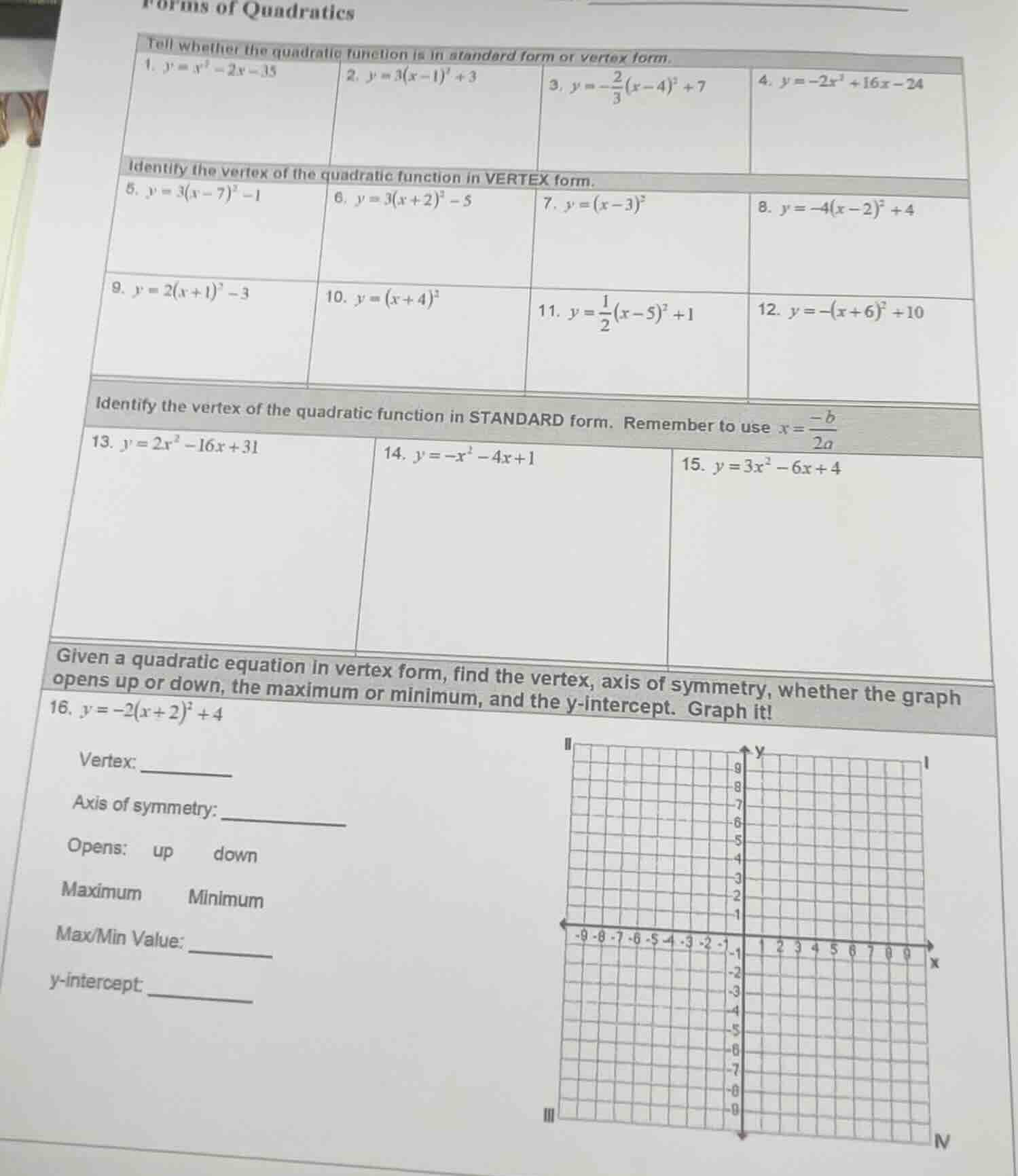
forms of quadratics
tell whether the quadratic function is in standard form or vertex form.
- $y = x^2 - 2x - 35$
- $y = 3(x-1)^2 + 3$
- $y = \frac{2}{3}(x-4)^2 + 7$
- $y = -2x^2 + 16x - 24$
identify the vertex of the quadratic function in vertex form.
- $y = 3(x-7)^2 - 1$
- $y = 3(x+2)^2 - 5$
- $y = (x-3)^2$
- $y = -4(x-2)^2 + 4$
- $y = 2(x+1)^2 - 3$
- $y = (x+4)^2$
- $y = \frac{1}{2}(x-5)^2 + 1$
- $y = -(x+6)^2 + 10$
identify the vertex of the quadratic function in standard form. remember to use $x = \frac{-b}{2a}$
- $y = 2x^2 - 16x + 31$
- $y = -x^2 - 4x + 1$
- $y = 3x^2 - 6x + 4$
given a quadratic equation in vertex form, find the vertex, axis of symmetry, whether the graph opens up or down, the maximum or minimum, and the y-intercept. graph it!
- $y = -2(x+2)^2 + 4$
vertex: ________
axis of symmetry: ________
opens: up down
maximum minimum
max/min value: ________
y-intercept: ________
Step1: Classify quadratic forms
Standard form: $y=ax^2+bx+c$; Vertex form: $y=a(x-h)^2+k$
- $y=x^2-2x-35$: Standard form
- $y=3(x-1)^2+3$: Vertex form
- $y=-\frac{2}{3}(x-4)^2+7$: Vertex form
- $y=-2x^2+16x-24$: Standard form
Step2: Find vertices (vertex form)
Vertex of $y=a(x-h)^2+k$ is $(h,k)$
- $y=3(x-7)^2-1$: $(7, -1)$
- $y=3(x+2)^2-5=3(x-(-2))^2-5$: $(-2, -5)$
- $y=(x-3)^2=(x-3)^2+0$: $(3, 0)$
- $y=-4(x-2)^2+4$: $(2, 4)$
- $y=2(x+1)^2-3=2(x-(-1))^2-3$: $(-1, -3)$
- $y=(x+4)^2=(x-(-4))^2+0$: $(-4, 0)$
- $y=\frac{1}{2}(x-5)^2+1$: $(5, 1)$
- $y=-(x+6)^2+10=-(x-(-6))^2+10$: $(-6, 10)$
Step3: Find vertices (standard form)
First calculate $x=-\frac{b}{2a}$, then find $y$
- $y=2x^2-16x+31$:
$x=-\frac{-16}{2\times2}=4$
$y=2(4)^2-16(4)+31=32-64+31=-1$
Vertex: $(4, -1)$
- $y=-x^2-4x+1$:
$x=-\frac{-4}{2\times(-1)}=-2$
$y=-(-2)^2-4(-2)+1=-4+8+1=5$
Vertex: $(-2, 5)$
- $y=3x^2-6x+4$:
$x=-\frac{-6}{2\times3}=1$
$y=3(1)^2-6(1)+4=3-6+4=1$
Vertex: $(1, 1)$
Step4: Analyze $y=-2(x+2)^2+4$
Step4a: Find vertex
Rewrite as $y=-2(x-(-2))^2+4$, vertex: $(-2, 4)$
Step4b: Axis of symmetry
Axis is $x=h$, so $x=-2$
Step4c: Direction of opening
$a=-2<0$, so opens down
Step4d: Max/min value
Opens down, so maximum at $y=4$
Step4e: Find y-intercept
Set $x=0$:
$y=-2(0+2)^2+4=-2(4)+4=-8+4=-4$
Y-intercept: $(0, -4)$

Snap & solve any problem in the app
Get step-by-step solutions on Sovi AI
Photo-based solutions with guided steps
Explore more problems and detailed explanations
- Standard form
- Vertex form
- Vertex form
- Standard form
- $(7, -1)$
- $(-2, -5)$
- $(3, 0)$
- $(2, 4)$
- $(-1, -3)$
- $(-4, 0)$
- $(5, 1)$
- $(-6, 10)$
- $(4, -1)$
- $(-2, 5)$
- $(1, 1)$
16.
Vertex: $(-2, 4)$
Axis of symmetry: $x=-2$
Opens: down
Maximum
Max/Min Value: $4$
y-intercept: $(0, -4)$
(Graph: Plot vertex $(-2,4)$, y-intercept $(0,-4)$, mirror the y-intercept over $x=-2$ to get $(-4,-4)$, then draw a downward-opening parabola through these points)