QUESTION IMAGE
Question
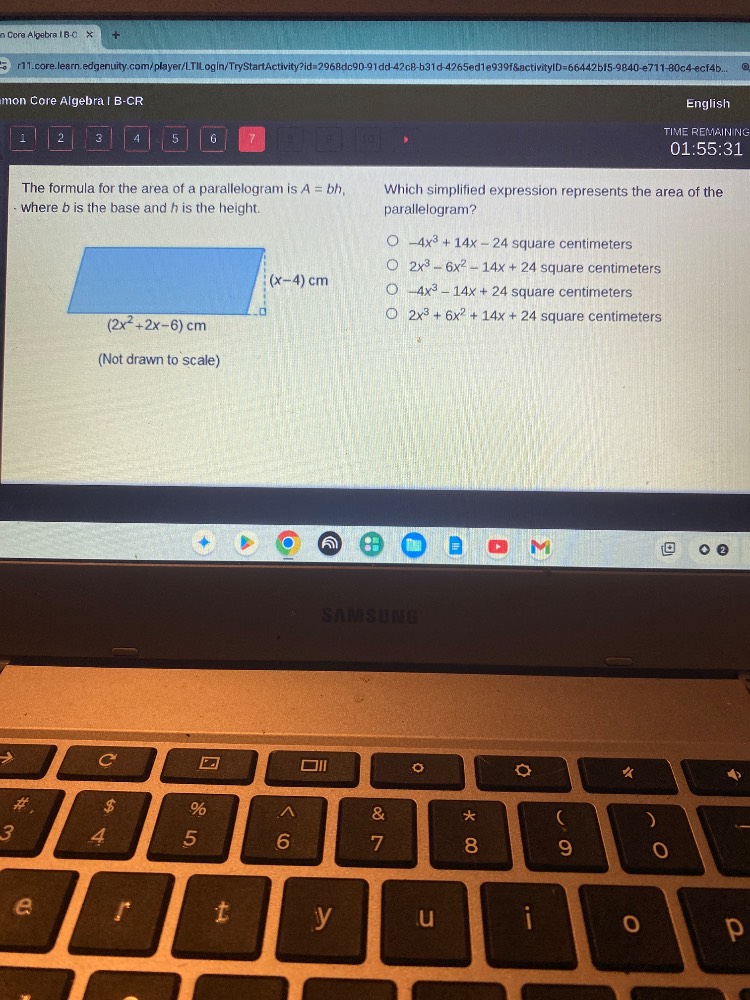
the formula for the area of a parallelogram is ( a = bh ), where ( b ) is the base and ( h ) is the height.
(the image shows a parallelogram with base ( (2x^2 + 2x - 6) ) cm and height ( (x - 4) ) cm, labeled not drawn to scale)
which simplified expression represents the area of the parallelogram?
( circ -4x^3 + 14x - 24 ) square centimeters
( circ 2x^3 - 6x^2 - 14x + 24 ) square centimeters
( circ -4x^3 - 14x + 24 ) square centimeters
( circ 2x^3 + 6x^2 + 14x + 24 ) square centimeters
Step1: Identify base and height
Base \( b = (2x^2 + 2x - 6) \) cm, Height \( h = (x - 4) \) cm. Area \( A = bh \).
Step2: Multiply the polynomials
Use distributive property (FOIL for polynomials):
\( (2x^2 + 2x - 6)(x - 4) = 2x^2(x - 4) + 2x(x - 4) - 6(x - 4) \)
\( = 2x^3 - 8x^2 + 2x^2 - 8x - 6x + 24 \)
Step3: Combine like terms
Combine \( x^2 \) terms: \( -8x^2 + 2x^2 = -6x^2 \)
Combine \( x \) terms: \( -8x - 6x = -14x \)
Result: \( 2x^3 - 6x^2 - 14x + 24 \)

Snap & solve any problem in the app
Get step-by-step solutions on Sovi AI
Photo-based solutions with guided steps
Explore more problems and detailed explanations
\( 2x^3 - 6x^2 - 14x + 24 \) square centimeters (corresponding to the second option: \( 2x^3 - 6x^2 - 14x + 24 \) square centimeters)