QUESTION IMAGE
Question
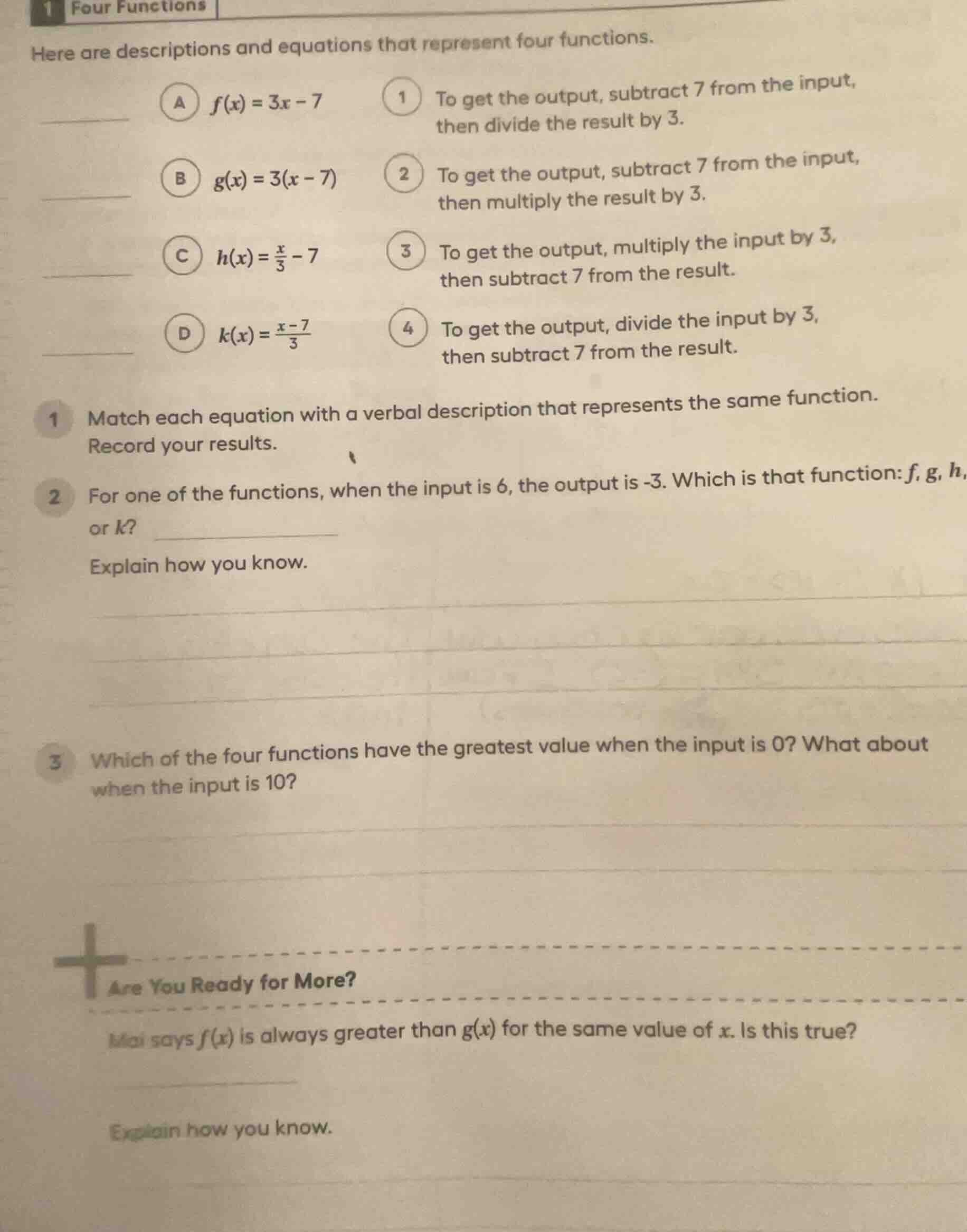
1 four functions
here are descriptions and equations that represent four functions.
a ( f(x) = 3x - 7 )
1 to get the output, subtract 7 from the input, then divide the result by 3.
b ( g(x) = 3(x - 7) )
2 to get the output, subtract 7 from the input, then multiply the result by 3.
c ( h(x) = \frac{x}{3} - 7 )
3 to get the output, multiply the input by 3, then subtract 7 from the result.
d ( k(x) = \frac{x - 7}{3} )
4 to get the output, divide the input by 3, then subtract 7 from the result.
1 match each equation with a verbal description that represents the same function. record your results.
2 for one of the functions, when the input is 6, the output is -3. which is that function: ( f, g, h ), or ( k )?
explain how you know.
3 which of the four functions have the greatest value when the input is 0? what about when the input is 10?
are you ready for more?
mai says ( f(x) ) is always greater than ( g(x) ) for the same value of ( x ). is this true?
explain how you know.
Sub - question 1:
Step 1: Analyze function \(f(x)=3x - 7\)
The operation is: multiply the input \(x\) by 3, then subtract 7. So it matches description 3.
Step 2: Analyze function \(g(x)=3(x - 7)\)
First, subtract 7 from the input \(x\), then multiply the result by 3. So it matches description 2.
Step 3: Analyze function \(h(x)=\frac{x}{3}-7\)
First, divide the input \(x\) by 3, then subtract 7. So it matches description 4.
Step 4: Analyze function \(k(x)=\frac{x - 7}{3}\)
First, subtract 7 from the input \(x\), then divide the result by 3. So it matches description 1.
Step 1: Calculate \(f(6)\)
For \(f(x)=3x - 7\), substitute \(x = 6\): \(f(6)=3\times6-7=18 - 7 = 11\)
Step 2: Calculate \(g(6)\)
For \(g(x)=3(x - 7)\), substitute \(x = 6\): \(g(6)=3\times(6 - 7)=3\times(- 1)=-3\)
Step 3: Calculate \(h(6)\)
For \(h(x)=\frac{x}{3}-7\), substitute \(x = 6\): \(h(6)=\frac{6}{3}-7=2 - 7=-5\)
Step 4: Calculate \(k(6)\)
For \(k(x)=\frac{x - 7}{3}\), substitute \(x = 6\): \(k(6)=\frac{6 - 7}{3}=\frac{-1}{3}\approx - 0.33\)
Step 1: Calculate the value of each function when \(x = 0\)
- For \(f(x)=3x - 7\), \(f(0)=3\times0-7=-7\)
- For \(g(x)=3(x - 7)\), \(g(0)=3\times(0 - 7)=-21\)
- For \(h(x)=\frac{x}{3}-7\), \(h(0)=\frac{0}{3}-7=-7\)
- For \(k(x)=\frac{x - 7}{3}\), \(k(0)=\frac{0 - 7}{3}=-\frac{7}{3}\approx - 2.33\)
Among \(-7,-21,-7,-\frac{7}{3}\), the greatest value is \(-\frac{7}{3}\) (from \(k(x)\)) when \(x = 0\).
Step 2: Calculate the value of each function when \(x = 10\)
- For \(f(x)=3x - 7\), \(f(10)=3\times10-7=30 - 7 = 23\)
- For \(g(x)=3(x - 7)\), \(g(10)=3\times(10 - 7)=3\times3 = 9\)
- For \(h(x)=\frac{x}{3}-7\), \(h(10)=\frac{10}{3}-7=\frac{10 - 21}{3}=-\frac{11}{3}\approx - 3.67\)
- For \(k(x)=\frac{x - 7}{3}\), \(k(10)=\frac{10 - 7}{3}=1\)
Among \(23,9,-\frac{11}{3},1\), the greatest value is \(23\) (from \(f(x)\)) when \(x = 10\).

Snap & solve any problem in the app
Get step-by-step solutions on Sovi AI
Photo-based solutions with guided steps
Explore more problems and detailed explanations
A - 3, B - 2, C - 4, D - 1