QUESTION IMAGE
Question
and fred korematsu present
the due process under the law.
so citizen and therefore was
no law.
penalized against for racial
trying to join the military when
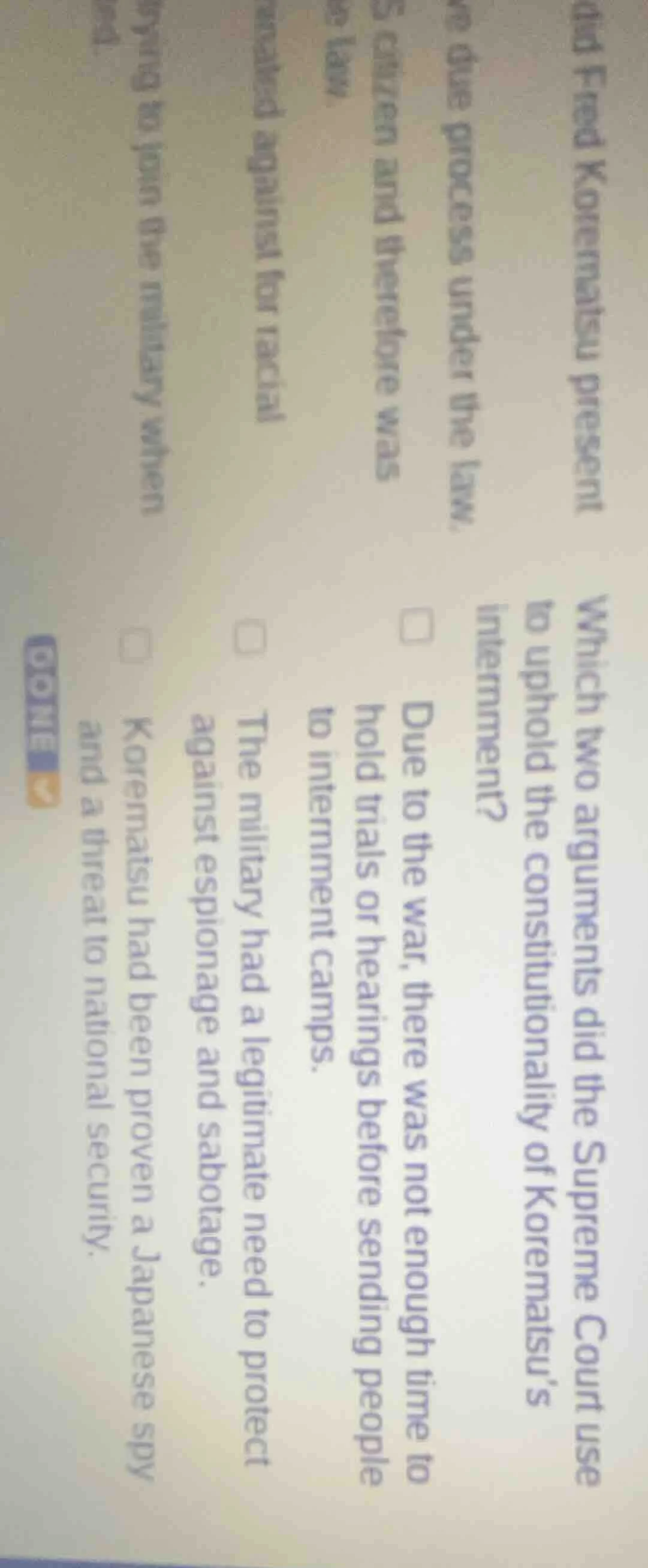
which two arguments did the supreme court use
to uphold the constitutionality of korematsu’s
internment?
due to the war, there was not enough time to
hold trials or hearings before sending people
to internment camps.
the military had a legitimate need to protect
against espionage and sabotage.
korematsu had been proven a japanese spy
and a threat to national security.
To determine the correct arguments, we analyze the Korematsu v. United States case. The Supreme Court upheld the internment by arguing that due to the war (World War II, specifically after Pearl Harbor), there was a legitimate military need to protect against espionage and sabotage (as there were fears of Japanese - American citizens aiding Japan), and also that due to the war, there was not enough time to hold trials or hearings before sending people to internment camps. The option “Korematsu had been proven a Japanese spy and a threat to national security” is incorrect as he was not proven to be a spy. The option “Sent to prison for racial reasons” is also incorrect as the internment was justified (by the Court) on national security/military necessity grounds, not pure racial reasons. So the two correct arguments are "Due to the war, there was not enough time to hold trials or hearings before sending people to internment camps" and "The military had a legitimate need to protect against espionage and sabotage".

Snap & solve any problem in the app
Get step-by-step solutions on Sovi AI
Photo-based solutions with guided steps
Explore more problems and detailed explanations
- Due to the war, there was not enough time to hold trials or hearings before sending people to internment camps.
- The military had a legitimate need to protect against espionage and sabotage.