QUESTION IMAGE
Question
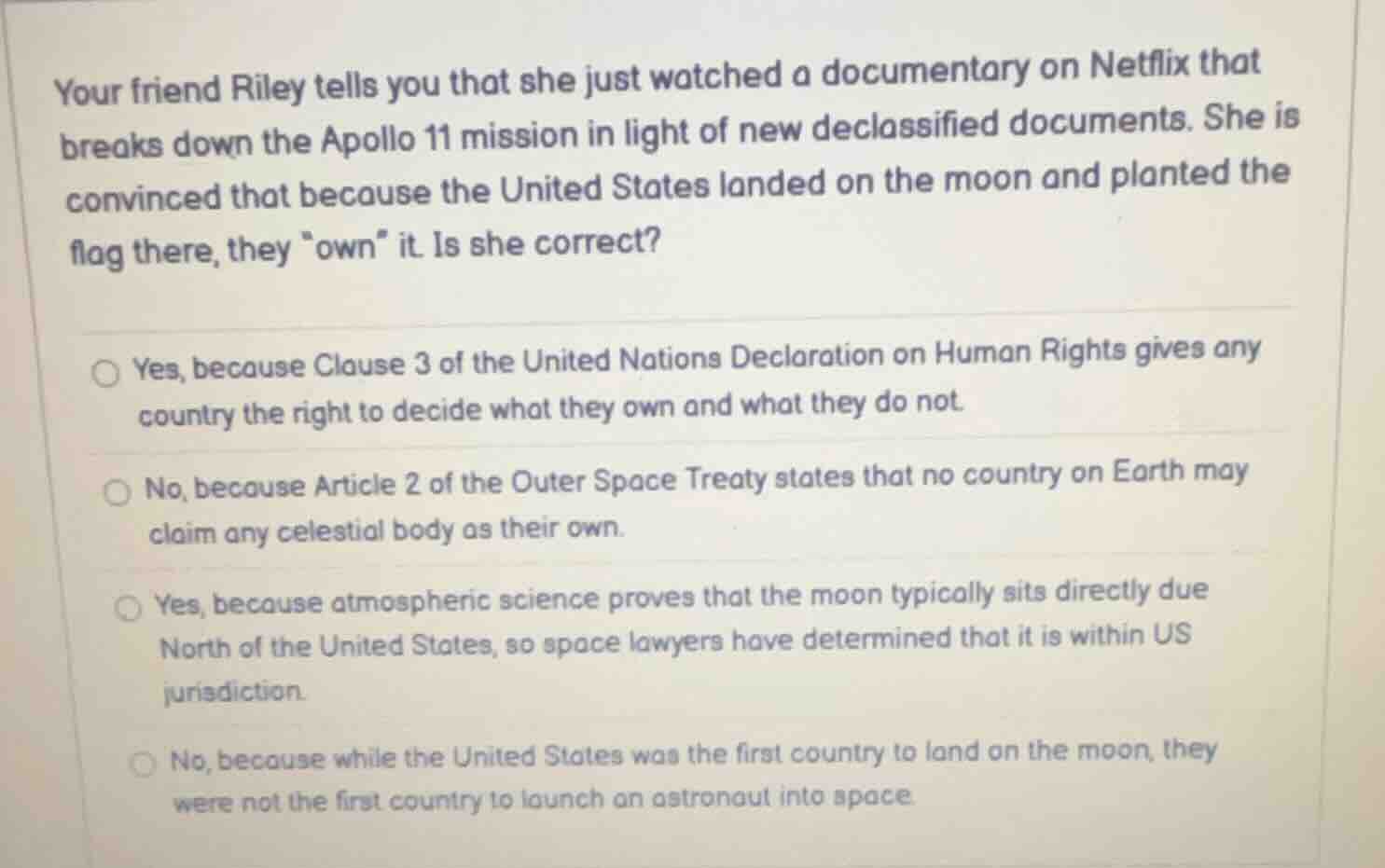
your friend riley tells you that she just watched a documentary on netflix that breaks down the apollo 11 mission in light of new declassified documents. she is convinced that because the united states landed on the moon and planted the flag there, they \own\ it. is she correct?
yes, because clause 3 of the united nations declaration on human rights gives any country the right to decide what they own and what they do not.
no, because article 2 of the outer space treaty states that no country on earth may claim any celestial body as their own.
yes, because atmospheric science proves that the moon typically sits directly due north of the united states, so space lawyers have determined that it is within us jurisdiction.
no, because while the united states was the first country to land on the moon, they were not the first country to launch an astronaut into space.
To determine if Riley is correct, we analyze each option:
- The first option is incorrect as the UN Declaration on Human Rights does not address ownership of celestial bodies.
- The second option is correct. The Outer Space Treaty's Article 2 explicitly prohibits countries from claiming celestial bodies (like the moon) as their own.
- The third option is incorrect; atmospheric science and the moon's position relative to the US have no bearing on ownership, and space law does not support such a claim.
- The fourth option is incorrect as the first country to launch an astronaut into space is irrelevant to moon ownership.

Snap & solve any problem in the app
Get step-by-step solutions on Sovi AI
Photo-based solutions with guided steps
Explore more problems and detailed explanations
B. No, because Article 2 of the Outer Space Treaty states that no country on Earth may claim any celestial body as their own.