QUESTION IMAGE
Question
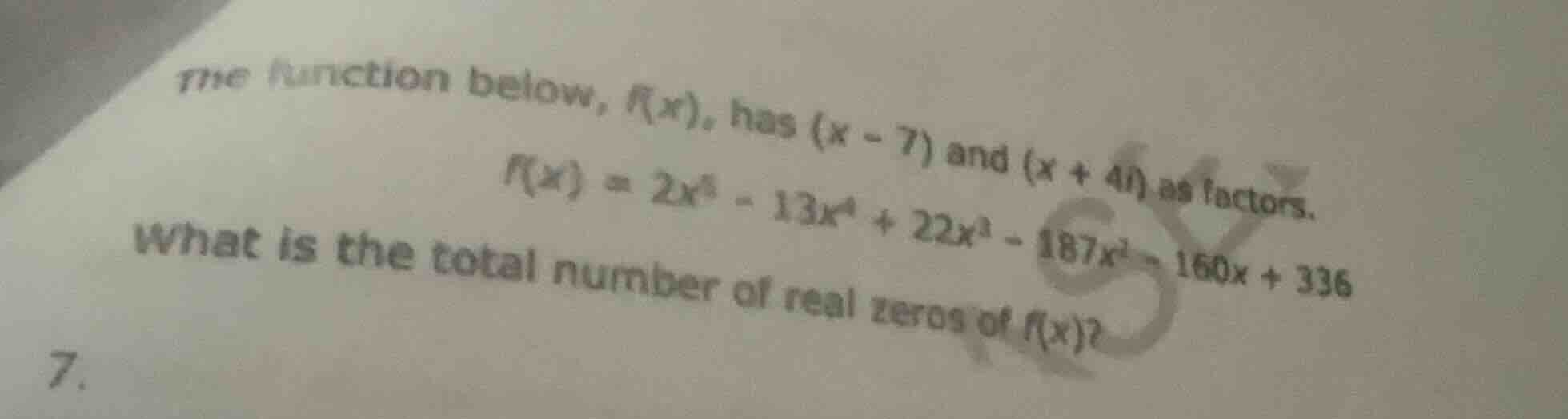
the function below, ( f(x) ), has ( (x - 7) ) and ( (x + 4i) ) as factors. ( f(x)=2x^{5}-13x^{4}+22x^{3}-187x^{2}-160x + 336 ) what is the total number of real zeros of ( f(x) )?
Step1: Analyze given factors
We know that if \((x - 7)\) is a factor, then \(x = 7\) is a real zero. For the factor \((x + 4i)\), since complex zeros come in conjugate pairs, its conjugate \((x - 4i)\) is also a factor, so \(x = 4i\) and \(x=- 4i\) are complex zeros.
Step2: Use Rational Root Theorem
The Rational Root Theorem states that possible rational roots are of the form \(\frac{p}{q}\), where \(p\) is a factor of the constant term and \(q\) is a factor of the leading coefficient. For \(f(x)=2x^{5}-13x^{4}+22x^{3}-187x^{2}-160x + 336\), the constant term is \(336\) and the leading coefficient is \(2\). Possible rational roots are \(\pm1,\pm2,\pm3,\pm4,\pm6,\pm7,\pm8,\pm12,\pm14,\pm16,\pm21,\pm24,\pm28,\pm42,\pm48,\pm56,\pm84,\pm112,\pm168,\pm336,\pm\frac{1}{2},\pm\frac{3}{2},\pm\frac{7}{2}\) etc. We already know \(x = 7\) is a root. Let's perform polynomial division or use synthetic division to factor out \((x - 7)\) from \(f(x)\).
Using synthetic division with root \(7\):
The coefficients of \(f(x)\) are \(2,-13,22,-187,-160,336\)
Bring down the \(2\). Multiply \(2\times7 = 14\). Add to \(-13\): \(-13 + 14=1\)
Multiply \(1\times7 = 7\). Add to \(22\): \(22 + 7 = 29\)
Multiply \(29\times7=203\). Add to \(-187\): \(-187+203 = 16\)
Multiply \(16\times7 = 112\). Add to \(-160\): \(-160 + 112=-48\)
Multiply \(-48\times7=-336\). Add to \(336\): \(-336 + 336 = 0\)
So, after dividing \(f(x)\) by \((x - 7)\), we get \(f(x)=(x - 7)(2x^{4}+x^{3}+29x^{2}+16x - 48)\)
Now we factor the quartic \(2x^{4}+x^{3}+29x^{2}+16x - 48\). Let's try to find another rational root. Let's test \(x = \frac{3}{2}\):
\(2\times(\frac{3}{2})^{4}+(\frac{3}{2})^{3}+29\times(\frac{3}{2})^{2}+16\times\frac{3}{2}-48\)
\(2\times\frac{81}{16}+\frac{27}{8}+29\times\frac{9}{4}+24 - 48\)
\(\frac{81}{8}+\frac{27}{8}+\frac{261}{4}-24\)
\(\frac{108}{8}+\frac{522}{8}-\frac{192}{8}=\frac{108 + 522-192}{8}=\frac{438}{8}
eq0\)
Test \(x=\frac{4}{2} = 2\):
\(2\times(2)^{4}+(2)^{3}+29\times(2)^{2}+16\times2-48\)
\(2\times16 + 8+29\times4 + 32-48\)
\(32+8 + 116+32 - 48=140
eq0\)
Test \(x = - \frac{3}{2}\):
\(2\times(-\frac{3}{2})^{4}+(-\frac{3}{2})^{3}+29\times(-\frac{3}{2})^{2}+16\times(-\frac{3}{2})-48\)
\(2\times\frac{81}{16}-\frac{27}{8}+29\times\frac{9}{4}-24 - 48\)
\(\frac{81}{8}-\frac{27}{8}+\frac{261}{4}-72\)
\(\frac{54}{8}+\frac{522}{8}-\frac{576}{8}=\frac{54 + 522-576}{8}=0\)
So \(x=-\frac{3}{2}\) is a root. Now we factor out \((2x + 3)\) (since \(x=-\frac{3}{2}\) implies \(2x+3 = 0\)) from the quartic \(2x^{4}+x^{3}+29x^{2}+16x - 48\) using polynomial long division or synthetic division for quadratic in terms of \(2x+3\).
After factoring out \((2x + 3)\) from \(2x^{4}+x^{3}+29x^{2}+16x - 48\), we get \(x^{3}-x^{2}+15x - 16\)? Wait, no, let's do synthetic division for the quartic with root \(x =-\frac{3}{2}\).
Using synthetic division for the quartic \(2x^{4}+x^{3}+29x^{2}+16x - 48\) with root \(x =-\frac{3}{2}\):
The coefficients are \(2,1,29,16,-48\)
Bring down \(2\). Multiply \(2\times(-\frac{3}{2})=-3\). Add to \(1\): \(1-3=-2\)
Multiply \(-2\times(-\frac{3}{2}) = 3\). Add to \(29\): \(29 + 3=32\)
Multiply \(32\times(-\frac{3}{2})=-48\). Add to \(16\): \(16-48=-32\)
Multiply \(-32\times(-\frac{3}{2}) = 48\). Add to \(-48\): \(-48 + 48=0\)
So the quartic factors as \((2x + 3)(2x^{3}-2x^{2}+32x - 32)\). Now factor the cubic \(2x^{3}-2x^{2}+32x - 32\). We can factor out a \(2\): \(2(x^{3}-x^{2}+16x - 16)\). Try to find a root of \(x^{3}-x^{2}+16x - 16\). Test \(x = 1\): \(1-1 + 16-16=0\). So \(x = 1\) is a root. Factor out \((x - 1…

Snap & solve any problem in the app
Get step-by-step solutions on Sovi AI
Photo-based solutions with guided steps
Explore more problems and detailed explanations
Step1: Analyze given factors
We know that if \((x - 7)\) is a factor, then \(x = 7\) is a real zero. For the factor \((x + 4i)\), since complex zeros come in conjugate pairs, its conjugate \((x - 4i)\) is also a factor, so \(x = 4i\) and \(x=- 4i\) are complex zeros.
Step2: Use Rational Root Theorem
The Rational Root Theorem states that possible rational roots are of the form \(\frac{p}{q}\), where \(p\) is a factor of the constant term and \(q\) is a factor of the leading coefficient. For \(f(x)=2x^{5}-13x^{4}+22x^{3}-187x^{2}-160x + 336\), the constant term is \(336\) and the leading coefficient is \(2\). Possible rational roots are \(\pm1,\pm2,\pm3,\pm4,\pm6,\pm7,\pm8,\pm12,\pm14,\pm16,\pm21,\pm24,\pm28,\pm42,\pm48,\pm56,\pm84,\pm112,\pm168,\pm336,\pm\frac{1}{2},\pm\frac{3}{2},\pm\frac{7}{2}\) etc. We already know \(x = 7\) is a root. Let's perform polynomial division or use synthetic division to factor out \((x - 7)\) from \(f(x)\).
Using synthetic division with root \(7\):
The coefficients of \(f(x)\) are \(2,-13,22,-187,-160,336\)
Bring down the \(2\). Multiply \(2\times7 = 14\). Add to \(-13\): \(-13 + 14=1\)
Multiply \(1\times7 = 7\). Add to \(22\): \(22 + 7 = 29\)
Multiply \(29\times7=203\). Add to \(-187\): \(-187+203 = 16\)
Multiply \(16\times7 = 112\). Add to \(-160\): \(-160 + 112=-48\)
Multiply \(-48\times7=-336\). Add to \(336\): \(-336 + 336 = 0\)
So, after dividing \(f(x)\) by \((x - 7)\), we get \(f(x)=(x - 7)(2x^{4}+x^{3}+29x^{2}+16x - 48)\)
Now we factor the quartic \(2x^{4}+x^{3}+29x^{2}+16x - 48\). Let's try to find another rational root. Let's test \(x = \frac{3}{2}\):
\(2\times(\frac{3}{2})^{4}+(\frac{3}{2})^{3}+29\times(\frac{3}{2})^{2}+16\times\frac{3}{2}-48\)
\(2\times\frac{81}{16}+\frac{27}{8}+29\times\frac{9}{4}+24 - 48\)
\(\frac{81}{8}+\frac{27}{8}+\frac{261}{4}-24\)
\(\frac{108}{8}+\frac{522}{8}-\frac{192}{8}=\frac{108 + 522-192}{8}=\frac{438}{8}
eq0\)
Test \(x=\frac{4}{2} = 2\):
\(2\times(2)^{4}+(2)^{3}+29\times(2)^{2}+16\times2-48\)
\(2\times16 + 8+29\times4 + 32-48\)
\(32+8 + 116+32 - 48=140
eq0\)
Test \(x = - \frac{3}{2}\):
\(2\times(-\frac{3}{2})^{4}+(-\frac{3}{2})^{3}+29\times(-\frac{3}{2})^{2}+16\times(-\frac{3}{2})-48\)
\(2\times\frac{81}{16}-\frac{27}{8}+29\times\frac{9}{4}-24 - 48\)
\(\frac{81}{8}-\frac{27}{8}+\frac{261}{4}-72\)
\(\frac{54}{8}+\frac{522}{8}-\frac{576}{8}=\frac{54 + 522-576}{8}=0\)
So \(x=-\frac{3}{2}\) is a root. Now we factor out \((2x + 3)\) (since \(x=-\frac{3}{2}\) implies \(2x+3 = 0\)) from the quartic \(2x^{4}+x^{3}+29x^{2}+16x - 48\) using polynomial long division or synthetic division for quadratic in terms of \(2x+3\).
After factoring out \((2x + 3)\) from \(2x^{4}+x^{3}+29x^{2}+16x - 48\), we get \(x^{3}-x^{2}+15x - 16\)? Wait, no, let's do synthetic division for the quartic with root \(x =-\frac{3}{2}\).
Using synthetic division for the quartic \(2x^{4}+x^{3}+29x^{2}+16x - 48\) with root \(x =-\frac{3}{2}\):
The coefficients are \(2,1,29,16,-48\)
Bring down \(2\). Multiply \(2\times(-\frac{3}{2})=-3\). Add to \(1\): \(1-3=-2\)
Multiply \(-2\times(-\frac{3}{2}) = 3\). Add to \(29\): \(29 + 3=32\)
Multiply \(32\times(-\frac{3}{2})=-48\). Add to \(16\): \(16-48=-32\)
Multiply \(-32\times(-\frac{3}{2}) = 48\). Add to \(-48\): \(-48 + 48=0\)
So the quartic factors as \((2x + 3)(2x^{3}-2x^{2}+32x - 32)\). Now factor the cubic \(2x^{3}-2x^{2}+32x - 32\). We can factor out a \(2\): \(2(x^{3}-x^{2}+16x - 16)\). Try to find a root of \(x^{3}-x^{2}+16x - 16\). Test \(x = 1\): \(1-1 + 16-16=0\). So \(x = 1\) is a root. Factor out \((x - 1)\) from \(x^{3}-x^{2}+16x - 16\):
Using synthetic division: coefficients \(1,-1,16,-16\). Bring down \(1\). Multiply \(1\times1 = 1\). Add to \(-1\): \(0\). Multiply \(0\times1 = 0\). Add to \(16\): \(16\). Multiply \(16\times1 = 16\). Add to \(-16\): \(0\). So \(x^{3}-x^{2}+16x - 16=(x - 1)(x^{2}+16)\)
So now we have factored \(f(x)\) as:
\(f(x)=(x - 7)(2x + 3)(x - 1)(x^{2}+16)\)
The quadratic \(x^{2}+16 = 0\) has roots \(x=\pm4i\) (complex roots).
Step3: Count real zeros
From the factored form \(f(x)=(x - 7)(2x + 3)(x - 1)(x^{2}+16)\), the real zeros come from \((x - 7)=0\) (i.e., \(x = 7\)), \((2x+3)=0\) (i.e., \(x=-\frac{3}{2}\)) and \((x - 1)=0\) (i.e., \(x = 1\)). The factor \((x^{2}+16)\) gives complex zeros. Also, we already considered the complex zeros from \((x\pm4i)\) earlier. So the real zeros are \(x = 7\), \(x=-\frac{3}{2}\) and \(x = 1\), and we also check if there are any other real zeros. Wait, the degree of the polynomial is \(5\). We have found three real zeros (\(x = 1\), \(x=-\frac{3}{2}\), \(x = 7\)) and two complex zeros (but wait, complex zeros come in pairs, but we have a fifth - degree polynomial, so total number of zeros (counting multiplicities) is \(5\). We have one real zero from \((x - 7)\), one from \((2x + 3)\), one from \((x - 1)\) and two complex zeros from \((x^{2}+16)\) and we already had the complex zeros from \((x\pm4i)\)? Wait, no, the original polynomial is degree \(5\), so we must have made a mistake in the factoring.
Wait, let's start over. The polynomial is of degree \(5\). We know that \((x - 7)\) is a factor, so we perform synthetic division of \(f(x)\) by \((x - 7)\):
Coefficients: \(2\) (x^5), \(-13\) (x^4), \(22\) (x^3), \(-187\) (x^2), \(-160\) (x), \(336\) (constant)
Using synthetic division with root \(7\):
\(7\) | \(2\) \(-13\) \(22\) \(-187\) \(-160\) \(336\)
| \(14\) \(7\) \(203\) \(112\) \(-336\)
-------------------------------
\(2\) \(1\) \(29\) \(16\) \(-48\) \(0\)
So \(f(x)=(x - 7)(2x^{4}+x^{3}+29x^{2}+16x - 48)\)
Now, let's try to factor the quartic \(2x^{4}+x^{3}+29x^{2}+16x - 48\). Let's use the Rational Root Theorem again. We can also try to group terms:
\(2x^{4}+x^{3}+29x^{2}+16x - 48=2x^{4}+x^{3}- 3x^{2}+32x^{2}+16x - 48\) (split \(29x^{2}\) as \(-3x^{2}+32x^{2}\))
\(=x^{2}(2x^{2}+x - 3)+16(2x^{2}+x - 3)\)
\(=(x^{2}+16)(2x^{2}+x - 3)\)
Ah! That's a better way. So \(2x^{4}+x^{3}+29x^{2}+16x - 48=(x^{2}+16)(2x^{2}+x - 3)\)
Now factor \(2x^{2}+x - 3\): \(2x^{2}+x - 3=(2x + 3)(x - 1)\)
So now \(f(x)=(x - 7)(x^{2}+16)(2x + 3)(x - 1)\)
Now, find the zeros:
- For \((x - 7)=0\), \(x = 7\) (real)
- For \((x^{2}+16)=0\), \(x=\pm4i\) (complex)
- For \((2x + 3)=0\), \(x=-\frac{3}{2}\) (real)
- For \((x - 1)=0\), \(x = 1\) (real)
So the real zeros are \(x = 7\), \(x=-\frac{3}{2}\), \(x = 1\). Wait, but the degree is \(5\), but we have factored it as a product of a linear, a quadratic (complex roots), a linear and a linear. Wait, no, \((x - 7)\) is linear, \((x^{2}+16)\) is quadratic, \((2x + 3)\) is linear, \((x - 1)\) is linear. So total factors: \(1 + 2+1 + 1=5\) (degree 5). So the real zeros are from the linear factors: \(x - 7\), \(2x + 3\), \(x - 1\). So that's 3 real zeros? Wait, no, wait the original factor given was \((x + 4i)\), so its conjugate \((x - 4i)\) is also a factor, but in our factoring above, we have \((x^{2}+16)=(x - 4i)(x + 4i)\), so that's correct. And we also have \((x - 7)\), \((2x + 3)\), \((x - 1)\) as linear factors with real roots. So the real zeros are \(x = 7\), \(x=-\frac{3}{2}\), \(x = 1\). Wait, but let's check the multiplicity? No, all factors are distinct. Wait, but the degree is 5, and we have 3 real zeros (each with multiplicity 1) and 2 complex zeros (each with multiplicity 1, and they are a pair). So the total number of real zeros is 3? Wait, no, wait:
Wait, \(f(x)=(x - 7)(x - 1)(2x + 3)(x^{2}+16)\). The linear factors are \((x - 7)\), \((x - 1)\), \((2x + 3)\) which give real roots, and the quadratic \((x^{2}+16)\) gives complex roots. So the number of real zeros is 3? But wait, let's check the graph or use Descartes' Rule of Signs.
Descartes' Rule of Signs: For \(f(x)=2x^{5}-13x^{4}+22x^{3}-187x^{2}-160x + 336\)
Number of sign changes in \(f(x)\):
- \(2x^{5}\) (positive) to \(-13x^{4}\) (negative): change 1
- \(-13x^{4}\) (negative) to \(22x^{3}\) (positive): change 2
- \(22x^{3}\) (positive) to \(-187x^{2}\) (negative): change 3
- \(-187x^{2}\) (negative) to \(-160x\) (negative): no change
- \(-160x\) (negative) to \(336\) (positive): change 4
So there are 4 or 2 or 0 positive real roots.
For \(f(-x)=-2x^{5}-13x^{4}-22x^{3}-187x^{2}+160x + 336\)
Number of sign changes:
- \(-2x^{5}\) (negative) to \(-13x^{4}\) (negative): no change
- \(-13x^{4}\) (negative) to \(-22x^{3}\) (negative): no change
- \(-22x^{3}\) (negative) to \(-187x^{2}\) (negative): no change
- \(-187x^{2}\) (negative) to \(160x\) (positive): change 1
- \(160x\) (positive) to \(336\) (positive): no change
So there is 1 negative real root.
From our factoring, we have positive real roots: \(x = 7\), \(x = 1\) (two positive real roots) and negative real root \(x=-\frac{3}{2}\) (one negative real root). Wait, that's three real roots. But according to Descartes' Rule, positive real roots could be 4, 2, or 0. We have 2 positive real roots? Wait, no, \(x = 7\) and \(x = 1\) are positive, so that's 2 positive, and \(x=-\frac{3}{2}\) is negative,