QUESTION IMAGE
Question
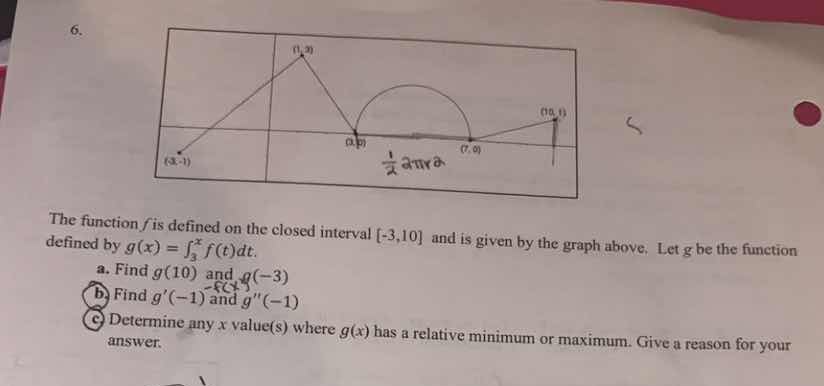
the function ( f ) is defined on the closed interval (-3,10) and is given by the graph above. let ( g ) be the function defined by ( g(x)=int_{3}^{x} f(t) dt ).
( \boldsymbol{\text{a.}} ) find ( g(10) ) and ( g(-3) )
( \boldsymbol{\text{b.}} ) find ( g(-1) ) and ( g(-1) )
( \boldsymbol{\text{c.}} ) determine any ( x ) value(s) where ( g(x) ) has a relative minimum or maximum. give a reason for your answer.
Step1: Recall g(x) definition
$g(x) = \int_{3}^{x} f(t)dt$
Step2: Evaluate g(10) (net area from 3 to10)
Break into geometric regions:
- Line from (-3,-1) to (1,3): Area from 3 to1 is triangle: $\frac{1}{2} \times 4 \times 4 = 8$
- Line from (1,3) to (0,0): Area from1 to0: $\frac{1}{2} \times1 \times3 = 1.5$
- Semicircle from (0,0) to (7,0): Radius $\frac{7}{2}$, area $\frac{1}{2} \pi (\frac{7}{2})^2 = \frac{49\pi}{8}$
- Line from (7,0) to (10,1): Area from7 to10: $\frac{1}{2} \times3 \times1 = 1.5$
Net area: $-8 + 1.5 + \frac{49\pi}{8} + 1.5 = \frac{49\pi}{8} -5$
Step3: Evaluate g(-3) (integral upper < lower)
$g(-3) = \int_{3}^{-3} f(t)dt = -\int_{-3}^{3} f(t)dt$
Area from -3 to3: Triangle from -3 to1 (area8) + triangle from1 to3 ($\frac{1}{2} \times2 \times3=3$)
$\int_{-3}^{3} f(t)dt = 8-3=5$, so $g(-3) = -5$
Step4: Find g'(x) (Fundamental Theorem)
$g'(x) = f(x)$, so $g'(-1)=f(-1)$
From line $f(t)=t+2$ (from (-3,-1) to (1,3)), $f(-1)=-1+2=1$
Step5: Find g''(x) (derivative of g'(x))
$g''(x) = f'(x)$, slope of f at x=-1: $\frac{3-(-1)}{1-(-3)} = 1$, so $g''(-1)=1$
Step6: Find relative extrema of g(x)
Critical points where $g'(x)=f(x)=0$: x=0, x=7, x=3
- x=0: f(x) changes from - to +, so g(x) has relative min.
- x=7: f(x) changes from + to -, so g(x) has relative max.
- x=3: f(x) does not change sign, no extrema.

Snap & solve any problem in the app
Get step-by-step solutions on Sovi AI
Photo-based solutions with guided steps
Explore more problems and detailed explanations
Part a
$g(10) = \frac{49\pi}{8} - 5$, $g(-3) = -5$
Part b
$g'(-1) = 1$, $g''(-1) = 1$
Part c
- Relative minimum at $x=0$: $g'(x)=f(x)$ changes from negative to positive here, so by the First Derivative Test, $g(x)$ has a relative minimum.
- Relative maximum at $x=7$: $g'(x)=f(x)$ changes from positive to negative here, so by the First Derivative Test, $g(x)$ has a relative maximum.