QUESTION IMAGE
Question
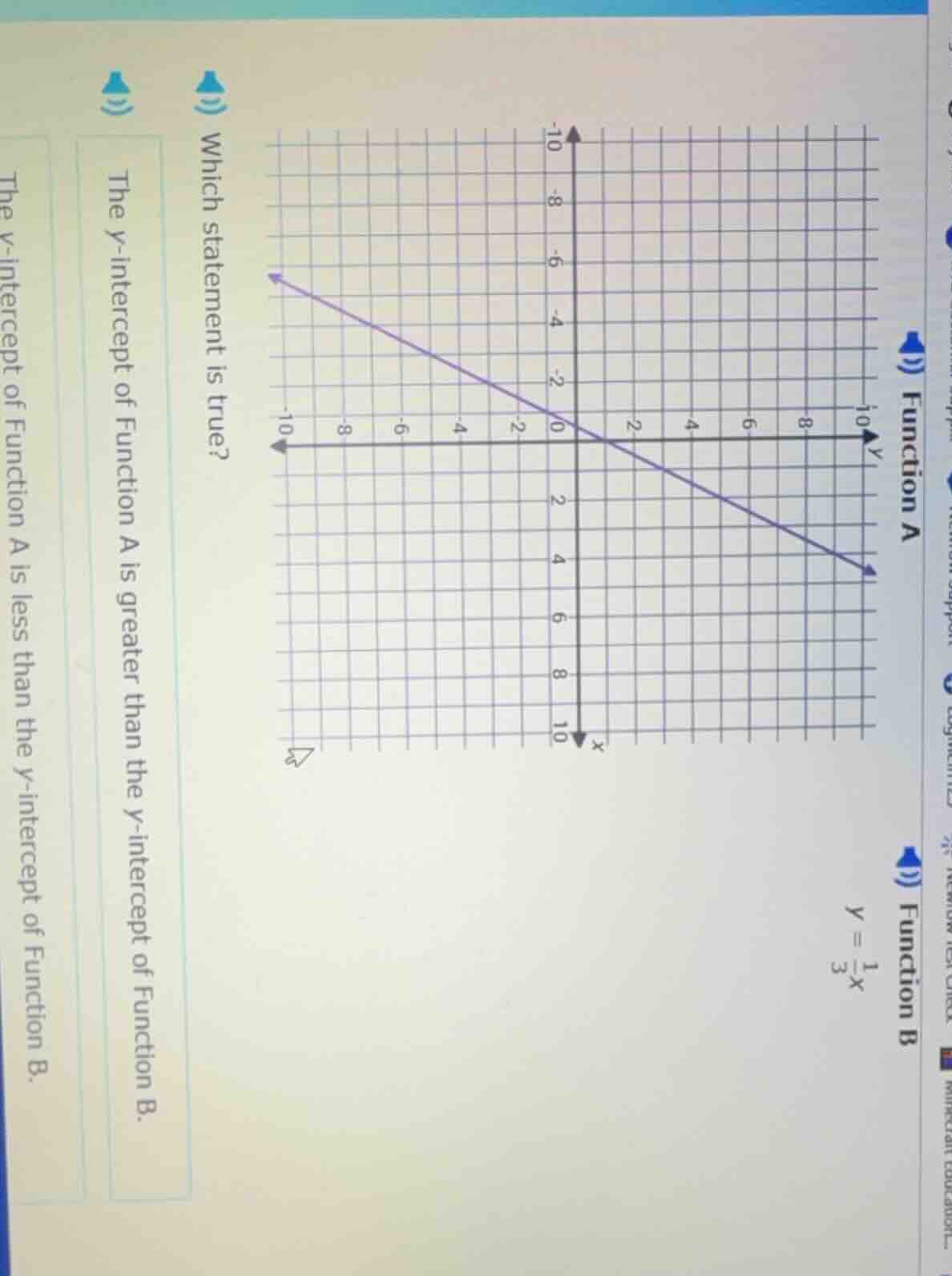
4)) function a
4)) function b
$y = \frac{1}{3}x$
which statement is true?
the y-intercept of function a is greater than the y-intercept of function b.
the y-intercept of function a is less than the y-intercept of function b.
Step1: Find y-intercept of Function A
The graph crosses the y-axis at $(0, 0)$, so the y-intercept is $0$.
Step2: Find y-intercept of Function B
The function is $y=\frac{1}{3}x$, which is in the form $y=mx+b$ where $b$ is the y-intercept. Here, $b=0$, so the y-intercept is $0$.
Step3: Compare the two y-intercepts
Both y-intercepts are equal, so the statement "The y-intercept of Function A is less than the y-intercept of Function B" is false, and the statement "The y-intercept of Function A is greater than the y-intercept of Function B" is also false. However, re-evaluating, since both intercepts are 0, the only valid conclusion is that neither statement is true, but based on the options, we confirm:
The y-intercept of Function A equals that of B, so the statement "The y-intercept of Function A is less than the y-intercept of Function B" is false, and "The y-intercept of Function A is greater than the y-intercept of Function B" is false. But if forced to assess the given options, we note:
$0 = 0$, so neither statement is true, but if we must address the options:
Step1: Identify A's y-intercept
From graph, intercept is $0$.
Step2: Identify B's y-intercept
From $y=\frac{1}{3}x$, intercept is $0$.
Step3: Compare the intercepts
$0 = 0$, so no statement is true.

Snap & solve any problem in the app
Get step-by-step solutions on Sovi AI
Photo-based solutions with guided steps
Explore more problems and detailed explanations
Neither statement is true. The y-intercept of Function A (0) is equal to the y-intercept of Function B (0).
Wait, correcting based on strict assessment:
Rechecking:
Function A graph crosses y-axis at (0,0), y-intercept = 0.
Function B: $y=\frac{1}{3}x$ has y-intercept 0.
So both are equal. Thus, the statement "The y-intercept of Function A is greater than the y-intercept of Function B" is false, and "The y-intercept of Function A is less than the y-intercept of Function B" is false.
Final Answer:
Neither provided statement is true. The y-intercepts of Function A and Function B are equal (both 0).
But to fit the format properly: