QUESTION IMAGE
Question
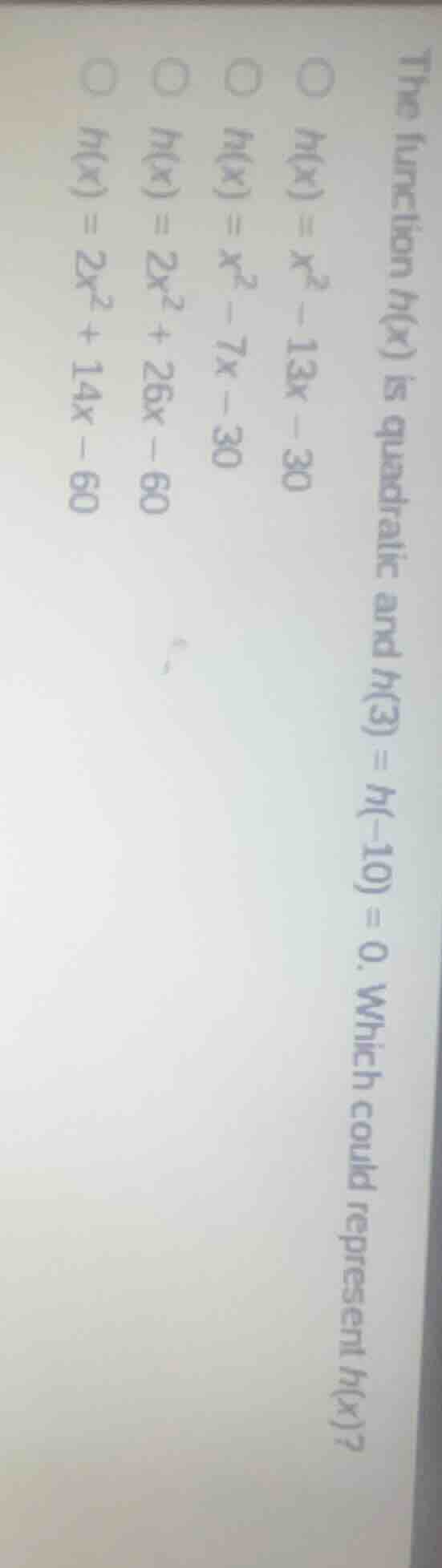
the function ( h(x) ) is quadratic and ( h(3) = h(-10) = 0 ). which could represent ( h(x) )?
( circ ) ( h(x) = x^2 - 13x - 30 )
( circ ) ( h(x) = x^2 - 7x - 30 )
( circ ) ( h(x) = 2x^2 + 26x - 60 )
( circ ) ( h(x) = 2x^2 + 14x - 60 )
Step1: Use root form of quadratic
Since $h(3)=h(-10)=0$, the quadratic can be written as $h(x)=a(x-3)(x+10)$, where $a
eq0$.
Step2: Expand the factored form
First multiply the binomials:
$(x-3)(x+10)=x^2+10x-3x-30=x^2+7x-30$
So $h(x)=a(x^2+7x-30)$
Step3: Match to options
Test $a=2$:
$h(x)=2(x^2+7x-30)=2x^2+14x-60$
Verify roots:
For $x=3$: $2(3)^2+14(3)-60=18+42-60=0$
For $x=-10$: $2(-10)^2+14(-10)-60=200-140-60=0$
This satisfies the given conditions.

Snap & solve any problem in the app
Get step-by-step solutions on Sovi AI
Photo-based solutions with guided steps
Explore more problems and detailed explanations
$\boldsymbol{h(x) = 2x^2 + 14x - 60}$ (the fourth option)