QUESTION IMAGE
Question
- functions: determine which relations are functions.
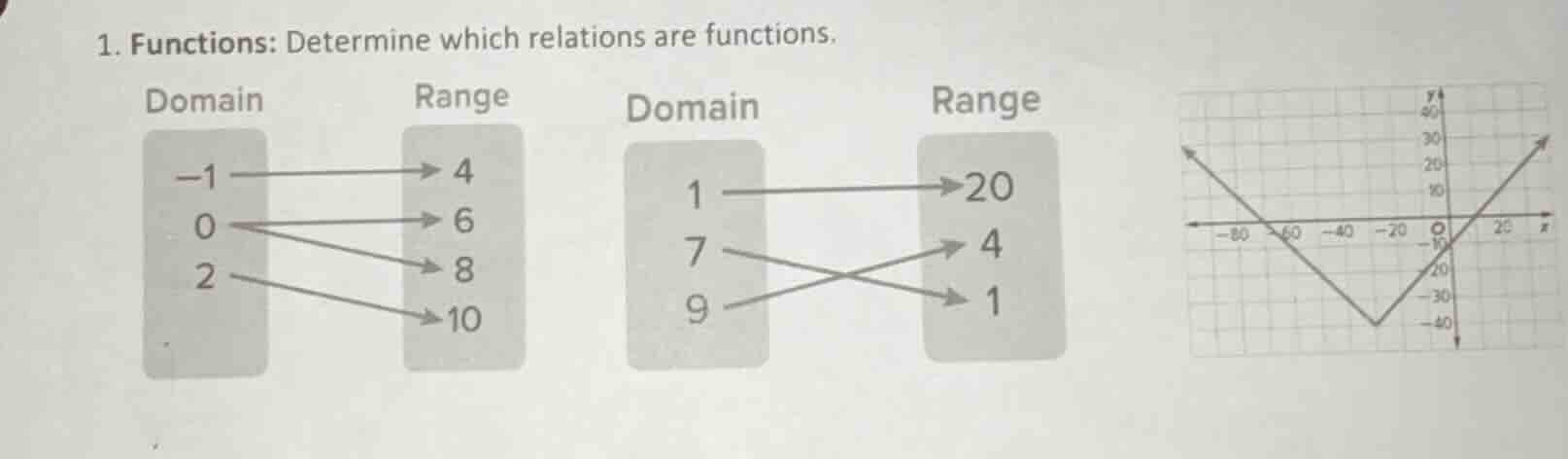
domain \t\trange \t\tdomain \t\trange
-1 → 4 \t\t1 → 20
0 → 6 \t\t7 → 4
2 → 8 \t\t9 → 1
0 → 10 \t\t\t\t\t\t\t(and a graph of a v - shaped line)
Step1: Recall the definition of a function
A relation is a function if every element in the domain is paired with exactly one element in the range. In other words, no input (domain element) has more than one output (range element).
Step2: Analyze the first relation (left mapping)
- Domain element \( -1 \): maps to \( 4 \) (one output)
- Domain element \( 0 \): maps to \( 6 \) and \( 8 \) (two outputs)
- Domain element \( 2 \): maps to \( 10 \) (one output)
Since \( 0 \) has two outputs, this relation is not a function.
Step3: Analyze the second relation (middle mapping)
- Domain element \( 1 \): maps to \( 20 \) (one output)
- Domain element \( 7 \): maps to \( 4 \) (one output)
- Domain element \( 9 \): maps to \( 1 \) (one output)
Every domain element has exactly one range element. This relation is a function.
Step4: Analyze the third relation (graph)
Use the vertical line test: if any vertical line intersects the graph more than once, it is not a function. For the given graph (a V - shaped graph, likely an absolute - value - type function), any vertical line will intersect the graph at most once. So this graph represents a function.

Snap & solve any problem in the app
Get step-by-step solutions on Sovi AI
Photo-based solutions with guided steps
Explore more problems and detailed explanations
- The first relation (left mapping) is not a function.
- The second relation (middle mapping) is a function.
- The third relation (graph) is a function.