QUESTION IMAGE
Question
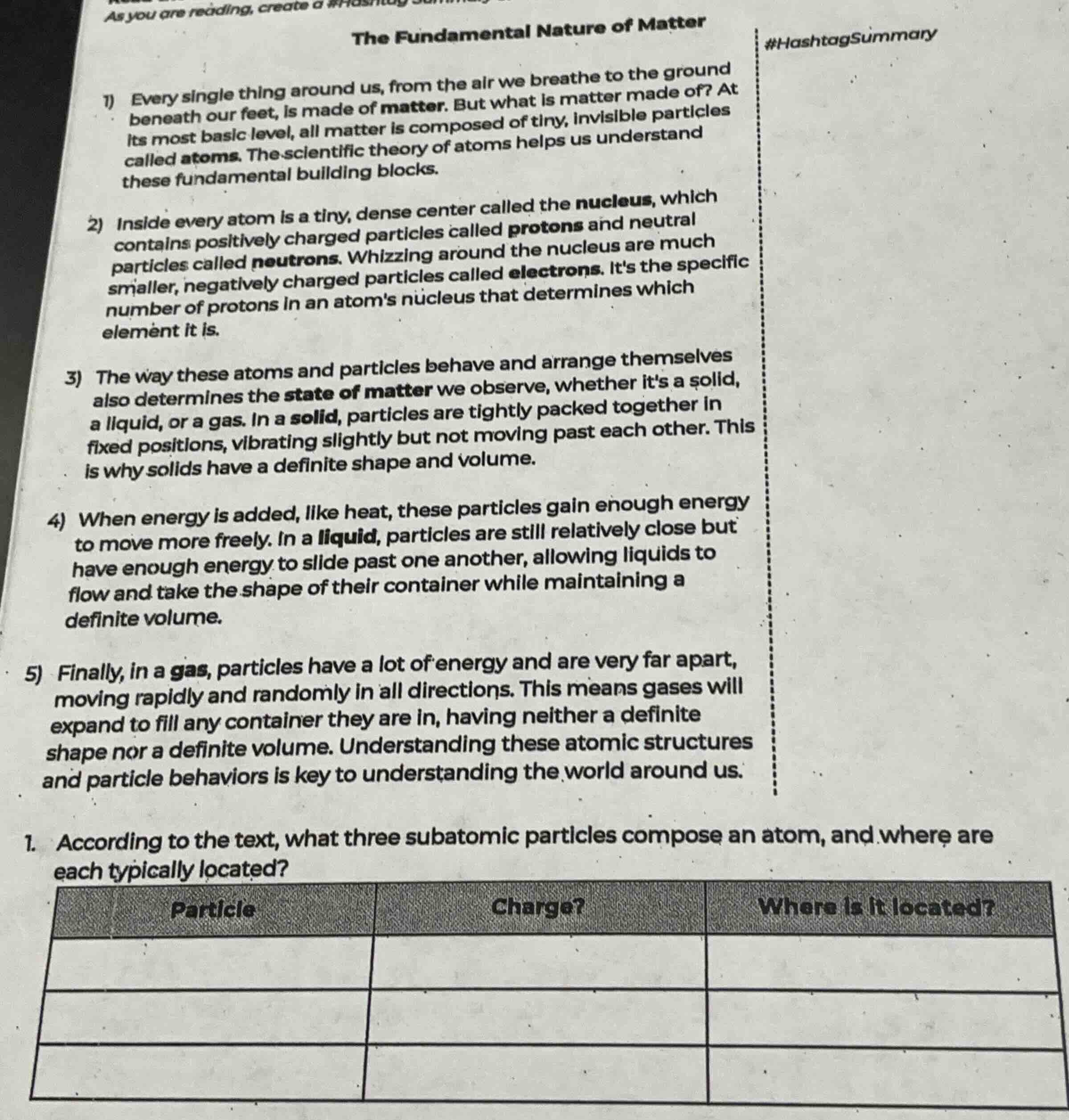
the fundamental nature of matter
- every single thing around us, from the air we breathe to the ground beneath our feet, is made of matter. but what is matter made of? at its most basic level, all matter is composed of tiny, invisible particles called atoms. the scientific theory of atoms helps us understand these fundamental building blocks.
- inside every atom is a tiny, dense center called the nucleus, which contains positively charged particles called protons and neutral particles called neutrons. whizzing around the nucleus are much smaller, negatively charged particles called electrons. its the specific number of protons in an atoms nucleus that determines which element it is.
- the way these atoms and particles behave and arrange themselves also determines the state of matter we observe, whether its a solid, a liquid, or a gas. in a solid, particles are tightly packed together in fixed positions, vibrating slightly but not moving past each other. this is why solids have a definite shape and volume.
- when energy is added, like heat, these particles gain enough energy to move more freely. in a liquid, particles are still relatively close but have enough energy to slide past one another, allowing liquids to flow and take the shape of their container while maintaining a definite volume.
- finally, in a gas, particles have a lot of energy and are very far apart, moving rapidly and randomly in all directions. this means gases will expand to fill any container they are in, having neither a definite shape nor a definite volume. understanding these atomic structures and particle behaviors is key to understanding the world around us.
- according to the text, what three subatomic particles compose an atom, and where are each typically located?
| particle | charge? | where is it located? |
|---|---|---|
Response
To solve this, we analyze the text (paragraph 2) for subatomic particles, their charges, and locations:
Step 1: Identify Proton Details
From the text: "Inside every atom... nucleus, which contains positively charged particles called protons".
- Particle: Proton
- Charge: Positive
- Location: In the nucleus of the atom
Step 2: Identify Neutron Details
From the text: "nucleus... and neutral particles called neutrons".
- Particle: Neutron
- Charge: Neutral (no charge)
- Location: In the nucleus of the atom
Step 3: Identify Electron Details
From the text: "Whizzing around the nucleus are... negatively charged particles called electrons".
- Particle: Electron
- Charge: Negative
- Location: Whizzing around (orbiting) the nucleus
Now, we fill the table:
| Particle | Charge? | Where is it located? |
|---|---|---|
| Neutron | Neutral | In the nucleus |
| Electron | Negative | Around the nucleus |

Snap & solve any problem in the app
Get step-by-step solutions on Sovi AI
Photo-based solutions with guided steps
Explore more problems and detailed explanations
| Particle | Charge? | Where is it located? |
|---|---|---|
| Neutron | Neutral | In the nucleus |
| Electron | Negative | Around the nucleus |