QUESTION IMAGE
Question
gel electrophoresis
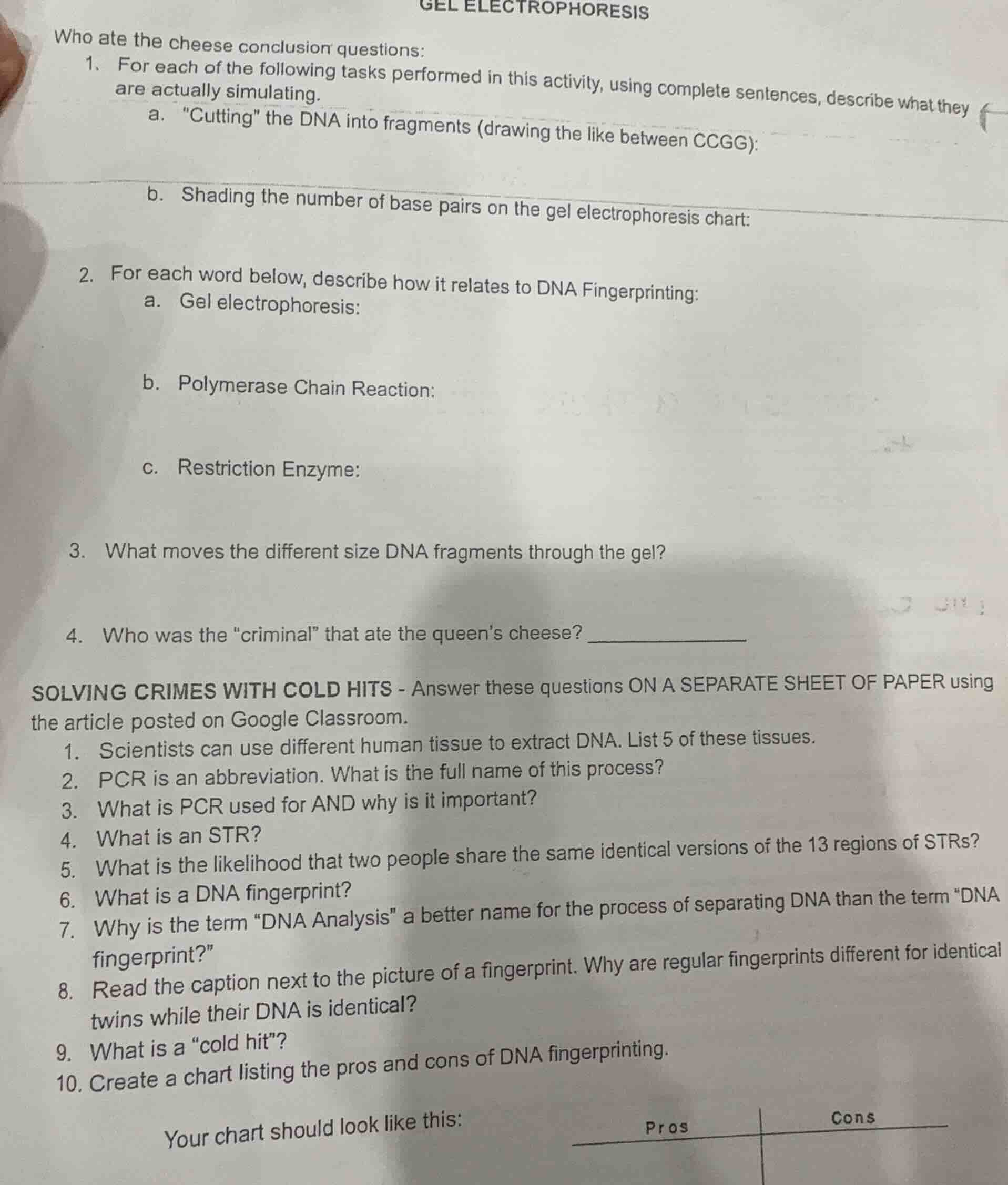
who ate the cheese conclusion questions:
- for each of the following tasks performed in this activity, using complete sentences, describe what they are actually simulating.
a. \cutting\ the dna into fragments (drawing the like between ccgg):
b. shading the number of base pairs on the gel electrophoresis chart:
- for each word below, describe how it relates to dna fingerprinting:
a. gel electrophoresis:
b. polymerase chain reaction:
c. restriction enzyme:
- what moves the different size dna fragments through the gel?
- who was the \criminal\ that ate the queens cheese?
solving crimes with cold hits - answer these questions on a separate sheet of paper using the article posted on google classroom.
- scientists can use different human tissue to extract dna. list 5 of these tissues.
- pcr is an abbreviation. what is the full name of this process?
- what is pcr used for and why is it important?
- what is an str?
- what is the likelihood that two people share the same identical versions of the 13 regions of strs?
- what is a dna fingerprint?
- why is the term \dna analysis\ a better name for the process of separating dna than the term \dna fingerprint?\
- read the caption next to the picture of a fingerprint. why are regular fingerprints different for identical twins while their dna is identical?
- what is a \cold hit\?
- create a chart listing the pros and cons of dna fingerprinting.
your chart should look like this:
\t\tpros\tcons
Section 1: Gel Electrophoresis Simulation Tasks
1a. This simulates restriction enzymes cutting DNA at specific recognition sequences (the CCGG site here), which is how DNA is fragmented in real DNA fingerprinting.
1b. This simulates the visualization of separated DNA fragments after gel electrophoresis, where the shaded areas represent the distinct bands of DNA fragments of specific base pair lengths that appear when stained in a real lab setting.
Section 2: DNA Fingerprinting Terms
2a. Gel electrophoresis is a core technique in DNA fingerprinting that separates DNA fragments by size using an electrical field through a gel matrix, creating a unique banding pattern for each individual.
2b. Polymerase Chain Reaction (PCR) is used in DNA fingerprinting to make millions of copies of a specific segment of DNA, which is critical when only a tiny sample of DNA is available for analysis.
2c. Restriction enzymes are enzymes that cut DNA at specific, short nucleotide sequences; they are used in DNA fingerprinting to fragment an individual's DNA into unique, analyzable pieces.
Section 3: Gel Electrophoresis Mechanism
- An applied electrical field moves DNA fragments through the gel. DNA is negatively charged, so it moves toward the positive electrode, with smaller fragments traveling faster and farther than larger ones.
Section 4: "Who Ate the Cheese?" Activity
- (Note: This requires data from the specific activity's gel results; a common result for this standard activity is Sam (or the individual whose banding pattern matches the DNA found at the cheese sample).)
Section 5: Solving Crimes with Cold Hits
- 5 human tissues for DNA extraction: Blood, saliva, hair follicles, skin cells, semen.
- PCR stands for Polymerase Chain Reaction.
- PCR is used to amplify (make many copies of) small segments of DNA; it is important because it allows analysis even when only a very small amount of DNA evidence is available, such as from a single hair or drop of blood.
- An STR (Short Tandem Repeat) is a region of DNA where a short nucleotide sequence is repeated multiple times; the number of repeats varies between individuals, making them ideal for DNA fingerprinting.
- The likelihood that two unrelated people share identical versions of the 13 standard STR regions is approximately 1 in 10 billion, making a match statistically unique for practical purposes.
- A DNA fingerprint is a unique pattern of DNA fragment bands (or STR repeat lengths) that is specific to an individual (except identical twins), used for identification and matching DNA samples.
- "DNA Analysis" is a better name because "DNA fingerprint" is a metaphor; the process involves analyzing and comparing genetic material, not actual fingerprints, and the term is more accurate for the full scope of genetic testing done in forensics.
- Regular fingerprints are formed by environmental factors in the womb and physical wear after birth, so even identical twins (who have identical DNA) develop unique ridge patterns on their fingers due to these non-genetic influences.
- A "cold hit" is a match between an unknown DNA sample from an unsolved (cold) crime and a DNA profile in a criminal database, which can lead to identifying a suspect long after the crime was committed.
- Pros and Cons of DNA Fingerprinting:
| Pros | Cons |
|---|---|
| Can solve cold cases via database matches | Privacy concerns over storage and misuse of genetic data |
| Exonerates wrongf…

Snap & solve any problem in the app
Get step-by-step solutions on Sovi AI
Photo-based solutions with guided steps
Explore more problems and detailed explanations
Section 1
1a. This task simulates the action of restriction enzymes cutting double-stranded DNA at specific recognition sequences (the CCGG sequence here), which generates the unique DNA fragments used in fingerprinting.
1b. This task simulates the visualization of separated DNA fragments after electrophoresis, where shaded areas represent the distinct, stainable bands of DNA fragments of specific base pair sizes that form in a real gel.
Section 2
2a. Gel electrophoresis is the key technique in DNA fingerprinting that separates DNA fragments by their size using an electrical field, creating a unique banding pattern for each individual.
2b. Polymerase Chain Reaction (PCR) amplifies small amounts of target DNA, making it possible to analyze tiny DNA samples that would otherwise be too small for fingerprinting.
2c. Restriction enzymes are specialized enzymes that cut DNA at specific nucleotide sequences; they are used to fragment an individual's DNA into the unique pieces that are separated in gel electrophoresis for fingerprinting.
Section 3
- An applied electrical field moves DNA fragments through the gel. DNA has a negative charge, so it migrates toward the positive electrode, with smaller fragments traveling faster and farther than larger fragments.
Section 4
- (Depends on activity data; common answer: Sam (or the individual whose DNA banding pattern matches the evidence sample from the cheese))
Section 5
- Blood, saliva, hair follicles, skin cells, semen
- Polymerase Chain Reaction
- PCR amplifies small DNA samples; it is critical because it enables analysis when only tiny amounts of DNA evidence exist.
- A Short Tandem Repeat (STR) is a DNA region with repeated short nucleotide sequences, where repeat counts vary between individuals for identification.
- Approximately 1 in 10 billion (for unrelated individuals)
- A DNA fingerprint is a unique pattern of DNA fragment bands (or STR repeat lengths) specific to an individual, used for sample matching and identification.
- "DNA Analysis" is more accurate because "DNA fingerprint" is a metaphor; the process involves genetic analysis, not actual fingerprints, and covers a broader scope of testing.
- Regular fingerprints are shaped by non-genetic factors like womb environment and physical wear, so identical twins (with identical DNA) develop unique fingerprint patterns.
- A cold hit is a match between an unsolved crime's unknown DNA sample and a profile in a criminal DNA database, identifying a suspect for a cold case.
10.
| Pros | Cons |
|---|---|
| Solves cold cases via databases | Genetic privacy concerns |
| Exonerates wrongfully convicted people | High testing costs |
| Works with tiny DNA samples | Risk of wrongful accusations |