QUESTION IMAGE
Question
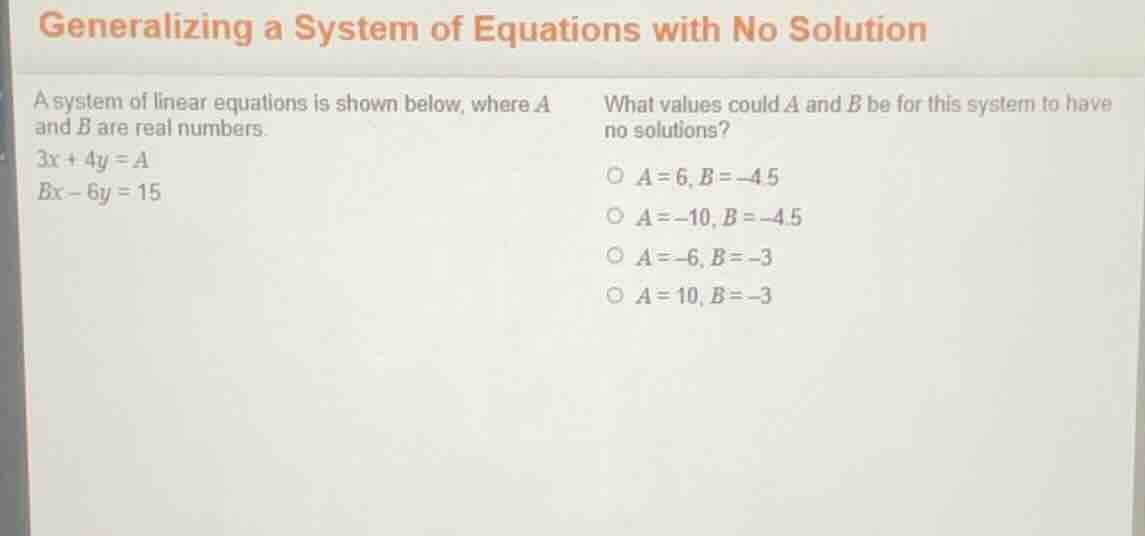
generalizing a system of equations with no solution
a system of linear equations is shown below, where a and b are real numbers.
$3x + 4y = a$
$bx - 6y = 15$
what values could a and b be for this system to have no solutions?
$\circ$ $a = 6, b = -4.5$
$\circ$ $a = -10, b = -4.5$
$\circ$ $a = -6, b = -3$
$\circ$ $a = 10, b = -3$
Step1: Define no-solution condition
A linear system
has no solutions if $\frac{a_1}{a_2}=\frac{b_1}{b_2}
eq\frac{c_1}{c_2}$.
Step2: Match given system to condition
For
, set $\frac{3}{B}=\frac{4}{-6}$.
Solve for $B$:
$$4B=3\times(-6) \implies 4B=-18 \implies B=\frac{-18}{4}=-4.5$$
Step3: Verify $\frac{c_1}{c_2}
eq$ ratio
Check $\frac{A}{15}
eq\frac{3}{-4.5}$. Calculate $\frac{3}{-4.5}=-\frac{2}{3}$, so $\frac{A}{15}
eq-\frac{2}{3} \implies A
eq-10$.
Step4: Test valid option
Check option A: $A=6, B=-4.5$. $\frac{3}{-4.5}=\frac{4}{-6}=-\frac{2}{3}$, and $\frac{6}{15}=\frac{2}{5}
eq-\frac{2}{3}$, satisfying the condition.

Snap & solve any problem in the app
Get step-by-step solutions on Sovi AI
Photo-based solutions with guided steps
Explore more problems and detailed explanations
A. $A=6, B=-4.5$