QUESTION IMAGE
Question
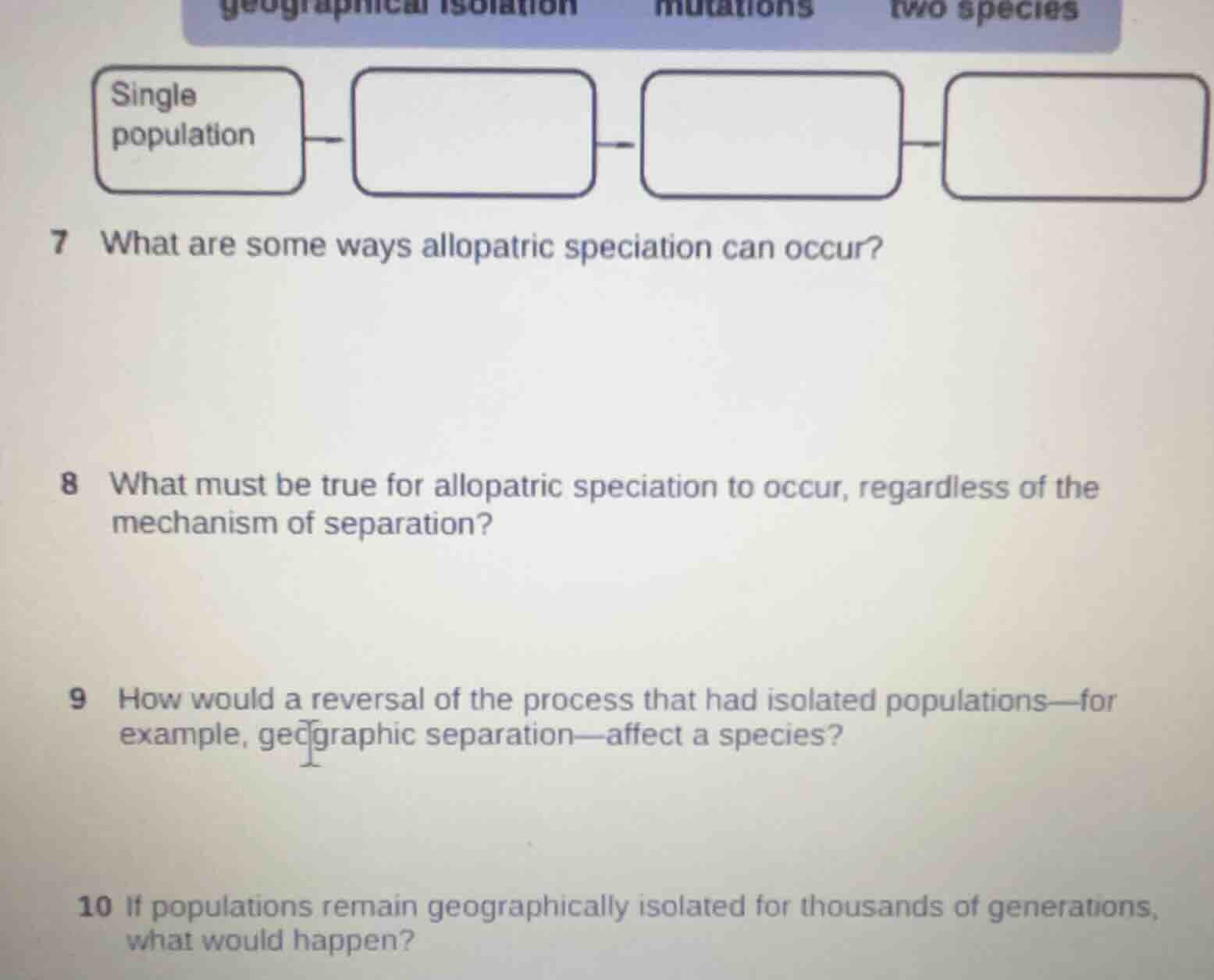
geographical isolation mutations two species
single
population
7 what are some ways allopatric speciation can occur?
8 what must be true for allopatric speciation to occur, regardless of the
mechanism of separation?
9 how would a reversal of the process that had isolated populations—for
example, geographic separation—affect a species?
10 if populations remain geographically isolated for thousands of generations,
what would happen?
For Question 7:
Allopatric speciation occurs when populations are geographically separated. Common natural or human-caused barriers drive this separation.
For Question 8:
The core requirement for allopatric speciation is that separated populations cannot interbreed and exchange genetic material, as this prevents gene flow that would keep them as a single species.
For Question 9:
Reversing isolation (like reconnecting separated habitats) lets populations interact again. If they can still interbreed, they may merge back into one species; if not, they may compete or form hybrid zones.
For Question 10:
Long-term geographic isolation means populations accumulate unique genetic changes from mutations, natural selection, and genetic drift. Over thousands of generations, these changes become so great that the populations can no longer interbreed, forming distinct species.
For the Flowchart:
The boxes follow the sequential steps of allopatric speciation, matching the labels above each box.

Snap & solve any problem in the app
Get step-by-step solutions on Sovi AI
Photo-based solutions with guided steps
Explore more problems and detailed explanations
- Flowchart boxes (left to right):
- Geographical isolation
- Mutations accumulate in isolated populations
- Reproductive isolation develops
- Question 7:
Allopatric speciation can occur via natural geographic barriers (like mountain ranges, rivers, or oceanic islands splitting a population), or human-caused barriers (like roads, dams, or deforestation that fragment habitats).
- Question 8:
Regardless of the separation mechanism, the separated populations must experience a complete (or near-complete) lack of gene flow—meaning individuals from the different populations cannot interbreed and exchange genetic material.
- Question 9:
If the isolating process is reversed, the previously separated populations may come back into contact. If they have not evolved reproductive isolation, they can interbreed, potentially merging back into a single, genetically mixed species. If reproductive isolation has developed, they may compete for resources, form hybrid zones (where limited interbreeding produces mixed offspring), or remain as distinct coexisting species.
- Question 10:
Over thousands of generations of geographic isolation, the separate populations will accumulate distinct genetic changes (from mutations, natural selection adapting to local environments, and genetic drift). Eventually, these populations will become reproductively isolated from one another, meaning they can no longer interbreed to produce viable, fertile offspring. At this point, they will be considered distinct species.