QUESTION IMAGE
Question
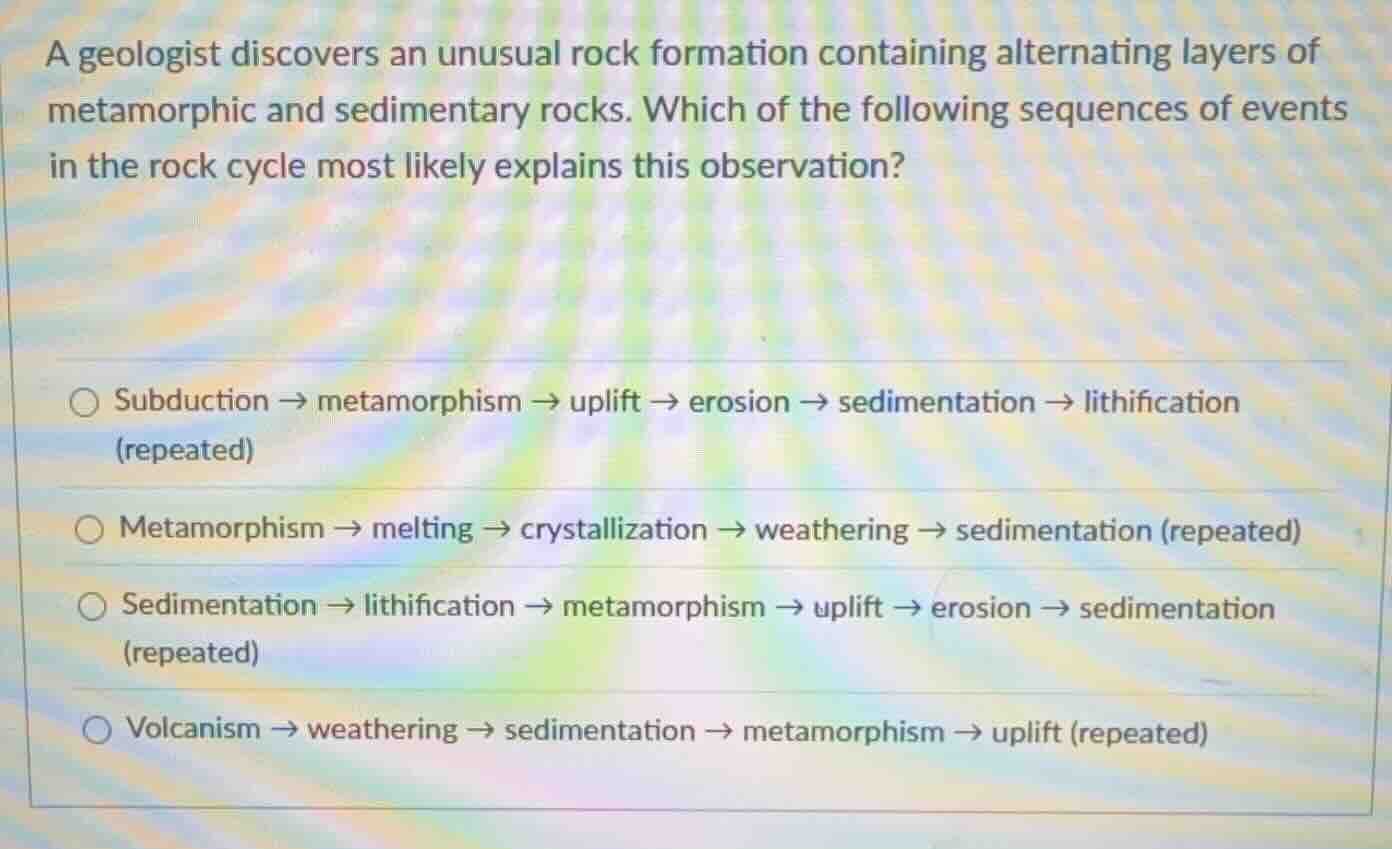
a geologist discovers an unusual rock formation containing alternating layers of metamorphic and sedimentary rocks. which of the following sequences of events in the rock cycle most likely explains this observation?
- subduction → metamorphism → uplift → erosion → sedimentation → lithification (repeated)
- metamorphism → melting → crystallization → weathering → sedimentation (repeated)
- sedimentation → lithification → metamorphism → uplift → erosion → sedimentation (repeated)
- volcanism → weathering → sedimentation → metamorphism → uplift (repeated)
To form alternating metamorphic and sedimentary layers, we need a cycle that first creates sedimentary rock, then transforms it to metamorphic, then returns to conditions that form new sedimentary rock, repeated.
- First, sedimentation (depositing sediment) and lithification turn that sediment into sedimentary rock.
- Then, metamorphism alters that sedimentary rock into metamorphic rock (via heat/pressure, e.g., from burial or subduction).
- Uplift brings the metamorphic rock to the surface, where erosion breaks it down into sediment.
- New sedimentation of that eroded material starts the cycle again, creating a new sedimentary layer on top of the metamorphic rock. Repeating this creates alternating layers.
Other options fail: The first skips initial sedimentary rock formation, the second includes melting (creating igneous rock, not alternating metamorphic/sedimentary), the fourth starts with volcanism (igneous rock, not the required sequence).

Snap & solve any problem in the app
Get step-by-step solutions on Sovi AI
Photo-based solutions with guided steps
Explore more problems and detailed explanations
C. Sedimentation → lithification → metamorphism → uplift → erosion → sedimentation (repeated)