QUESTION IMAGE
Question
geometry
complete numbers 3-6, 23-29, 31, 32
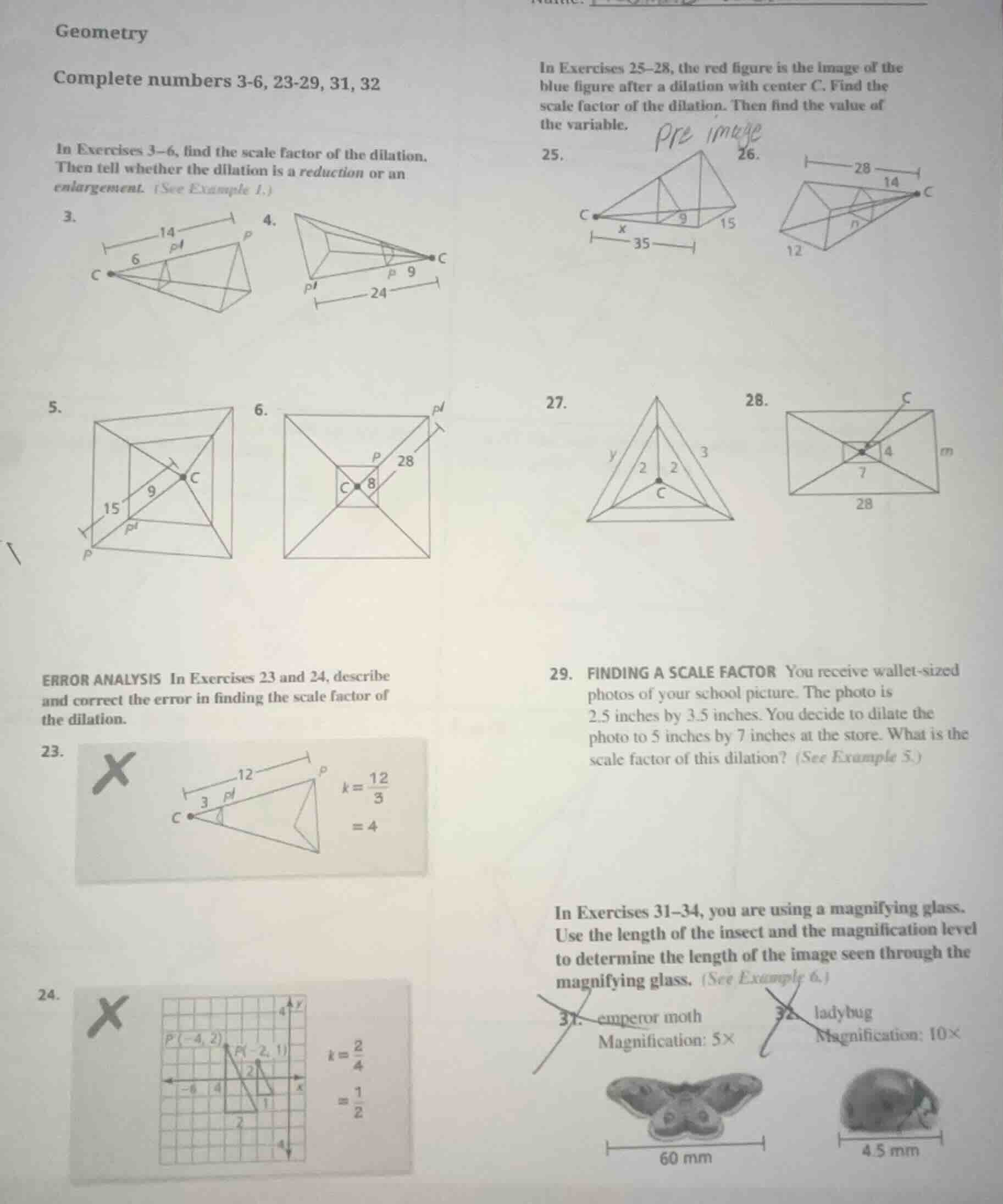
in exercises 3–6, find the scale factor of the dilation. then tell whether the dilation is a reduction or an enlargement. (see example 1.)
3.
4.
5.
6.
error analysis in exercises 23 and 24, describe and correct the error in finding the scale factor of the dilation.
23.
24.
in exercises 25–28, the red figure is the image of the blue figure after a dilation with center c. find the scale factor of the dilation. then find the value of the variable.
25.
26.
27.
28.
- finding a scale factor you receive wallet - sized photos of your school picture. the photo is 2.5 inches by 3.5 inches. you decide to dilate the photo to 5 inches by 7 inches at the store. what is the scale factor of this dilation? (see example 5.)
in exercises 31–34, you are using a magnifying glass. use the length of the insect and the magnification level to determine the length of the image seen through the magnifying glass. (see example 6.)
- emperor moth
magnification: 5×
- ladybug
magnification: 10×
Step1: Find scale factor (Q3)
Scale factor $k = \frac{\text{image length}}{\text{pre-image length}} = \frac{14}{6} = \frac{7}{3}$
Step2: Classify dilation (Q3)
Since $k>1$, it is an enlargement.
Step3: Find scale factor (Q4)
$k = \frac{9}{24} = \frac{3}{8}$
Step4: Classify dilation (Q4)
Since $k<1$, it is a reduction.
Step5: Find scale factor (Q5)
$k = \frac{15}{9} = \frac{5}{3}$
Step6: Classify dilation (Q5)
Since $k>1$, it is an enlargement.
Step7: Find scale factor (Q6)
$k = \frac{28}{8} = \frac{7}{2}$
Step8: Classify dilation (Q6)
Since $k>1$, it is an enlargement.
Step9: Correct scale factor (Q23)
Scale factor is $\frac{\text{image}}{\text{pre-image}} = \frac{3}{12} = \frac{1}{4}$; original used $\frac{\text{pre-image}}{\text{image}}$.
Step10: Correct scale factor (Q24)
Scale factor is $\frac{\text{image}}{\text{pre-image}} = \frac{4}{2} = 2$; original used $\frac{\text{pre-image x}}{\text{image x}}$.
Step11: Find scale factor (Q25)
$k = \frac{15}{9} = \frac{5}{3}$
Step12: Solve for x (Q25)
$x = 35 \times \frac{3}{5} = 21$
Step13: Find scale factor (Q26)
$k = \frac{14}{28} = \frac{1}{2}$
Step14: Solve for n (Q26)
$n = 12 \times \frac{1}{2} = 6$
Step15: Find scale factor (Q27)
$k = \frac{3}{2}$
Step16: Solve for y (Q27)
$y = 2 \times \frac{3}{2} = 3$
Step17: Find scale factor (Q28)
$k = \frac{7}{4}$
Step18: Solve for m (Q28)
$m = 28 \times \frac{4}{7} = 16$
Step19: Find photo scale factor (Q29)
$k = \frac{5}{2.5} = 2$ (or $\frac{7}{3.5}=2$)
Step20: Find moth image length (Q31)
$\text{Length} = 60 \times 5 = 300$ mm
Step21: Find ladybug image length (Q32)
$\text{Length} = 4.5 \times 10 = 45$ mm

Snap & solve any problem in the app
Get step-by-step solutions on Sovi AI
Photo-based solutions with guided steps
Explore more problems and detailed explanations
- Scale factor: $\frac{7}{3}$, Enlargement
- Scale factor: $\frac{3}{8}$, Reduction
- Scale factor: $\frac{5}{3}$, Enlargement
- Scale factor: $\frac{7}{2}$, Enlargement
- Error: Used pre-image/image instead of image/pre-image. Correct scale factor: $\frac{1}{4}$
- Error: Used pre-image x-coordinate ratio instead of image/pre-image. Correct scale factor: $2$
- Scale factor: $\frac{5}{3}$, $x=21$
- Scale factor: $\frac{1}{2}$, $n=6$
- Scale factor: $\frac{3}{2}$, $y=3$
- Scale factor: $\frac{7}{4}$, $m=16$
- Scale factor: $2$
- $300$ mm
- $45$ mm