QUESTION IMAGE
Question
geometry mp2 day 1 point value board
you may complete as many problems as needed to reach your goal! your goal is to earn 10 points.
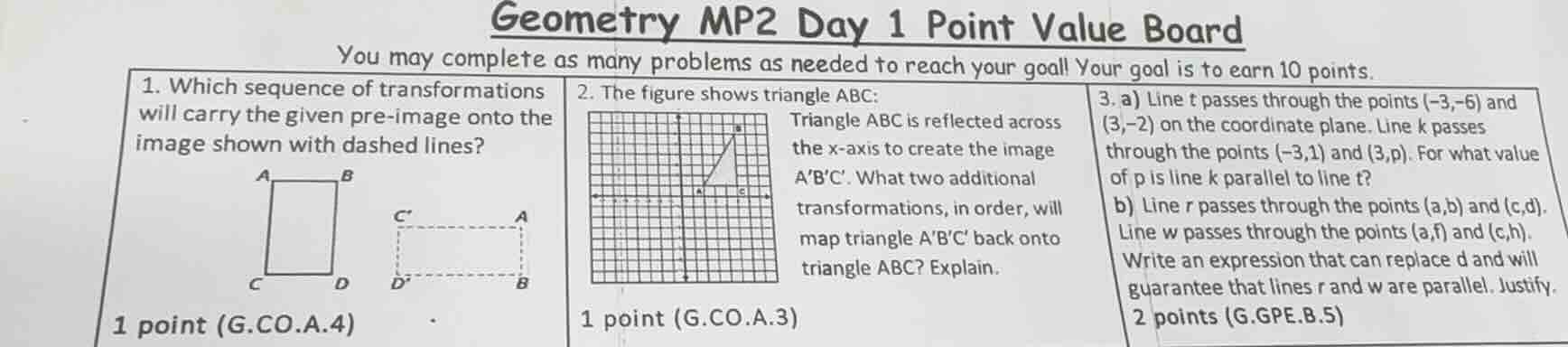
- which sequence of transformations will carry the given pre - image onto the image shown with dashed lines?
image of a rectangle abcd and its dashed - line image with vertices c, a, d, b
1 point (g.co.a.4)
- the figure shows triangle abc:
image of a coordinate grid with triangle abc
triangle abc is reflected across the x - axis to create the image abc. what two additional transformations, in order, will map triangle abc back onto triangle abc? explain.
1 point (g.co.a.3)
- a) line t passes through the points (-3,-6) and (3,-2) on the coordinate plane. line k passes through the points (-3,1) and (3,p). for what value of p is line k parallel to line t?
b) line r passes through the points (a,b) and (c,d). line w passes through the points (a,f) and (c,h). write an expression that can replace d and will guarantee that lines r and w are parallel. justify.
2 points (g.gpe.b.5)
Since the problem is about geometry (specifically coordinate geometry and transformations), we'll analyze each part. Let's start with part 3a:
3a) Step-by-Step Solution:
To determine when lines \( t \) and \( k \) are parallel, their slopes must be equal. The slope formula is \( m = \frac{y_2 - y_1}{x_2 - x_1} \).
Step 1: Calculate the slope of line \( t \)
Line \( t \) passes through \( (-3, -5) \) and \( (3, -2) \). Using the slope formula:
\( m_t = \frac{-2 - (-5)}{3 - (-3)} = \frac{-2 + 5}{3 + 3} = \frac{3}{6} = \frac{1}{2} \)
Step 2: Calculate the slope of line \( k \)
Line \( k \) passes through \( (-3, 1) \) and \( (3, p) \). Using the slope formula:
\( m_k = \frac{p - 1}{3 - (-3)} = \frac{p - 1}{6} \)
Step 3: Set slopes equal (since parallel lines have equal slopes)
\( \frac{p - 1}{6} = \frac{1}{2} \)
Step 4: Solve for \( p \)
Multiply both sides by 6: \( p - 1 = 3 \)
Add 1 to both sides: \( p = 4 \)
3b) Step-by-Step Solution:
For lines \( r \) and \( w \) to be parallel, their slopes must be equal. The slope formula is \( m = \frac{y_2 - y_1}{x_2 - x_1} \).
Step 1: Calculate the slope of line \( r \)
Line \( r \) passes through \( (a, b) \) and \( (c, d) \). Slope:
\( m_r = \frac{d - b}{c - a} \)
Step 2: Calculate the slope of line \( w \)
Line \( w \) passes through \( (a, f) \) and \( (c, h) \). Slope:
\( m_w = \frac{h - f}{c - a} \)
Step 3: Set slopes equal (for parallel lines)
\( \frac{d - b}{c - a} = \frac{h - f}{c - a} \)
Since \( c
eq a \) (otherwise the lines would be vertical, but we can assume \( c
eq a \) for non-vertical lines), we can multiply both sides by \( c - a \):
\( d - b = h - f \)
We need to find \( d \) in terms of \( b, f, h \). Rearranging:
\( d = b + (h - f) \) or \( d = h - f + b \) (this ensures the slopes are equal, so lines are parallel).
1) Sequence of Transformations:
Looking at the pre-image (rectangle \( ABCD \)) and image (rectangle \( A C' D' B \)):
- First, observe the rotation: The pre-image is rotated 90 degrees clockwise (or 270 degrees counterclockwise) so that the orientation changes.
- Then, a translation (or maybe a reflection, but from the diagram, after rotation, a translation to align the sides). Alternatively, a rotation and then a reflection, but more likely: Rotation 90 degrees clockwise (or counterclockwise) and then a translation. Wait, the pre-image \( ABCD \) (vertical rectangle) and image \( A C' D' B \) (horizontal rectangle). So first, rotate 90 degrees clockwise (so \( A \) moves to the right, \( C \) moves up, etc.), then translate to align the vertices. Or, a reflection over a vertical or horizontal line, but the key is identifying the transformations (rotation and translation, or rotation and reflection). The standard transformation here: Rotation 90 degrees clockwise (or 270 counterclockwise) and then a translation, or a reflection and rotation. But for G.CO.A.4, the sequence is likely a rotation (90 degrees) and then a translation, or a reflection and rotation. Let's check coordinates: Pre-image \( A \) is top, \( B \) is top-right, \( C \) is bottom-left, \( D \) is bottom-right. Image \( A \) is right, \( C' \) is top-left, \( D' \) is bottom-left, \( B \) is bottom-right. So rotating 90 degrees clockwise around the center, then translating. Alternatively, a reflection over a horizontal line and then a rotation, but the main idea is identifying the transformations (e.g., rotation 90 degrees clockwise and then translation, or reflection and rotation).
2) Transformations to Map \( A'B'C' \) back to \( ABC \):
Triangle \( ABC \) is reflected over the \( x \)-axis to get \( A'B'C' \). To map \( A'B'C' \) back to \( ABC \), we need the inverse transformation of the reflection, which is another reflection over the \( x \)-axis (since reflecting twice over the same axis brings it back). Wait, no: Reflecting over \( x \)-axis changes \( (x, y) \) to \( (x, -y) \). So to reverse it, reflect over \( x \)-axis again (since \( (x, -y) \) reflected over \( x \)-axis is \( (x, y) \)). Alternatively, a translation, but reflection over \( x \)-axis is its own inverse. Wait, the problem says "two additional transformations". Wait, maybe I misread: Triangle \( ABC \) is reflected over \( x \)-axis to get \( A'B'C' \). To map \( A'B'C' \) back to \( ABC \), we can reflect over \( x \)-axis again (1st transformation) and then... Wait, no, maybe a rotation? Wait, the diagram: Triangle \( ABC \) is above the \( x \)-axis, \( A'B'C' \) is below (after reflection over \( x \)-axis). So to…

Snap & solve any problem in the app
Get step-by-step solutions on Sovi AI
Photo-based solutions with guided steps
Explore more problems and detailed explanations
\( p = 4 \)
3b)
The expression for \( d \) is \( d = b + (h - f) \) (or \( d = h - f + b \)) because the slopes of lines \( r \) and \( w \) must be equal for them to be parallel. The slope of \( r \) is \( \frac{d - b}{c - a} \) and the slope of \( w \) is \( \frac{h - f}{c - a} \). Setting them equal gives \( d - b = h - f \), so \( d = b + h - f \).