QUESTION IMAGE
Question
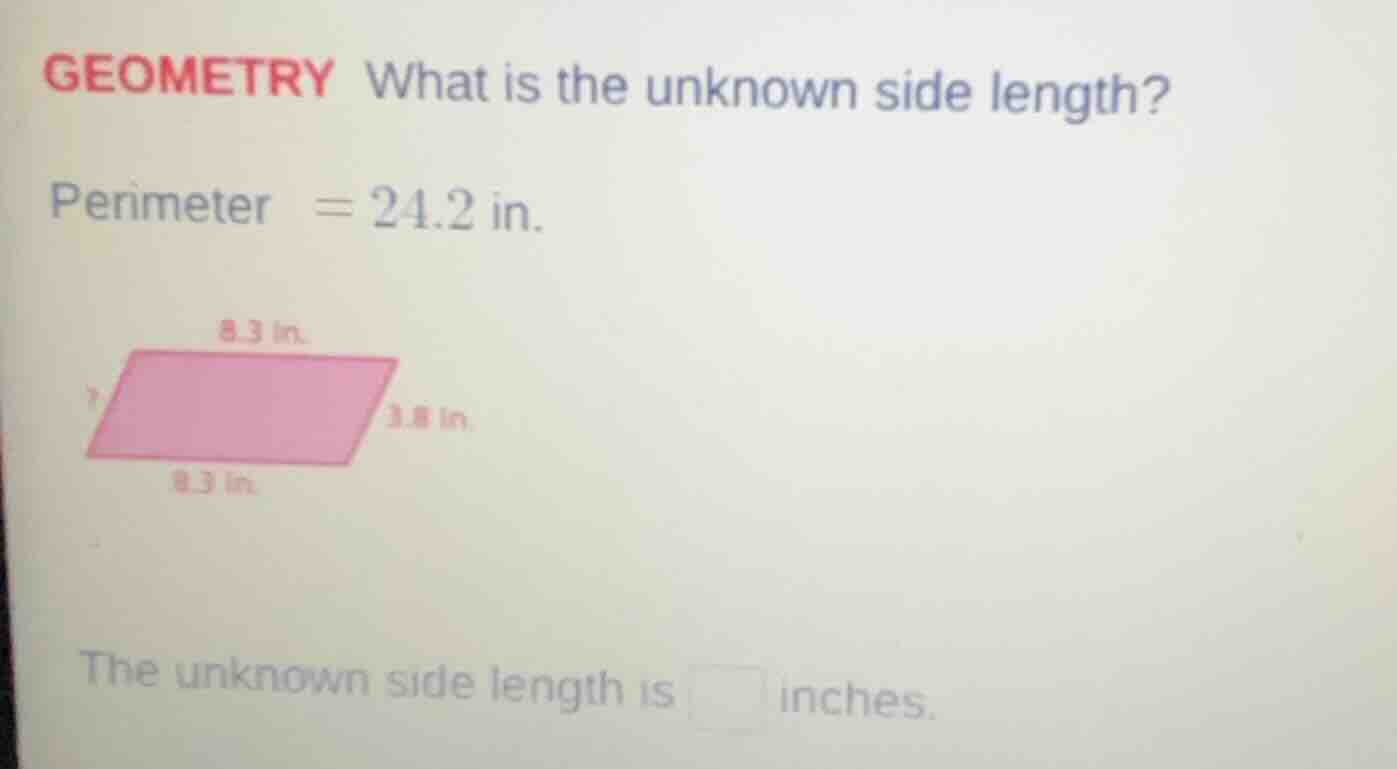
geometry what is the unknown side length? perimeter = 24.2 in. image of a parallelogram with sides 8.3 in, 3.8 in, 8.3 in, and y (unknown) the unknown side length is blank inches.
Step1: Recall perimeter formula for parallelogram
A parallelogram has opposite sides equal. So perimeter \( P = 2(a + b) \), where \( a \) and \( b \) are adjacent sides. Here, known sides are \( 8.3 \) in and \( 3.8 \) in? Wait, no, looking at the diagram, two sides are \( 8.3 \) in (opposite), and two sides are \( y \) (opposite) and \( 3.8 \) in? Wait, no, maybe I misread. Wait, the parallelogram has two sides of \( 8.3 \) in and two sides of \( y \) (and one labeled \( 3.8 \)? Wait, no, maybe the diagram: top and bottom are \( 8.3 \) in, and the other two sides (left and right) are \( y \) and \( 3.8 \)? Wait, no, that can't be. Wait, no, in a parallelogram, opposite sides are equal. So if top is \( 8.3 \), bottom is \( 8.3 \). Then the other two sides (left and right) should be equal. Wait, maybe the diagram has left side \( y \), right side \( 3.8 \)? But that would mean \( y = 3.8 \), but perimeter is \( 24.2 \). Wait, let's recalculate. Perimeter of parallelogram: sum of all sides. So \( P = 8.3 + y + 8.3 + 3.8 \)? No, that can't be, because opposite sides should be equal. Wait, maybe the diagram is a parallelogram with two sides \( 8.3 \) and two sides \( 3.8 \)? But then perimeter would be \( 2(8.3 + 3.8) = 2(12.1) = 24.2 \). Wait, that's exactly the perimeter given (24.2 in). Wait, but then the unknown side \( y \) would be \( 3.8 \)? But that seems odd. Wait, no, maybe I misread the diagram. Wait, the problem says "unknown side length" \( y \). Let's check the perimeter formula again. Perimeter is sum of all sides: \( 8.3 + y + 8.3 + 3.8 = 24.2 \)? Wait, no, that would be if the sides are 8.3, y, 8.3, 3.8. But in a parallelogram, opposite sides are equal, so if top is 8.3, bottom is 8.3; left is y, right is 3.8, so y should equal 3.8. But then perimeter would be \( 8.3 + 3.8 + 8.3 + 3.8 = (8.3 + 3.8) \times 2 = 12.1 \times 2 = 24.2 \), which matches the given perimeter. Wait, so then the unknown side \( y \) is 3.8? But that seems like the known side. Wait, maybe the diagram has a typo, or I misread. Wait, the problem says "unknown side length" \( y \). Let's do the math. Perimeter \( P = 8.3 + y + 8.3 + 3.8 = 24.2 \). Wait, no, that would be if the sides are 8.3, y, 8.3, 3.8. But in a parallelogram, opposite sides are equal, so 8.3 should equal 8.3 (correct), and y should equal 3.8. But then \( 8.3 + 3.8 + 8.3 + 3.8 = 8.3 \times 2 + 3.8 \times 2 = 16.6 + 7.6 = 24.2 \), which matches the perimeter. So then \( y = 3.8 \)? But that seems like the known side. Wait, maybe the diagram labels the right side as 3.8, and left side as y, so y = 3.8. But that would mean the unknown side is 3.8. But let's check the calculation. Let's set up the equation: \( 8.3 + y + 8.3 + 3.8 = 24.2 \). Wait, no, that's not correct. Wait, no, in a parallelogram, opposite sides are equal, so two sides are length \( a \), two sides are length \( b \). So perimeter \( P = 2a + 2b \). So if \( a = 8.3 \), then \( 2a = 16.6 \). Then \( 2b = P - 2a = 24.2 - 16.6 = 7.6 \). Then \( b = 7.6 / 2 = 3.8 \). So the unknown side \( y \) is 3.8 inches. Wait, that makes sense. So the steps:
Step1: Calculate sum of known equal sides
Two sides are 8.3 in, so their total is \( 8.3 \times 2 = 16.6 \) in.
Step2: Subtract from perimeter to find sum of other two sides
Perimeter is 24.2 in, so sum of the other two sides is \( 24.2 - 16.6 = 7.6 \) in.
Step3: Divide by 2 to find unknown side (since they are equal)
Since the other two sides are equal (opposite sides of parallelogram), each is \( 7.6 \div 2 = 3.8 \) in.

Snap & solve any problem in the app
Get step-by-step solutions on Sovi AI
Photo-based solutions with guided steps
Explore more problems and detailed explanations
\( 3.8 \)