QUESTION IMAGE
Question
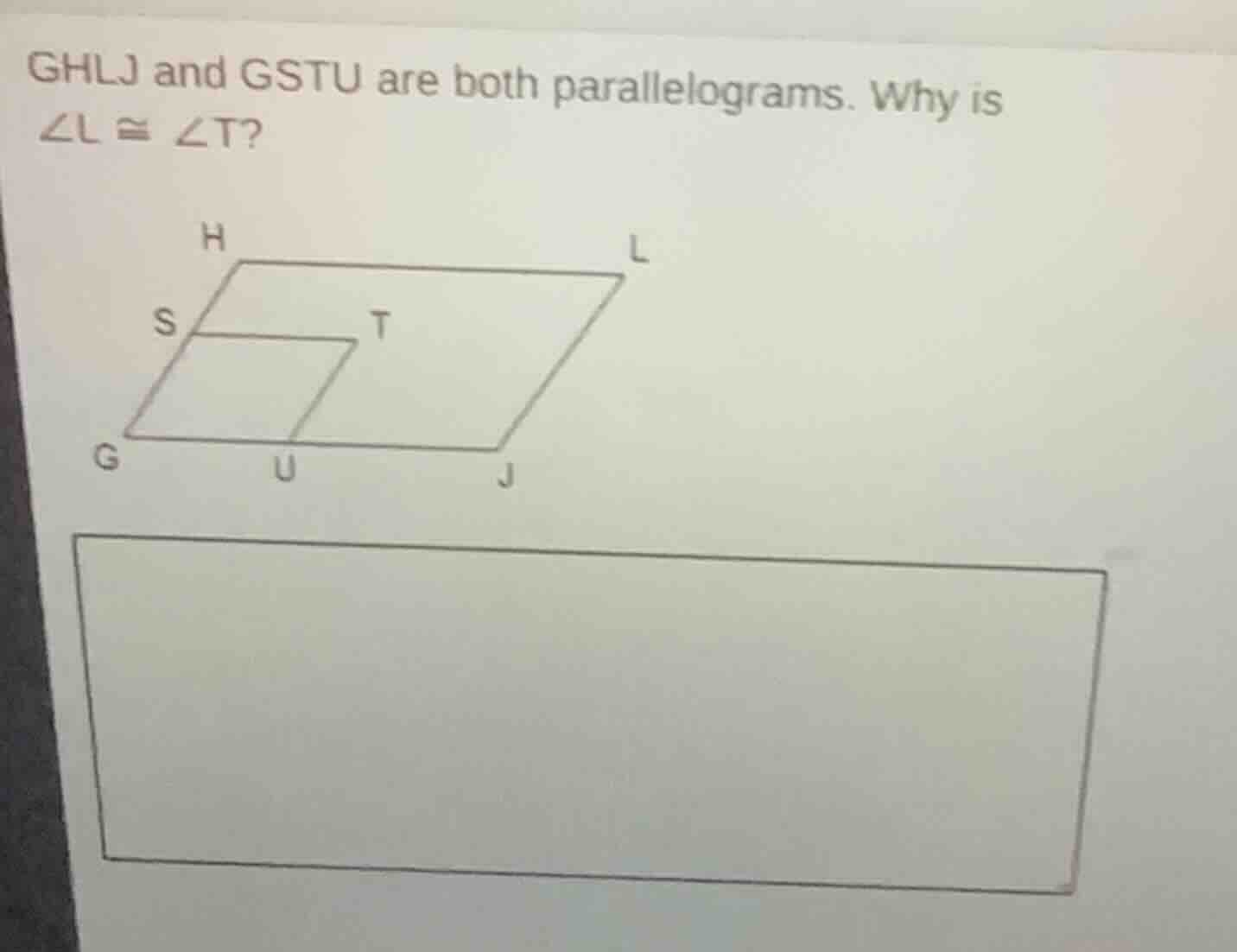
ghlj and gstu are both parallelograms. why is \\(\angle l \cong \angle t\\)?
Step1: Recall parallelogram angle property
In a parallelogram, opposite angles are congruent, and also, corresponding angles of similar - shaped (or same - type) parallelograms can be related. For a parallelogram, the opposite angles are equal, and also, if two parallelograms have their sides parallel in the same way, the angles will be equal.
For parallelogram \(GHLJ\), \(\angle L\) and \(\angle G\) are related, but more importantly, in a parallelogram, opposite angles are equal, and also, the angle \(\angle L\) is equal to the angle \(\angle G\) (alternate - interior or corresponding? Wait, no, in parallelogram \(GHLJ\), \(HL\parallel GJ\) and \(GH\parallel LJ\). So \(\angle L\) and \(\angle G\) are equal? Wait, no, in a parallelogram, consecutive angles are supplementary and opposite angles are equal. So in \(GHLJ\), \(\angle L=\angle G\) (opposite angles? Wait, no, vertices are \(G\), \(H\), \(L\), \(J\) in order. So \(GH\parallel LJ\) and \(HL\parallel GJ\). So \(\angle G\) and \(\angle L\): \(\angle G\) is at \(G\), between \(GJ\) and \(GH\); \(\angle L\) is at \(L\), between \(HL\) and \(LJ\). Since \(HL\parallel GJ\) and \(GH\parallel LJ\), \(\angle L\) and \(\angle G\) are equal (corresponding angles or alternate - interior angles).
For parallelogram \(GSTU\), \(\angle T\) and \(\angle G\) are equal (opposite angles of a parallelogram? Wait, \(GSTU\) has vertices \(G\), \(S\), \(T\), \(U\) in order. So \(GS\parallel TU\) and \(ST\parallel GU\). So \(\angle T\) and \(\angle G\) are opposite angles? Wait, no, in parallelogram \(GSTU\), opposite angles: \(\angle G\) and \(\angle T\), \(\angle S\) and \(\angle U\). So in parallelogram \(GSTU\), \(\angle T=\angle G\) (opposite angles of a parallelogram are congruent).
Step2: Transitive property of congruence
Since \(\angle L = \angle G\) (from parallelogram \(GHLJ\), because in a parallelogram, opposite angles are equal? Wait, actually, in parallelogram \(GHLJ\), \(HL\parallel GJ\) and \(GH\parallel LJ\), so \(\angle L\) and \(\angle G\) are equal (corresponding angles as \(HL\parallel GJ\) and \(GH\) is a transversal? Wait, no, \(GH\parallel LJ\), so \(\angle G+\angle J = 180^{\circ}\), \(\angle L+\angle J=180^{\circ}\), so \(\angle L=\angle G\) (supplementary to the same angle). Similarly, in parallelogram \(GSTU\), \(\angle T\) and \(\angle G\) are equal (because in \(GSTU\), \(ST\parallel GU\) and \(GS\parallel TU\), so \(\angle T\) and \(\angle G\) are equal, either as opposite angles or as angles supplementary to the same angle).
Since \(\angle L=\angle G\) and \(\angle T = \angle G\), by the transitive property of congruence (\(a = b\) and \(c = b\) implies \(a=c\)), we have \(\angle L\cong\angle T\).
Another way: In a parallelogram, opposite angles are congruent. Also, if two parallelograms are such that their sides are parallel in the same direction (i.e., the parallelograms are "similar" in orientation), the corresponding angles are equal. Since both \(GHLJ\) and \(GSTU\) are parallelograms, \(\angle L\) (in \(GHLJ\)) and \(\angle T\) (in \(GSTU\)) are equal because they are both equal to \(\angle G\) (the angle at vertex \(G\)) and by the transitive property of congruence, \(\angle L\cong\angle T\).

Snap & solve any problem in the app
Get step-by-step solutions on Sovi AI
Photo-based solutions with guided steps
Explore more problems and detailed explanations
\(\angle L\cong\angle T\) because in a parallelogram, opposite angles are congruent. For parallelogram \(GHLJ\), \(\angle L\) is equal to \(\angle G\) (since consecutive angles are supplementary and opposite angles are equal, or by parallel - line angle relationships). For parallelogram \(GSTU\), \(\angle T\) is equal to \(\angle G\) (opposite angles of a parallelogram are congruent). By the transitive property of congruence, if \(\angle L=\angle G\) and \(\angle T = \angle G\), then \(\angle L\cong\angle T\).