QUESTION IMAGE
Question
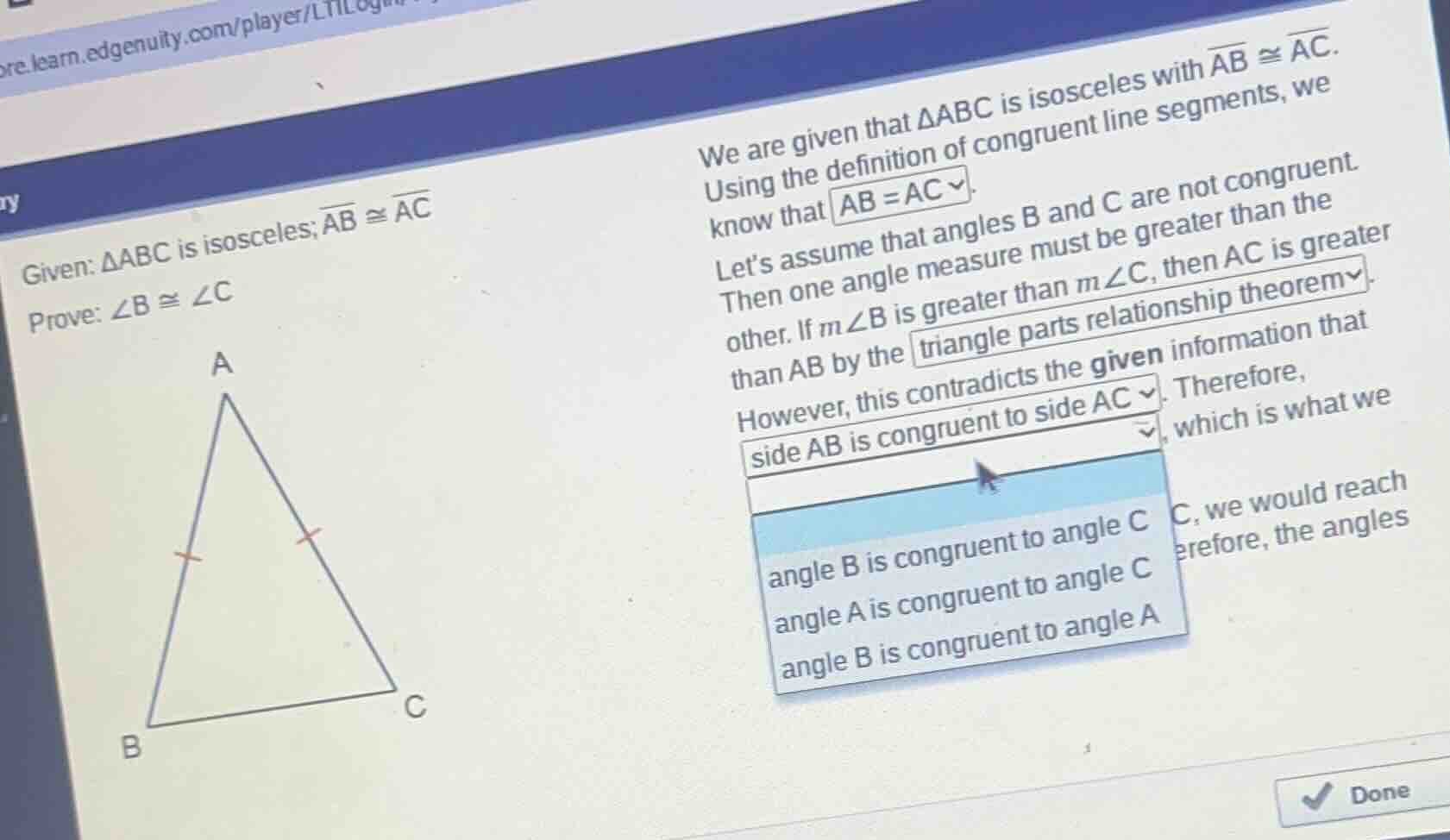
given: δabc is isosceles; \\(\overline{ab} \cong \overline{ac}\\)
prove: \\(\angle b \cong \angle c\\)
we are given that \\(\delta abc\\) is isosceles with \\(\overline{ab} \cong \overline{ac}\\).
using the definition of congruent line segments, we know that \\(ab = ac\\).
let’s assume that angles b and c are not congruent.
then one angle measure must be greater than the other. if \\(m\angle b\\) is greater than \\(m\angle c\\), then ac is greater than ab by the triangle parts relationship theorem.
however, this contradicts the given information that side ab is congruent to side ac. therefore, dropdown options: angle b is congruent to angle c, angle a is congruent to angle c, angle b is congruent to angle a, which is what we...
Step1: Recall the proof context
We are proving that in isosceles triangle \( \triangle ABC \) with \( \overline{AB} \cong \overline{AC} \), \( \angle B \cong \angle C \). We used a proof by contradiction: assumed \( \angle B \) and \( \angle C \) are not congruent, which led to a contradiction with \( \overline{AB} \cong \overline{AC} \). So we must conclude the opposite of our assumption.
Step2: Determine the correct conclusion
The assumption was that \( \angle B \) and \( \angle C \) are not congruent. Since the contradiction shows the assumption is false, we conclude \( \angle B \cong \angle C \).

Snap & solve any problem in the app
Get step-by-step solutions on Sovi AI
Photo-based solutions with guided steps
Explore more problems and detailed explanations
angle B is congruent to angle C