QUESTION IMAGE
Question
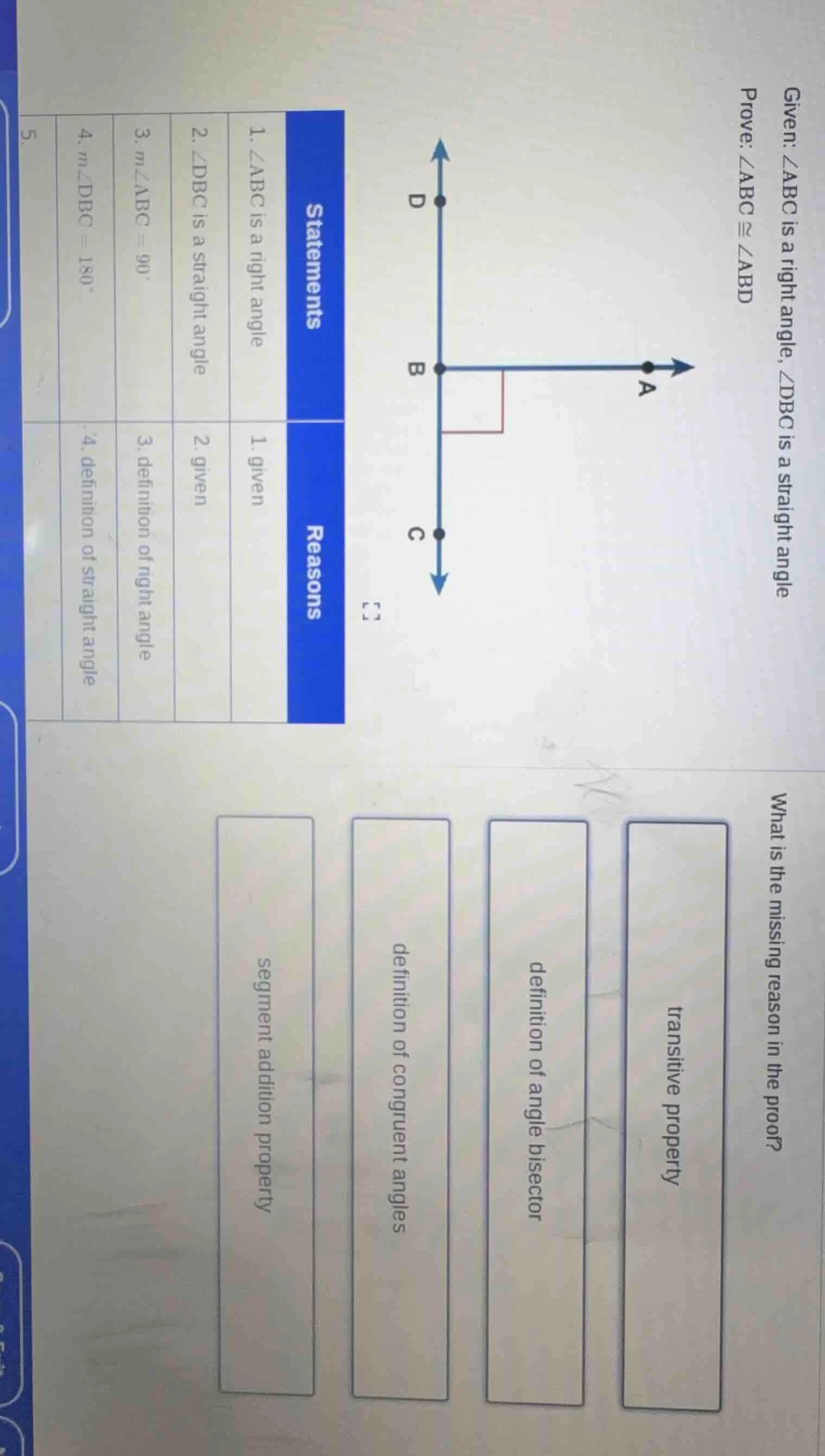
given: ∠abc is a right angle, ∠dbc is a straight angle
prove: ∠abc ≅ ∠abd
what is the missing reason in the proof?
image of a diagram with points d, b, c on a vertical line and a on a horizontal line from b, with a right angle at b between ba and bc
statements | reasons
- ∠abc is a right angle | 1. given
- ∠dbc is a straight angle | 2. given
- m∠abc = 90° | 3. definition of right angle
- m∠dbc = 180° | 4. definition of straight angle
- blank | blank
options for missing reason: transitive property, definition of angle bisector, definition of congruent angles, segment addition property
Brief Explanations
To prove \( \angle ABC \cong \angle ABD \), we know:
- \( \angle ABC \) is a right angle (given), so \( m\angle ABC = 90^\circ \) (definition of right angle).
- \( \angle DBC \) is a straight angle (given), so \( m\angle DBC = 180^\circ \) (definition of straight angle).
- \( \angle ABD \) and \( \angle ABC \) are related such that \( m\angle ABD = 90^\circ \) (since \( \angle DBC = 180^\circ \) and \( \angle ABC = 90^\circ \), \( \angle ABD = 180^\circ - 90^\circ = 90^\circ \)).
- Congruent angles are defined as angles with equal measures. Since \( m\angle ABC = 90^\circ \) and \( m\angle ABD = 90^\circ \), by the definition of congruent angles, \( \angle ABC \cong \angle ABD \). The missing reason is the "definition of congruent angles" because we use the fact that equal - measure angles are congruent.

Snap & solve any problem in the app
Get step-by-step solutions on Sovi AI
Photo-based solutions with guided steps
Explore more problems and detailed explanations
definition of congruent angles