QUESTION IMAGE
Question
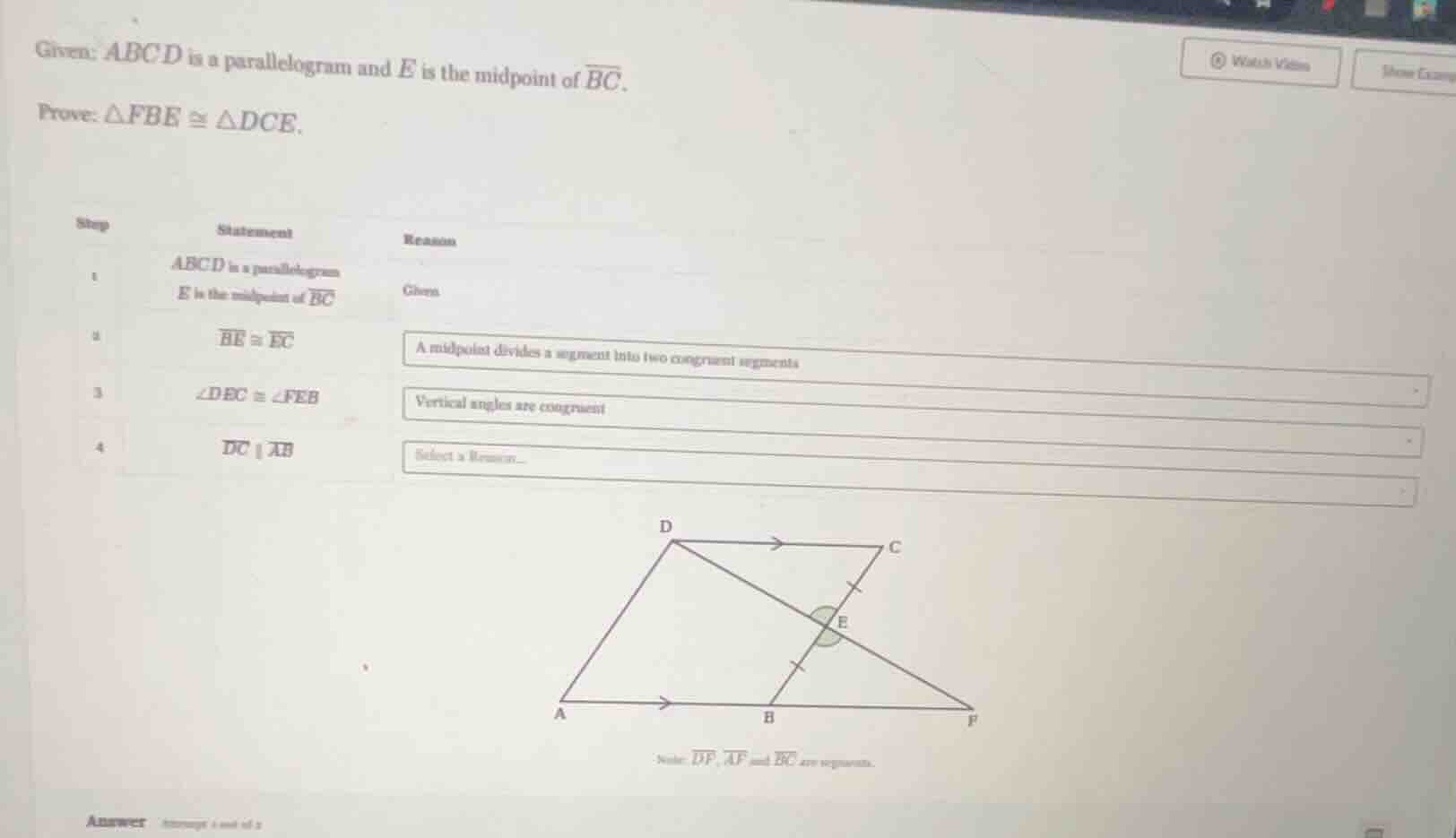
given: abcd is a parallelogram and e is the midpoint of \\(\overline{bc}\\).
prove: \\(\triangle fbe \cong \triangle dce\\).
step | statement | reason
1 | abcd is a parallelogram; e is the midpoint of \\(\overline{bc}\\) | given
2 | \\(\overline{be} \cong \overline{ec}\\) | a midpoint divides a segment into two congruent segments
3 | \\(\angle dec \cong \angle feb\\) | vertical angles are congruent
4 | \\(dc \parallel ab\\) | select a reason...
(image of parallelogram abcd with points a, b, f on the bottom side (a---b---f), d and c on the top side (d---c), e is the midpoint of bc, and df, af, bc are segments.)
Step1: Recall parallelogram property
In a parallelogram, opposite sides are parallel. For parallelogram \(ABCD\), \(AB\) and \(DC\) are opposite sides. So, by the definition of a parallelogram (a quadrilateral with both pairs of opposite sides parallel), we have \(DC \parallel AB\).

Snap & solve any problem in the app
Get step-by-step solutions on Sovi AI
Photo-based solutions with guided steps
Explore more problems and detailed explanations
The reason for \(DC \parallel AB\) is "Opposite sides of a parallelogram are parallel".