QUESTION IMAGE
Question
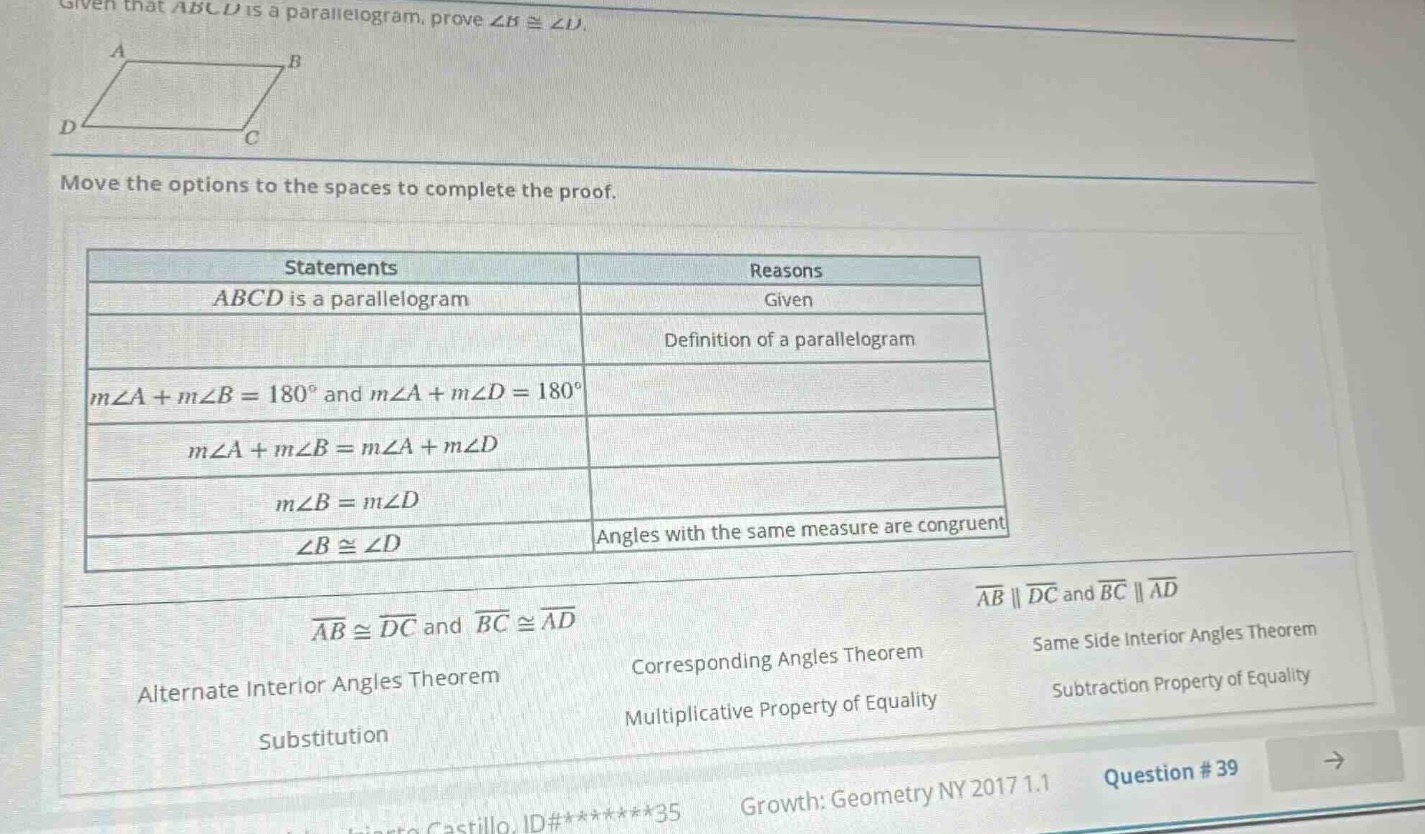
given that abcd is a parallelogram, prove $\angle b \cong \angle d$.
move the options to the spaces to complete the proof.
| statements | reasons |
|---|---|
| definition of a parallelogram | |
| $m\angle a + m\angle b = 180^\circ$ and $m\angle a + m\angle d = 180^\circ$ | |
| $m\angle a + m\angle b = m\angle a + m\angle d$ | |
| $m\angle b = m\angle d$ | |
| $\angle b \cong \angle d$ | angles with the same measure are congruent |
options:
$\overline{ab} \cong \overline{dc}$ and $\overline{bc} \cong \overline{ad}$
$\overline{ab} \parallel \overline{dc}$ and $\overline{bc} \parallel \overline{ad}$
alternate interior angles theorem
corresponding angles theorem
same side interior angles theorem
substitution
multiplicative property of equality
subtraction property of equality
Step1: Fill first missing statement
By definition of a parallelogram, opposite sides are parallel. So the statement is $\overline{AB} \parallel \overline{DC}$ and $\overline{BC} \parallel \overline{AD}$.
Step2: Fill reason for angle sum
Same-side interior angles are supplementary for parallel lines.
Reason: Same Side Interior Angles Theorem
Step3: Fill reason for equating sums
Set the two equal angle sums equal via substitution.
Reason: Substitution
Step4: Fill reason for angle equality
Subtract $m\angle A$ from both sides using subtraction property.
Reason: Subtraction Property of Equality

Snap & solve any problem in the app
Get step-by-step solutions on Sovi AI
Photo-based solutions with guided steps
Explore more problems and detailed explanations
| Statements | Reasons |
|---|---|
| $\overline{AB} \parallel \overline{DC}$ and $\overline{BC} \parallel \overline{AD}$ | Definition of a parallelogram |
| $m\angle A + m\angle B = 180^\circ$ and $m\angle A + m\angle D = 180^\circ$ | Same Side Interior Angles Theorem |
| $m\angle A + m\angle B = m\angle A + m\angle D$ | Substitution |
| $m\angle B = m\angle D$ | Subtraction Property of Equality |
| $\angle B \cong \angle D$ | Angles with the same measure are congruent |