QUESTION IMAGE
Question
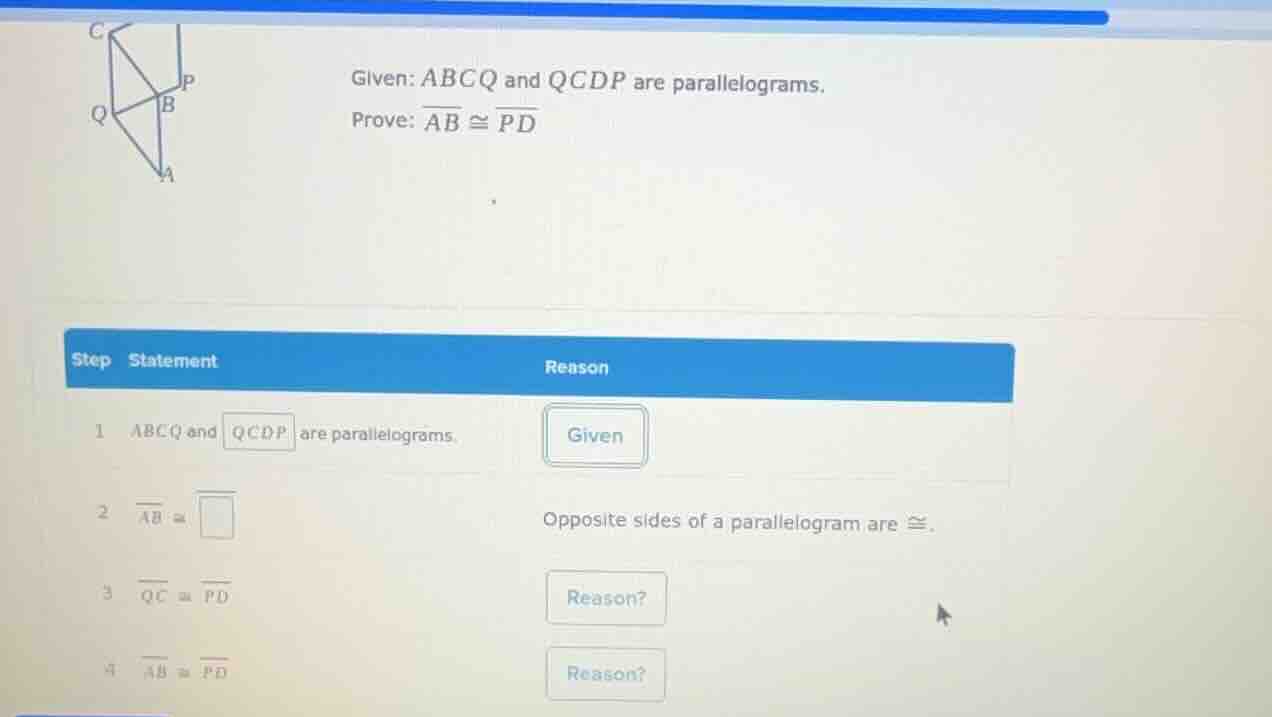
given: abcq and qcdp are parallelograms. prove: \\(overline{ab} \cong \overline{pd}\\) step statement reason 1 abcq and qcdp are parallelograms. given 2 \\(overline{ab} \cong \square\\) opposite sides of a parallelogram are \\(\cong\\). 3 \\(overline{qc} \cong \overline{pd}\\) reason? 4 \\(overline{ab} \cong \overline{pd}\\) reason?
Step2: Identify opposite side of AB in ABCQ
In parallelogram \( ABCQ \), opposite sides are congruent. So, \( \overline{AB} \cong \overline{QC} \) because \( AB \) and \( QC \) are opposite sides of parallelogram \( ABCQ \).
<Expression>$\overline{QC}$</Expression>
Step3: Reason for \( \overline{QC} \cong \overline{PD} \)
Since \( QCDP \) is a parallelogram (from Step 1), by the property of parallelograms (opposite sides of a parallelogram are congruent), \( \overline{QC} \cong \overline{PD} \).
<Reason>Opposite sides of a parallelogram are $\cong$.</Reason>
Step4: Reason for \( \overline{AB} \cong \overline{PD} \)
From Step 2, \( \overline{AB} \cong \overline{QC} \), and from Step 3, \( \overline{QC} \cong \overline{PD} \). By the Transitive Property of Congruence (if \( a \cong b \) and \( b \cong c \), then \( a \cong c \)), we can conclude \( \overline{AB} \cong \overline{PD} \).
<Reason>Transitive Property of Congruence</Reason>

Snap & solve any problem in the app
Get step-by-step solutions on Sovi AI
Photo-based solutions with guided steps
Explore more problems and detailed explanations
Step 2: \(\overline{QC}\)
Step 3: Opposite sides of a parallelogram are \(\cong\).
Step 4: Transitive Property of Congruence