QUESTION IMAGE
Question
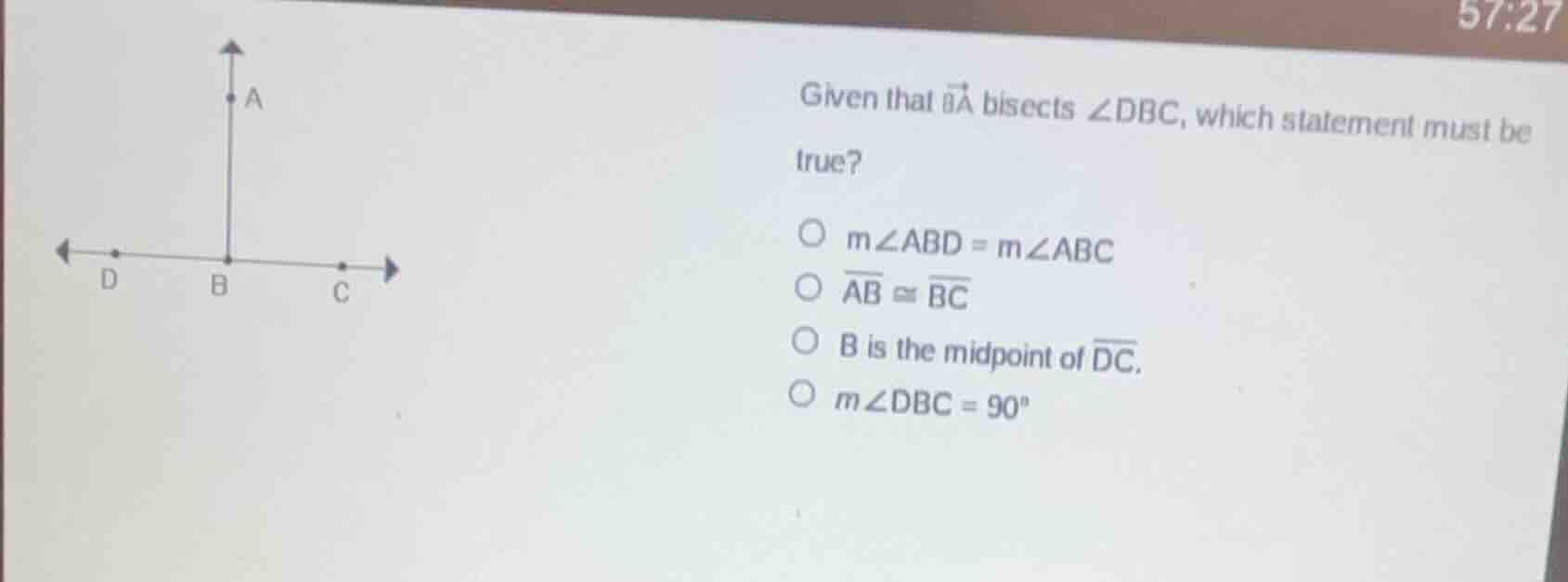
given that \\(\overrightarrow{ba}\\) bisects \\(\angle dbc\\), which statement must be true? \\(\bigcirc\\ m\angle abd = m\angle abc\\) \\(\bigcirc\\ \overline{ab} \cong \overline{bc}\\) \\(\bigcirc\\ b\\) is the midpoint of \\(\overline{dc}\\). \\(\bigcirc\\ m\angle dbc = 90^\circ\\)
An angle bisector divides an angle into two equal - measure angles. Given that \(\overrightarrow{BA}\) bisects \(\angle DBC\), by the definition of an angle bisector, \(\overrightarrow{BA}\) splits \(\angle DBC\) into two angles \(\angle ABD\) and \(\angle ABC\) such that their measures are equal.
- For the option \(\overline{AB}\cong\overline{BC}\): There is no information given to suggest that the lengths of \(AB\) and \(BC\) are equal. The angle - bisector property is about angle measures, not side lengths.
- For the option “\(B\) is the mid - point of \(\overline{DC}\)”: The angle - bisector property has nothing to do with the mid - point of a segment. The mid - point of a segment is defined in terms of equal - length sub - segments, while the angle bisector is defined in terms of equal - measure angles.
- For the option \(m\angle DBC = 90^{\circ}\): Just because \(\overrightarrow{BA}\) bisects \(\angle DBC\), we cannot conclude that \(\angle DBC\) is a right angle. The angle could be of any measure, and the bisector will just split it into two equal parts.

Snap & solve any problem in the app
Get step-by-step solutions on Sovi AI
Photo-based solutions with guided steps
Explore more problems and detailed explanations
\(m\angle ABD = m\angle ABC\)