QUESTION IMAGE
Question
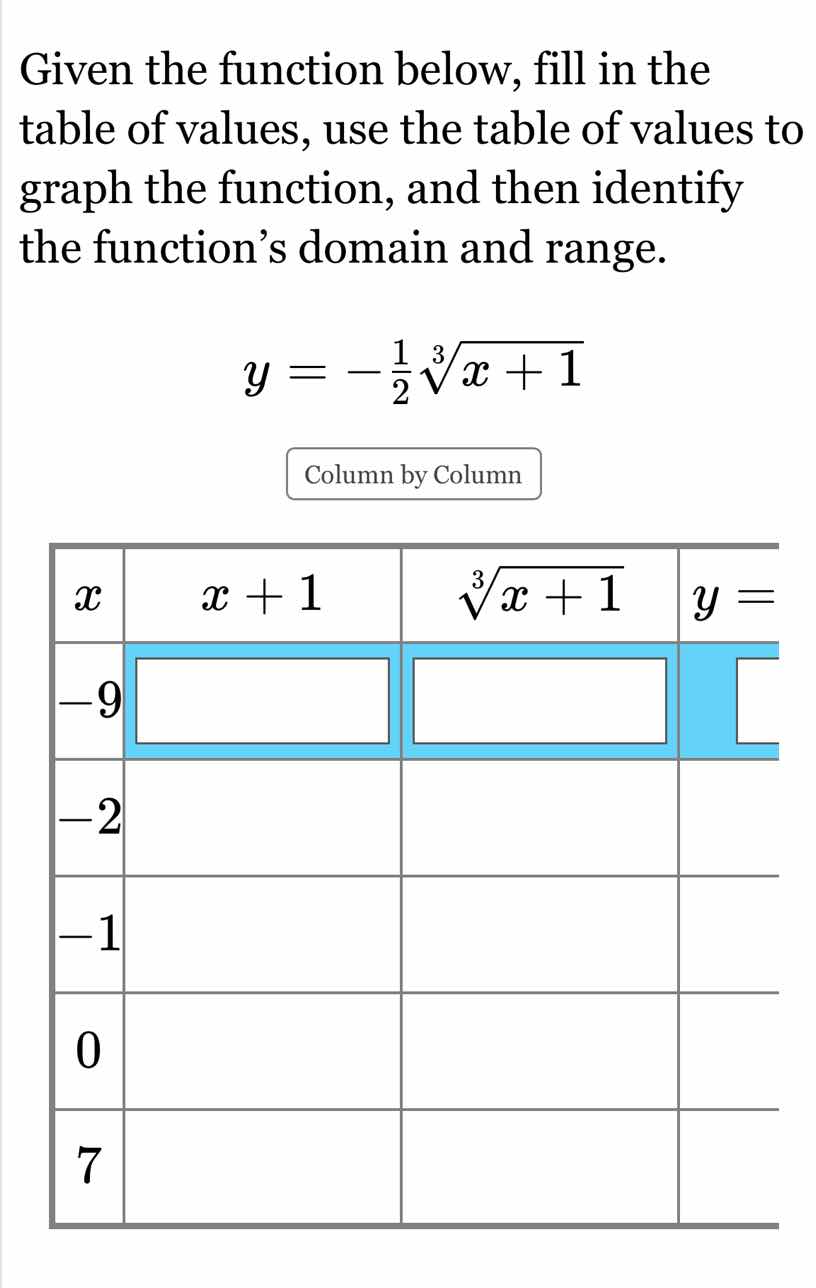
given the function below, fill in the table of values, use the table of values to graph the function, and then identify the function’s domain and range.
$y = -\frac{1}{2}sqrt3{x + 1}$
column by column
| $x$ | $x + 1$ | $sqrt3{x + 1}$ | $y =$ |
|---|---|---|---|
| $-2$ | |||
| $-1$ | |||
| $0$ | |||
| $7$ |
Step1: Calculate $x+1$ for each $x$
For $x=-9$: $-9+1=-8$
For $x=-2$: $-2+1=-1$
For $x=-1$: $-1+1=0$
For $x=0$: $0+1=1$
For $x=7$: $7+1=8$
Step2: Compute $\sqrt[3]{x+1}$
For $x+1=-8$: $\sqrt[3]{-8}=-2$
For $x+1=-1$: $\sqrt[3]{-1}=-1$
For $x+1=0$: $\sqrt[3]{0}=0$
For $x+1=1$: $\sqrt[3]{1}=1$
For $x+1=8$: $\sqrt[3]{8}=2$
Step3: Find $y=-\frac{1}{2}\sqrt[3]{x+1}$
For $\sqrt[3]{x+1}=-2$: $y=-\frac{1}{2}(-2)=1$
For $\sqrt[3]{x+1}=-1$: $y=-\frac{1}{2}(-1)=\frac{1}{2}$
For $\sqrt[3]{x+1}=0$: $y=-\frac{1}{2}(0)=0$
For $\sqrt[3]{x+1}=1$: $y=-\frac{1}{2}(1)=-\frac{1}{2}$
For $\sqrt[3]{x+1}=2$: $y=-\frac{1}{2}(2)=-1$
Step4: Identify domain
Cube roots accept all real numbers, so $x$ can be any real number.
Step5: Identify range
Outputs of cube roots are all real numbers, scaling by $-\frac{1}{2}$ preserves all real numbers as outputs.

Snap & solve any problem in the app
Get step-by-step solutions on Sovi AI
Photo-based solutions with guided steps
Explore more problems and detailed explanations
Completed Table:
| $x$ | $x+1$ | $\sqrt[3]{x+1}$ | $y=-\frac{1}{2}\sqrt[3]{x+1}$ |
|---|---|---|---|
| $-2$ | $-1$ | $-1$ | $\frac{1}{2}$ |
| $-1$ | $0$ | $0$ | $0$ |
| $0$ | $1$ | $1$ | $-\frac{1}{2}$ |
| $7$ | $8$ | $2$ | $-1$ |