QUESTION IMAGE
Question
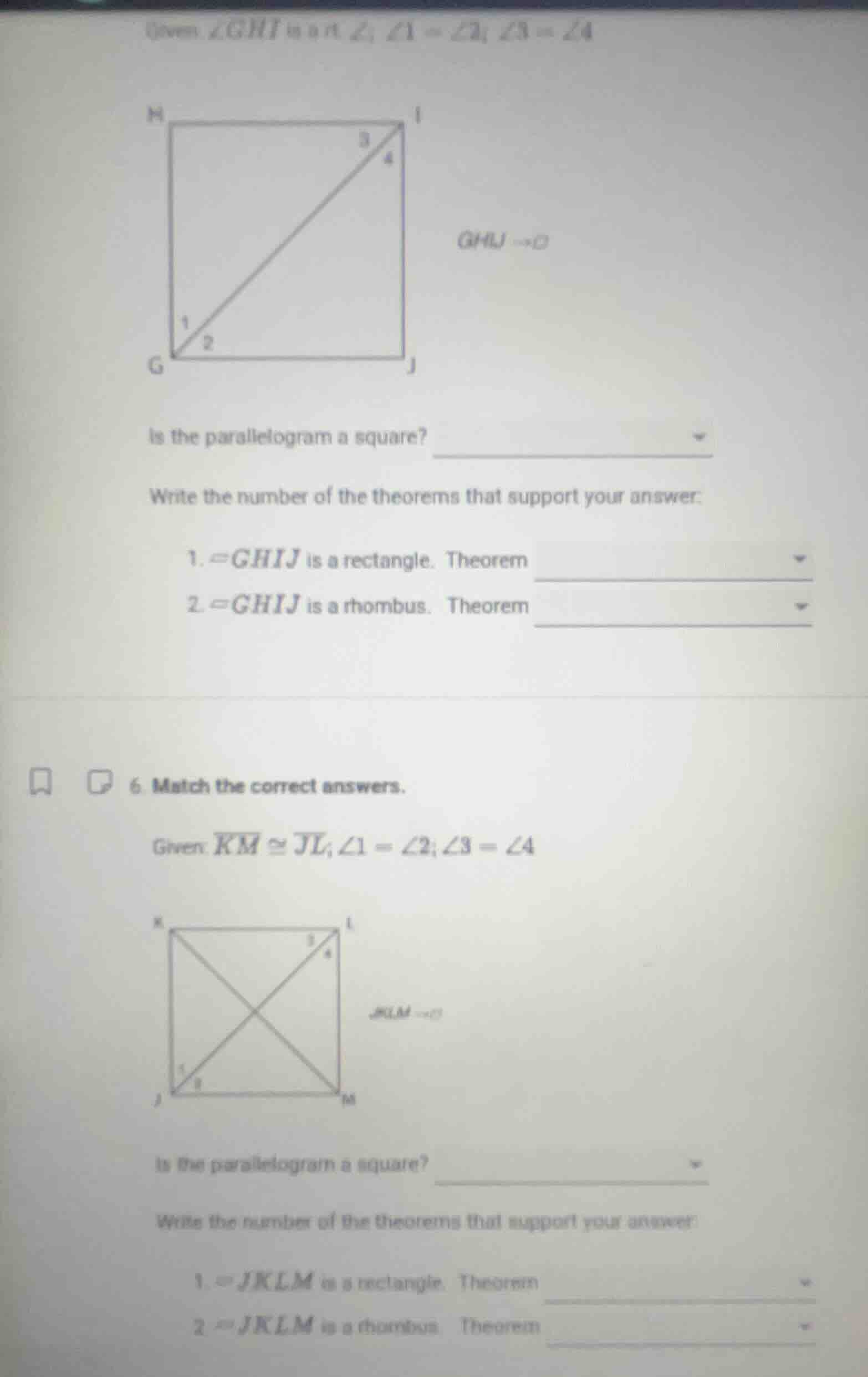
given: ∠ghi is a rt ∠; ∠1 = ∠2; ∠3 = ∠4
is the parallelogram a square?
write the number of the theorems that support your answer:
- ▱ghij is a rectangle. theorem
- ▱ghij is a rhombus. theorem
- match the correct answers.
given: (overline{km} cong overline{jl}); ∠1 = ∠2; ∠3 = ∠4
is the parallelogram a square?
write the number of the theorems that support your answer:
- ▱jklm is a rectangle. theorem
- ▱jklm is a rhombus. theorem
First Parallelogram (GHIJ)
Step1: Analyze ∠GHI is a right angle
Given ∠GHI is a right angle, in a parallelogram, if one angle is a right angle, it's a rectangle (Theorem: A parallelogram with one right angle is a rectangle).
Step2: Analyze ∠1 = ∠2 and ∠3 = ∠4
In triangle \( \triangle GHI \) and \( \triangle GIJ \), since \( \angle 1=\angle 2 \) and \( \angle 3 = \angle 4 \), and \( \angle GHI = 90^\circ \), we can show that the sides are equal. In a rectangle, if adjacent sides are equal (or diagonals bisect angles), it's a rhombus. A parallelogram that is both a rectangle and a rhombus is a square.
For "Is the parallelogram a square?"
A parallelogram with a right angle (so rectangle) and angle - bisecting diagonals (implying equal sides, so rhombus) is a square. So the answer is yes.
Theorem: A parallelogram with one right angle is a rectangle. Since \( \angle GHI \) is a right angle and \( GHIJ \) is a parallelogram, it's a rectangle.

Snap & solve any problem in the app
Get step-by-step solutions on Sovi AI
Photo-based solutions with guided steps
Explore more problems and detailed explanations
Yes