QUESTION IMAGE
Question
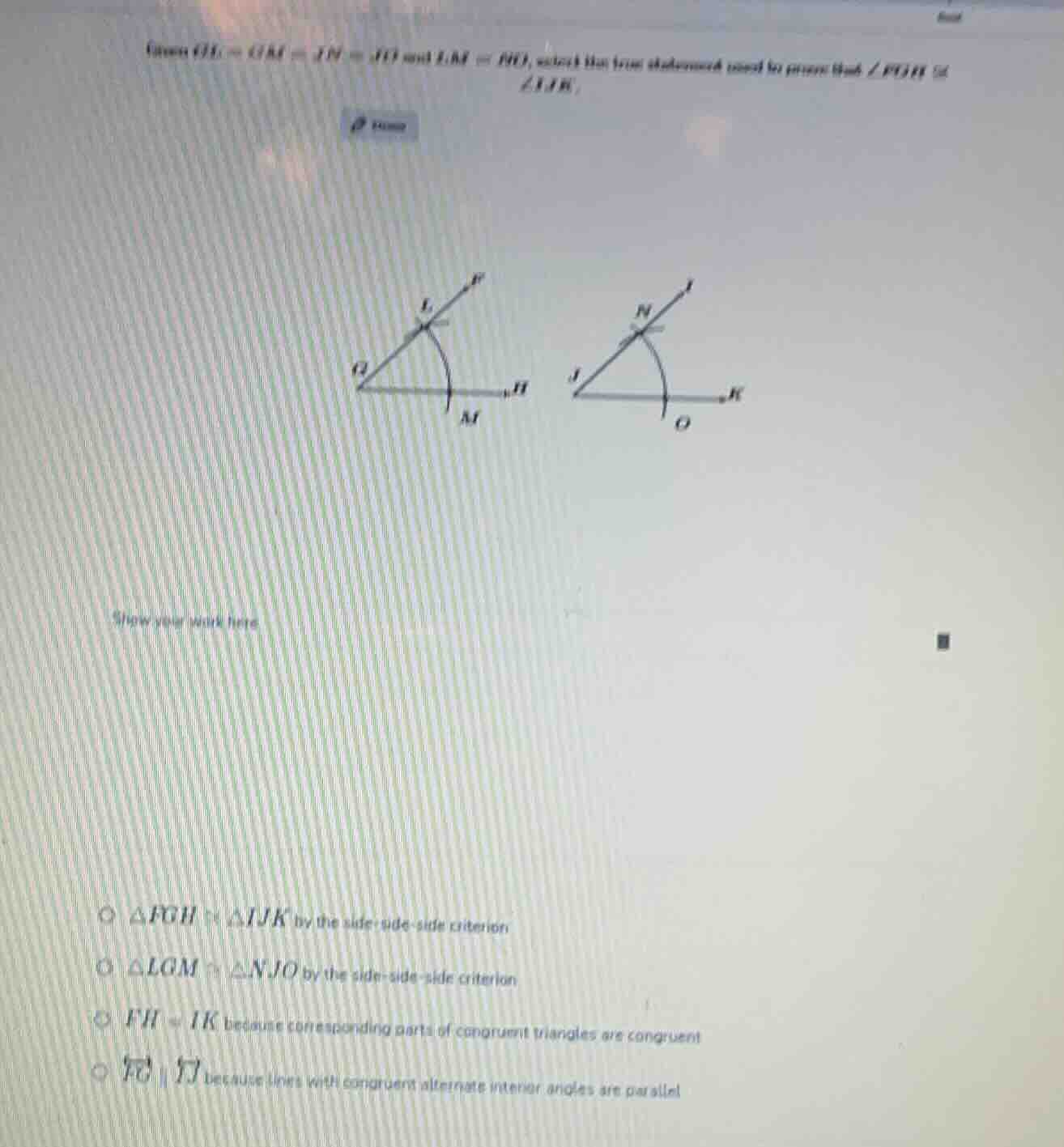
given gl = lk = jn = jo and lm = no, select the true statement used to prove that ∠fgh ≅ ∠ijk.
show your work here
○ △fgh ≅ △ijk by the side - side - side criterion
○ △lgm ≅ △njo by the side - side - side criterion
○ fh ≅ ik because corresponding parts of congruent triangles are congruent
○ fh || ik because lines with congruent alternate interior angles are parallel
We are given \( GL = LK = JN = JO \) and \( LM = NO \). To prove triangle congruence for the purpose of showing angle congruence, we look at the triangles \( \triangle LGM \) and \( \triangle NJO \). We have \( GL = JN \) (given), \( LM = NO \) (given), and \( GM \) and \( JO \)? Wait, no, actually, \( GL = JN \), \( LM = NO \), and \( \angle GLM \) and \( \angle JNO \)? Wait, no, the sides: \( GL = JN \), \( LM = NO \), and \( GM \) and \( JO \)? Wait, no, the triangles \( \triangle LGM \) and \( \triangle NJO \): \( GL = JN \) (given), \( LM = NO \) (given), and \( GM \) and \( JO \)? Wait, no, the third side: \( GL = JN \), \( LM = NO \), and \( GM \) and \( JO \)? Wait, no, actually, \( GL = JN \), \( LM = NO \), and \( \angle GLM \) and \( \angle JNO \)? No, the SSS criterion: if three sides of one triangle are equal to three sides of another triangle, then the triangles are congruent. Here, \( GL = JN \), \( LM = NO \), and \( GM = JO \)? Wait, no, the problem states \( GL = LK = JN = JO \) and \( LM = NO \). Wait, \( GL = JN \), \( LM = NO \), and \( GM \) (which is \( GL + LM \)? No, wait, the triangles are \( \triangle LGM \) and \( \triangle NJO \). So \( GL = JN \), \( LM = NO \), and \( GM = JO \)? Wait, no, \( GL = JN \), \( LM = NO \), and the third side: \( GM \) and \( JO \). Wait, maybe \( GL = JN \), \( LM = NO \), and \( GM = JO \) (since \( GL = JO \) as \( GL = JO \) from \( GL = JO \) (given \( GL = JO \) as \( GL = LK = JN = JO \))? Wait, no, \( GL = JN \), \( LM = NO \), and \( GM = JO \). So by SSS, \( \triangle LGM \cong \triangle NJO \). Then, the corresponding angles would be congruent. So the correct statement is \( \triangle LGM \cong \triangle NJO \) by the side - side - side criterion. Let's check the options:
- Option 1: \( \triangle FGH \cong \triangle IJK \) – there is no mention of \( F, G, H, I, J, K \) in the given sides, so this is incorrect.
- Option 2: \( \triangle LGM \cong \triangle NJO \) by SSS – this matches our reasoning as \( GL = JN \), \( LM = NO \), and \( GM = JO \) (since \( GL = JO \) from \( GL = JO \) (given \( GL = JO \) as \( GL = LK = JN = JO \)) and \( LM = NO \), so the three sides are equal).
- Option 3: \( FH = IK \) – there is no \( F, H, I, K \) in the given context related to the triangles we need, so incorrect.
- Option 4: The last option is about parallel lines, which is not relevant to proving the triangles congruent for the angle congruence here.

Snap & solve any problem in the app
Get step-by-step solutions on Sovi AI
Photo-based solutions with guided steps
Explore more problems and detailed explanations
\(\boldsymbol{\triangle LGM \cong \triangle NJO}\) by the side - side - side criterion