QUESTION IMAGE
Question
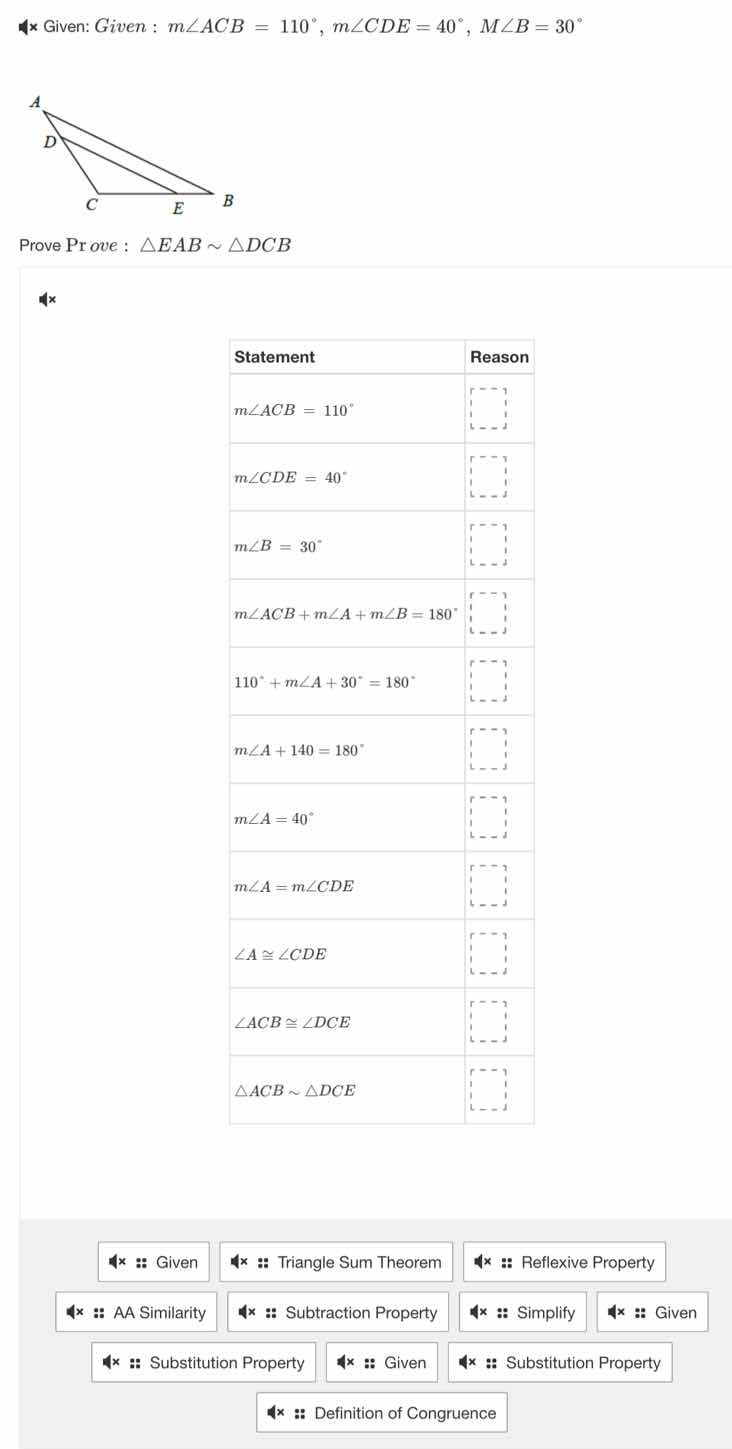
given : ( mangle acb = 110^circ ), ( mangle cde = 40^circ ), ( mangle b = 30^circ )
prove : ( \triangle eab sim \triangle dcb )
| statement | reason |
|---|---|
| ( mangle cde = 40^circ ) | |
| ( mangle b = 30^circ ) | |
| ( mangle acb + mangle a + mangle b = 180^circ ) | |
| ( 110^circ + mangle a + 30^circ = 180^circ ) | |
| ( mangle a + 140 = 180^circ ) | |
| ( mangle a = 40^circ ) | |
| ( mangle a = mangle cde ) | |
| ( angle a cong angle cde ) | |
| ( angle acb cong angle dce ) | |
| ( \triangle acb sim \triangle dce ) |
options: given, triangle sum theorem, reflexive property, aa similarity, subtraction property, simplify, substitution property, definition of congruence
Step1: Fill in "Given" for angle measures from problem
For \( m\angle ACB = 110^\circ \), \( m\angle CDE = 40^\circ \), \( m\angle B = 30^\circ \), the reason is "Given" (as these are provided in the problem statement).
Step2: Triangle Sum Theorem for angle sum
The statement \( m\angle ACB + m\angle A + m\angle B = 180^\circ \) uses the "Triangle Sum Theorem" (sum of angles in a triangle is \( 180^\circ \)).
Step3: Substitution Property for angle values
Substitute \( m\angle ACB = 110^\circ \) and \( m\angle B = 30^\circ \) into the sum: \( 110^\circ + m\angle A + 30^\circ = 180^\circ \) (reason: "Substitution Property").
Step4: Simplify the equation
Simplify \( 110^\circ + 30^\circ \) to get \( m\angle A + 140^\circ = 180^\circ \) (reason: "Simplify").
Step5: Subtraction Property to solve for \( m\angle A \)
Subtract \( 140^\circ \) from both sides: \( m\angle A = 40^\circ \) (reason: "Subtraction Property").
Step6: Substitution to compare angles
Since \( m\angle A = 40^\circ \) and \( m\angle CDE = 40^\circ \), \( m\angle A = m\angle CDE \) (reason: "Substitution Property").
Step7: Definition of Congruence
If \( m\angle A = m\angle CDE \), then \( \angle A \cong \angle CDE \) (reason: "Definition of Congruence").
Step8: Reflexive Property for \( \angle ACB \) and \( \angle DCE \)
\( \angle ACB \cong \angle DCE \) because they are the same angle (reason: "Reflexive Property").
Step9: AA Similarity for triangles
With \( \angle A \cong \angle CDE \) and \( \angle ACB \cong \angle DCE \), \( \triangle ACB \sim \triangle DCE \) (reason: "AA Similarity").
(Note: To prove \( \triangle EAB \sim \triangle DCB \), we can extend the reasoning: \( \angle B \) is common to both \( \triangle EAB \) and \( \triangle DCB \), and we can show another pair of angles equal using the above. But for the given table, we filled the reasons as per the steps.)

Snap & solve any problem in the app
Get step-by-step solutions on Sovi AI
Photo-based solutions with guided steps
Explore more problems and detailed explanations
The reasons filled in order for the statements are: Given, Given, Given, Triangle Sum Theorem, Substitution Property, Simplify, Subtraction Property, Substitution Property, Definition of Congruence, Reflexive Property, AA Similarity. (For the specific table cells, each statement's reason is filled as per the step-by-step above.)