QUESTION IMAGE
Question
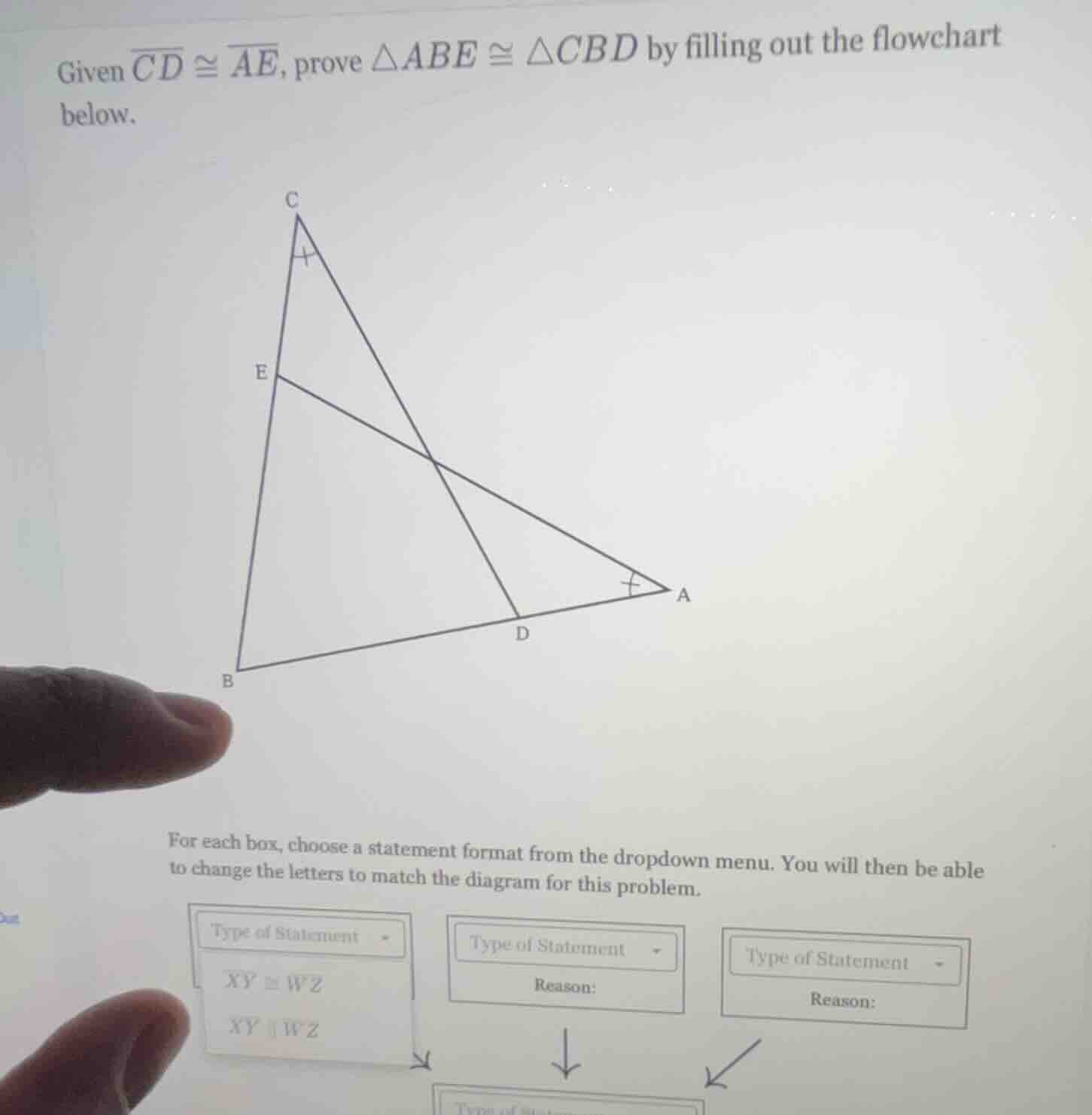
given \\(\overline{cd} \cong \overline{ae}\\), prove \\(\triangle abe \cong \triangle cbd\\) by filling out the flowchart below.
for each box, choose a statement format from the dropdown menu. you will then be able to change the letters to match the diagram for this problem.
Step1: Identify Common Angle
First, we note that $\angle B$ is common to both $\triangle ABE$ and $\triangle CBD$. So, $\angle ABE \cong \angle CBD$ (Reflexive Property of Congruence, as an angle is congruent to itself).
Step2: Identify Given Congruent Sides
We are given that $\overline{CD} \cong \overline{AE}$.
Step3: Identify Congruent Angles from Diagram
From the diagram, we can see that $\angle A \cong \angle C$ (marked with the same tick marks, indicating they are congruent angles).
Step4: Apply AAS Congruence Criterion
Now, in $\triangle ABE$ and $\triangle CBD$:
- $\angle ABE \cong \angle CBD$ (common angle, Reflexive Property)
- $\angle A \cong \angle C$ (from diagram)
- $\overline{AE} \cong \overline{CD}$ (given)
By the Angle - Angle - Side (AAS) Congruence Theorem, if two angles and a non - included side of one triangle are congruent to the corresponding two angles and non - included side of another triangle, then the triangles are congruent. So, $\triangle ABE \cong \triangle CBD$ by AAS.

Snap & solve any problem in the app
Get step-by-step solutions on Sovi AI
Photo-based solutions with guided steps
Explore more problems and detailed explanations
To fill the flowchart:
- First box (statement): $\angle A \cong \angle C$ (Reason: Given by the tick marks in the diagram, indicating congruent angles)
- Second box (statement): $\angle ABE \cong \angle CBD$ (Reason: Reflexive Property of Congruence, as $\angle B$ is common to both triangles)
- Third box (statement): $\overline{AE} \cong \overline{CD}$ (Reason: Given)
- Final statement: $\triangle ABE \cong \triangle CBD$ (Reason: AAS Congruence Theorem, since we have two congruent angles and a congruent non - included side)