QUESTION IMAGE
Question
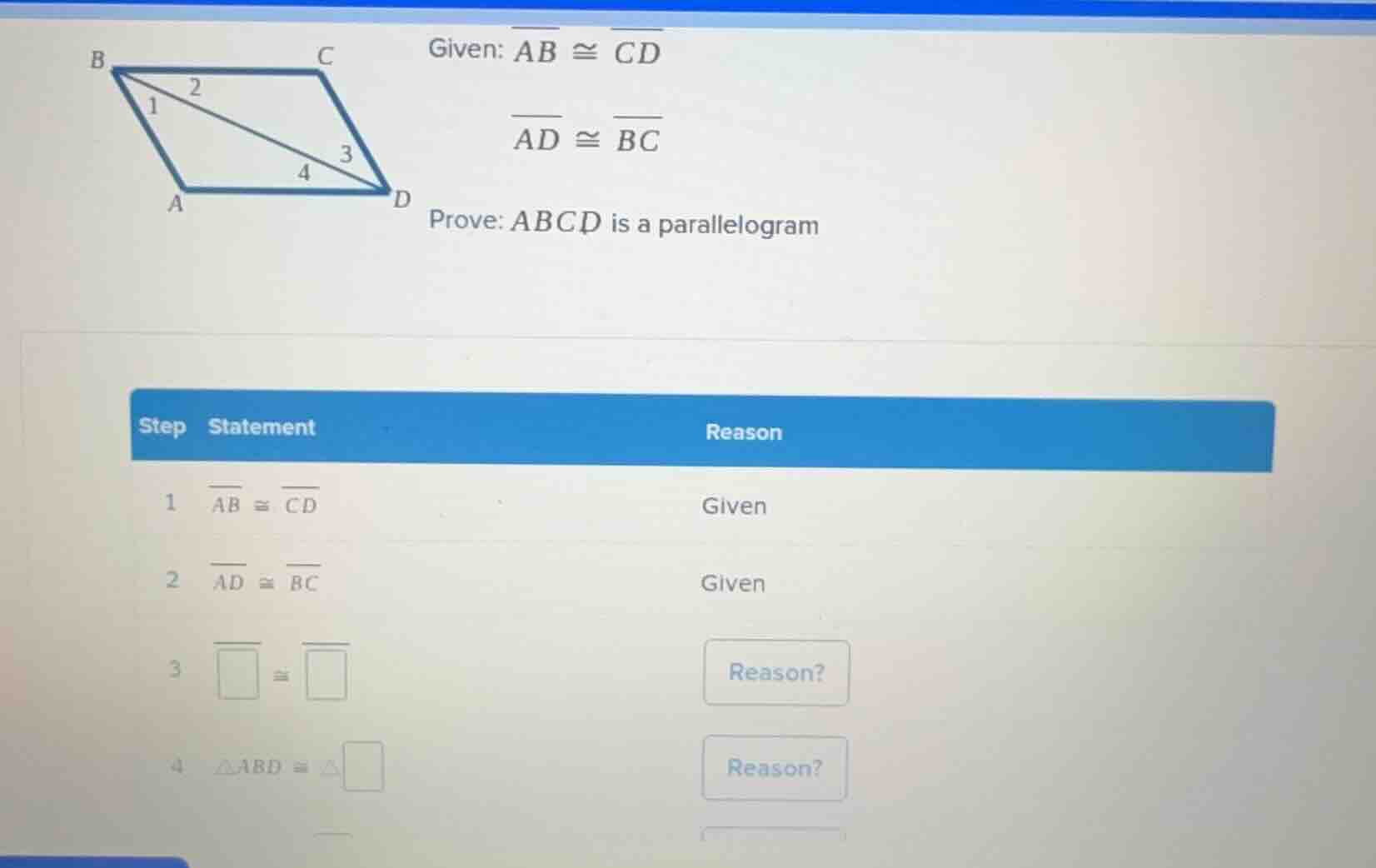
given: \\(\overline{ab} \cong \overline{cd}\\) \\(\overline{ad} \cong \overline{bc}\\) prove: \\(abcd\\) is a parallelogram step statement reason 1 \\(\overline{ab} \cong \overline{cd}\\) given 2 \\(\overline{ad} \cong \overline{bc}\\) given 3 \\(\square \cong \square\\) reason? 4 \\(\triangle abd \cong \triangle \square\\) reason?
Step1: Identify Common Side
In triangles \( \triangle ABD \) and \( \triangle CDB \), the side \( \overline{BD} \) is common to both triangles. So, \( \overline{BD} \cong \overline{BD} \) by the Reflexive Property of Congruence (a segment is congruent to itself).
Step2: Apply SSS Congruence
We know \( \overline{AB} \cong \overline{CD} \) (Given), \( \overline{AD} \cong \overline{BC} \) (Given), and \( \overline{BD} \cong \overline{BD} \) (Reflexive Property). By the Side - Side - Side (SSS) Congruence Postulate, if three sides of one triangle are congruent to three sides of another triangle, then the two triangles are congruent. So, \( \triangle ABD \cong \triangle CDB \).
Step3: Corresponding Angles Congruent
Since \( \triangle ABD \cong \triangle CDB \), their corresponding angles are congruent. So, \( \angle 1\cong\angle 3 \) and \( \angle 2\cong\angle 4 \) (Corresponding Parts of Congruent Triangles are Congruent - CPCTC).
Step4: Prove Parallel Sides
If alternate interior angles are congruent, then the lines are parallel. Since \( \angle 1\cong\angle 3 \), \( \overline{AB}\parallel\overline{CD} \) (Alternate Interior Angles Theorem). Since \( \angle 2\cong\angle 4 \), \( \overline{AD}\parallel\overline{BC} \) (Alternate Interior Angles Theorem).
Step5: Define Parallelogram
A quadrilateral with both pairs of opposite sides parallel is a parallelogram. Since \( \overline{AB}\parallel\overline{CD} \) and \( \overline{AD}\parallel\overline{BC} \), \( ABCD \) is a parallelogram.
For the given proof table:
Step 3:
Statement: \( \overline{BD} \cong \overline{BD} \)
Reason: Reflexive Property of Congruence (a segment is congruent to itself)
Step 4:
Statement: \( \triangle ABD \cong \triangle CDB \)
Reason: SSS (Side - Side - Side) Congruence Postulate (because \( \overline{AB} \cong \overline{CD} \), \( \overline{AD} \cong \overline{BC} \), and \( \overline{BD} \cong \overline{BD} \))

Snap & solve any problem in the app
Get step-by-step solutions on Sovi AI
Photo-based solutions with guided steps
Explore more problems and detailed explanations
Step 3:
Statement: \( \boldsymbol{\overline{BD} \cong \overline{BD}} \)
Reason: Reflexive Property of Congruence
Step 4:
Statement: \( \boldsymbol{\triangle ABD \cong \triangle CDB} \)
Reason: SSS Congruence Postulate