QUESTION IMAGE
Question
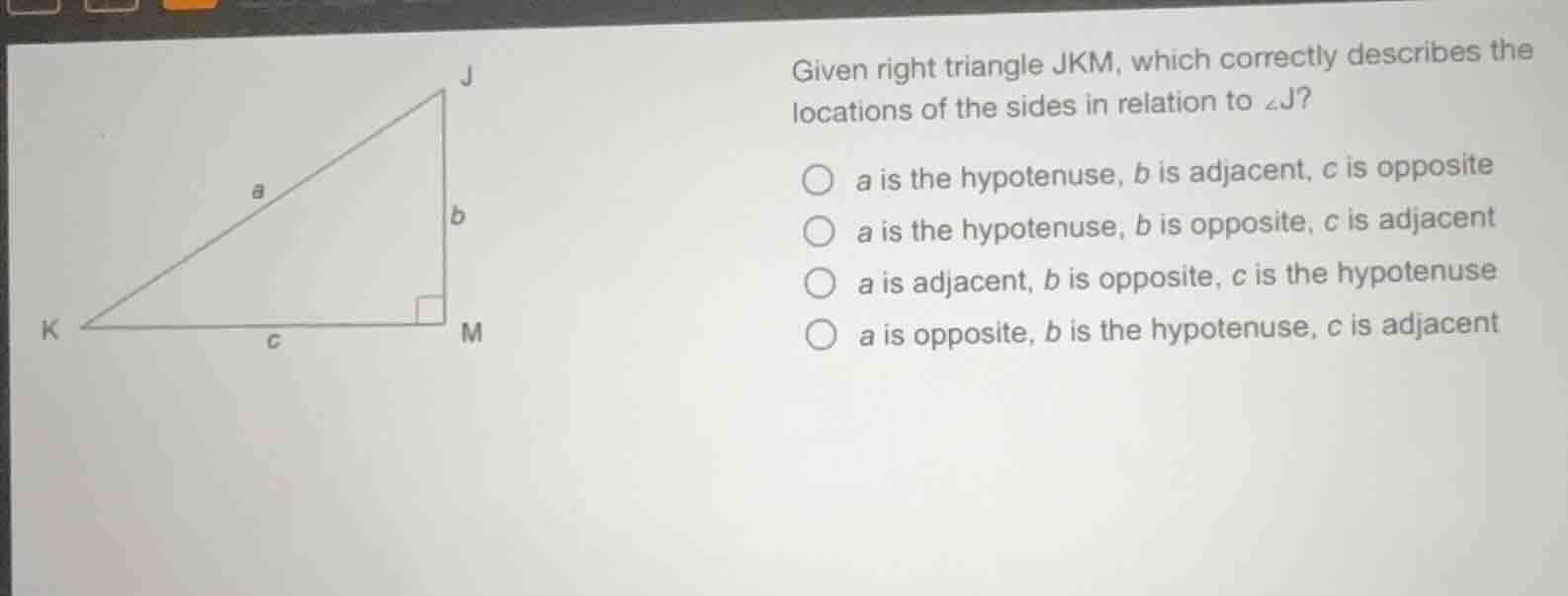
given right triangle jkm, which correctly describes the locations of the sides in relation to ∠j? a is the hypotenuse, b is adjacent, c is opposite a is the hypotenuse, b is opposite, c is adjacent a is adjacent, b is opposite, c is the hypotenuse a is opposite, b is the hypotenuse, c is adjacent
Brief Explanations
- Recall the definitions: In a right triangle, the hypotenuse is the side opposite the right angle (the longest side). For an acute angle (like ∠J), the adjacent side is the one that forms the angle with the hypotenuse, and the opposite side is the one not forming the angle.
- In right triangle JKM, the right angle is at M. So side \(a\) (JK) is the hypotenuse (opposite the right angle at M). For ∠J:
- Side \(b\) (JM) is adjacent to ∠J (forms ∠J with hypotenuse \(a\)).
- Side \(c\) (KM) is opposite to ∠J (does not form ∠J with hypotenuse \(a\)). Wait, no—wait, let's re - check. Wait, ∠J is at vertex J. So the sides:
- Hypotenuse: The side opposite the right angle (angle M) is JK, which is \(a\). So \(a\) is hypotenuse.
- For ∠J: The adjacent side is the one that is part of ∠J and is not the hypotenuse. ∠J is between sides \(b\) (JM) and \(a\) (JK), so \(b\) is adjacent. The side opposite ∠J is \(c\) (KM), because it's across from ∠J. So the first option says "a is the hypotenuse, b is adjacent, c is opposite"—wait, no, wait the options: Wait the first option is "a is the hypotenuse, b is adjacent, c is opposite". Wait let's re - analyze:
- Hypotenuse: In right triangle, hypotenuse is the side opposite the right angle. Right angle at M, so hypotenuse is JK (\(a\)). Correct.
- Adjacent to ∠J: The side that is next to ∠J and is not the hypotenuse. ∠J is at J, between sides JM (\(b\)) and JK (\(a\)). So JM (\(b\)) is adjacent to ∠J.
- Opposite to ∠J: The side that is across from ∠J, which is KM (\(c\)). So the first option "a is the hypotenuse, b is adjacent, c is opposite" is correct? Wait no, wait the second option: "a is the hypotenuse, b is opposite, c is adjacent"—no, let's draw the triangle. Vertex J, K, M with right angle at M. So:
- ∠J: sides:
- Hypotenuse: JK (\(a\)) – correct.
- Adjacent: JM (\(b\)) – because it's one of the two sides forming ∠J (the other is hypotenuse \(a\)).
- Opposite: KM (\(c\)) – because it's not forming ∠J, it's opposite. So the first option: "a is the hypotenuse, b is adjacent, c is opposite" is correct? Wait the first option is "a is the hypotenuse, b is adjacent, c is opposite" – yes. Wait but let's check the options again:
- Option 1: a is hypotenuse, b adjacent, c opposite.
- Option 2: a hypotenuse, b opposite, c adjacent.
- Option 3: a adjacent, b opposite, c hypotenuse – no, \(a\) is hypotenuse, so this is wrong.
- Option 4: a opposite, b hypotenuse, c adjacent – wrong, \(a\) is hypotenuse.
Wait, maybe I made a mistake. Let's use the standard definitions:
- Hypotenuse: The side opposite the right angle. Right angle at M, so hypotenuse is JK (\(a\)) – correct.
- For angle J:
- Adjacent side: The side that is part of angle J and is not the hypotenuse. Angle J is between JM (\(b\)) and JK (\(a\)), so JM (\(b\)) is adjacent.
- Opposite side: The side that is not part of angle J and is opposite to it. That is KM (\(c\)). So the first option: "a is the hypotenuse, b is adjacent, c is opposite" is correct. Wait but let's check the options again. Wait the first option is "a is the hypotenuse, b is adjacent, c is opposite" – yes. Wait no, wait the problem's options: Wait the first option: "a is the hypotenuse, b is adjacent, c is opposite"—yes, that matches our analysis. Wait but maybe I mixed up opposite and adjacent. Wait, no—let's take angle J. The sides:
- Hypotenuse: \(a\) (JK) – correct.
- Adjacent to ∠J: the side that is adjacent (next to) ∠J, which…

Snap & solve any problem in the app
Get step-by-step solutions on Sovi AI
Photo-based solutions with guided steps
Explore more problems and detailed explanations
A. a is the hypotenuse, b is adjacent, c is opposite