QUESTION IMAGE
Question
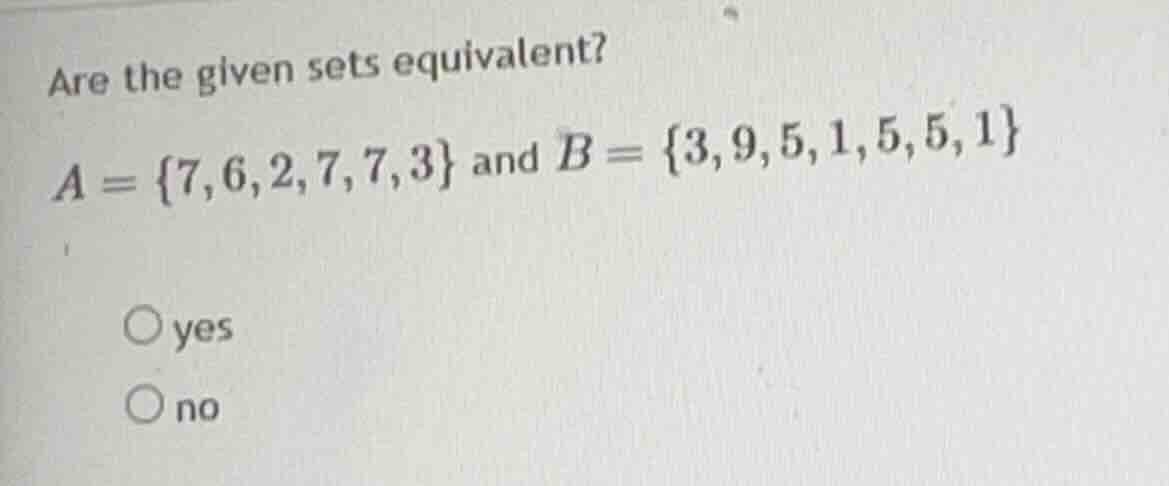
are the given sets equivalent?
$a = \\{7, 6, 2, 7, 7, 3\\}$ and $b = \\{3, 9, 5, 1, 5, 5, 1\\}$
\\(\circ\\) yes
\\(\circ\\) no
Step1: Find the number of distinct elements in set A
In a set, duplicate elements are not counted multiple times. For set \( A = \{7, 6, 2, 7, 7, 3\} \), the distinct elements are \( 7, 6, 2, 3 \). Wait, no, actually, when considering the cardinality (number of elements) of a set, we count the number of distinct elements. Wait, no, hold on: actually, when we talk about equivalent sets, two sets are equivalent if they have the same cardinality (number of elements), regardless of the elements themselves. Wait, first, let's correctly find the cardinality of each set.
Wait, no, let's re-express the sets by removing duplicates (since sets don't have duplicate elements).
For set \( A \): The elements are \( 7, 6, 2, 7, 7, 3 \). Removing duplicates, we get \( A = \{7, 6, 2, 3\} \). Wait, no, that's not right. Wait, no: the set \( A \) as given has elements, but in set theory, a set is a collection of distinct objects. So the set \( A \) is actually \( \{3, 6, 2, 7\} \) (since we remove the duplicate 7s). Wait, no, the number of elements in set \( A \) (cardinality) is the number of distinct elements. Wait, no, wait: the original set \( A \) has elements \( 7, 6, 2, 7, 7, 3 \). So the distinct elements are \( 3, 6, 2, 7 \), so the cardinality of \( A \) is 4? Wait, no, wait: let's count again. The elements are 7 (appears 3 times), 6 (1), 2 (1), 3 (1). So distinct elements: 7, 6, 2, 3. So cardinality of \( A \) is 4? Wait, no, that's not correct. Wait, no, the set \( A \) is \( \{7, 6, 2, 3\} \), so the number of elements (cardinality) is 4? Wait, no, 7, 6, 2, 3: that's 4 elements? Wait, 7, 6, 2, 3: four elements. Now set \( B \): \( B = \{3, 9, 5, 1, 5, 5, 1\} \). Removing duplicates, we get \( B = \{1, 3, 5, 9\} \). So the cardinality of \( B \) is 4? Wait, no, 1, 3, 5, 9: that's 4 elements? Wait, no, 1 (appears 2 times), 3 (1), 5 (3), 9 (1). So distinct elements: 1, 3, 5, 9. So cardinality of \( B \) is 4? Wait, but that can't be. Wait, no, wait, maybe I made a mistake. Wait, let's count the number of elements in each set correctly. Wait, no: the problem is about equivalent sets. Two sets are equivalent if they have the same cardinality (number of elements), regardless of what the elements are. Wait, but let's check the number of elements in each set (including duplicates? No, no: in set theory, a set does not have duplicate elements. So the set \( A \) is \( \{3, 6, 2, 7\} \) (since we remove the duplicate 7s), so the number of elements (cardinality) is 4. The set \( B \) is \( \{1, 3, 5, 9\} \) (removing duplicate 1s and 5s), so cardinality is 4. Wait, but that would mean they are equivalent. But wait, maybe I messed up. Wait, no, wait: the original problem: maybe the question is about equivalent sets in the sense of having the same number of elements (cardinality), regardless of the elements. So let's count the number of elements in each set, considering that in a set, duplicates are not counted. Wait, no, maybe the problem is considering the sets as multisets? But the question says "sets", not "multisets". Wait, the problem says "Are the given sets equivalent?". In set theory, two sets are equivalent (or have the same cardinality) if there is a bijection between them, i.e., they have the same number of elements. So let's count the number of elements in each set (cardinality).
For set \( A \): The elements are \( 7, 6, 2, 7, 7, 3 \). As a set, the distinct elements are \( 3, 6, 2, 7 \), so cardinality \( |A| = 4 \).
For set \( B \): The elements are \( 3, 9, 5, 1, 5, 5, 1 \). As a set, the distinct elements are \( 1, 3, 5, 9 \),…

Snap & solve any problem in the app
Get step-by-step solutions on Sovi AI
Photo-based solutions with guided steps
Explore more problems and detailed explanations
yes