QUESTION IMAGE
Question
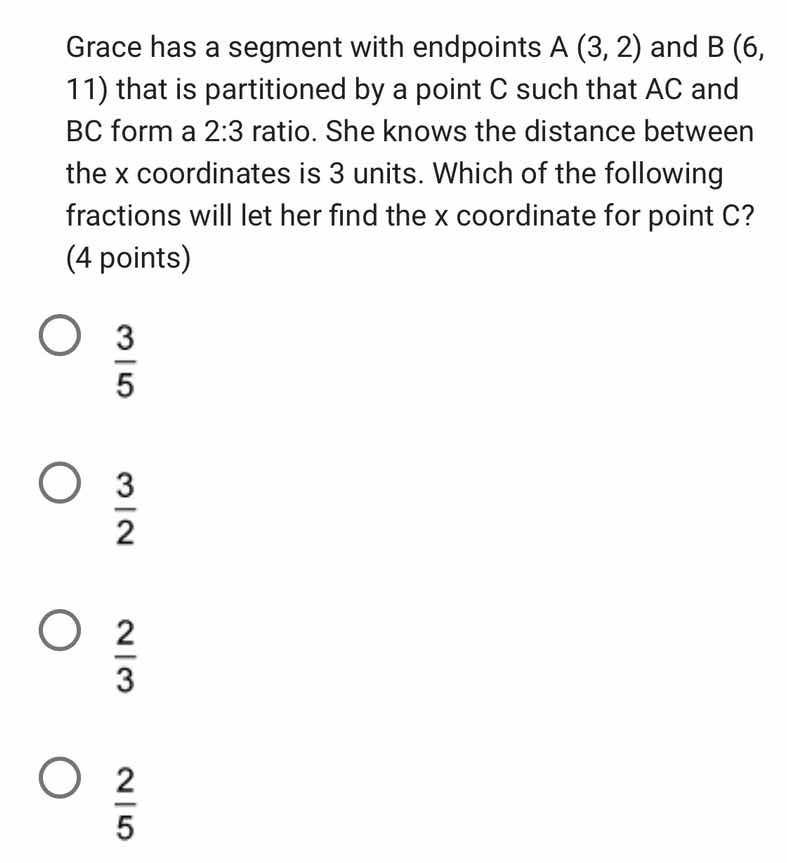
grace has a segment with endpoints a (3, 2) and b (6, 11) that is partitioned by a point c such that ac and bc form a 2:3 ratio. she knows the distance between the x coordinates is 3 units. which of the following fractions will let her find the x coordinate for point c? (4 points) \\(\frac{3}{5}\\) \\(\frac{3}{2}\\) \\(\frac{2}{3}\\) \\(\frac{2}{5}\\)
Step1: Understand the Section Formula
When a point \( C \) divides a segment \( AB \) in the ratio \( m:n \) (where \( AC:CB = m:n \)), the \( x \)-coordinate of \( C \) can be found using the formula that involves the fraction \( \frac{m}{m + n} \) (or \( \frac{n}{m + n} \) depending on direction, but here we analyze the ratio given). Here, the ratio \( AC:BC = 2:3 \), so \( m = 2 \) and \( n = 3 \).
Step2: Determine the Fraction for x - coordinate
To find the \( x \)-coordinate of \( C \), we consider the movement from \( A \) to \( B \) (or vice - versa). The total number of parts in the ratio \( AC:BC=2:3 \) is \( m + n=2 + 3=5 \) parts.
If we are moving from \( A \) to \( B \), the fraction of the horizontal (x - coordinate) distance that we cover from \( A \) to \( C \) is determined by the ratio of \( AC \) to the total length \( AB \) (where \( AB=AC + BC \)). Since \( AC:BC = 2:3 \), the length of \( AC \) is 2 parts and the length of \( AB \) is \( 2 + 3=5 \) parts. But when finding the \( x \)-coordinate, we can also think in terms of the ratio of the part we take from the difference in \( x \)-coordinates. The difference in \( x \)-coordinates between \( A(3,2) \) and \( B(6,11) \) is \( 6 - 3 = 3 \) units (as given). To find the \( x \)-coordinate of \( C \), we start with the \( x \)-coordinate of \( A \) (or \( B \)) and add (or subtract) a fraction of this difference.
The fraction of the difference in \( x \)-coordinates that we need to take from \( A \) towards \( B \) is \( \frac{2}{5} \)? Wait, no. Wait, let's re - express. Let the ratio be \( AC:CB = 2:3 \). So, using the section formula for internal division, the \( x \)-coordinate of \( C \) is given by \( x_C=x_A+\frac{m}{m + n}(x_B - x_A) \), where \( m = 2 \) (the ratio of \( AC \)) and \( n = 3 \) (the ratio of \( BC \)). Wait, no, actually, if \( AC:BC=m:n \), then the formula is \( x_C=\frac{n\times x_A+m\times x_B}{m + n} \) (when the ratio is \( AC:BC = m:n \)). Wait, let's clarify the ratio notation. If \( AC:CB=m:n \), then the coordinates of \( C \) are given by \( x=\frac{n\times x_A+m\times x_B}{m + n} \) and \( y=\frac{n\times y_A+m\times y_B}{m + n} \). Here, \( AC:BC = 2:3 \), so \( m = 2 \), \( n = 3 \). Then \( x_C=\frac{3\times3+2\times6}{2 + 3}=\frac{9 + 12}{5}=\frac{21}{5}=4.2 \), and the \( x \)-coordinate of \( A \) is 3, the difference in \( x \)-coordinates is \( 6 - 3=3 \). So \( x_C=3+\frac{2}{5}\times3 \)? Wait, no, \( \frac{2}{5}\times3=\frac{6}{5} \), and \( 3+\frac{6}{5}=\frac{15 + 6}{5}=\frac{21}{5}=4.2 \), which matches. But wait, the question is about which fraction will let her find the \( x \)-coordinate. Let's think again.
The difference in \( x \)-coordinates is \( 6 - 3 = 3 \) units. We need to find how much of this 3 - unit difference we add to the \( x \)-coordinate of \( A \) (or subtract from \( B \)) to get the \( x \)-coordinate of \( C \). Since \( AC:BC = 2:3 \), the length of \( AC \) is 2 parts and \( BC \) is 3 parts. So the fraction of the total length \( AB\) (where \( AB = AC+BC\)) that \( AC \) occupies is \( \frac{2}{5} \), but the fraction of the difference in \( x \)-coordinates (which is equal to the length of the horizontal component of \( AB \)) that we need to take from \( A \) towards \( B \) is \( \frac{2}{5} \)? Wait, no, maybe I mixed up. Wait, let's take an example. Suppose the ratio is \( AC:CB = 2:3 \). So starting at \( A(3,2) \), moving towards \( B(6,11) \), the total number of parts is \( 2 + 3=5 \) parts. The length from \( A \) to \( C \) is 2 parts and from \( C \) to \( B \) is…

Snap & solve any problem in the app
Get step-by-step solutions on Sovi AI
Photo-based solutions with guided steps
Explore more problems and detailed explanations
\(\boldsymbol{\frac{2}{5}}\) (the option with \(\frac{2}{5}\))