QUESTION IMAGE
Question
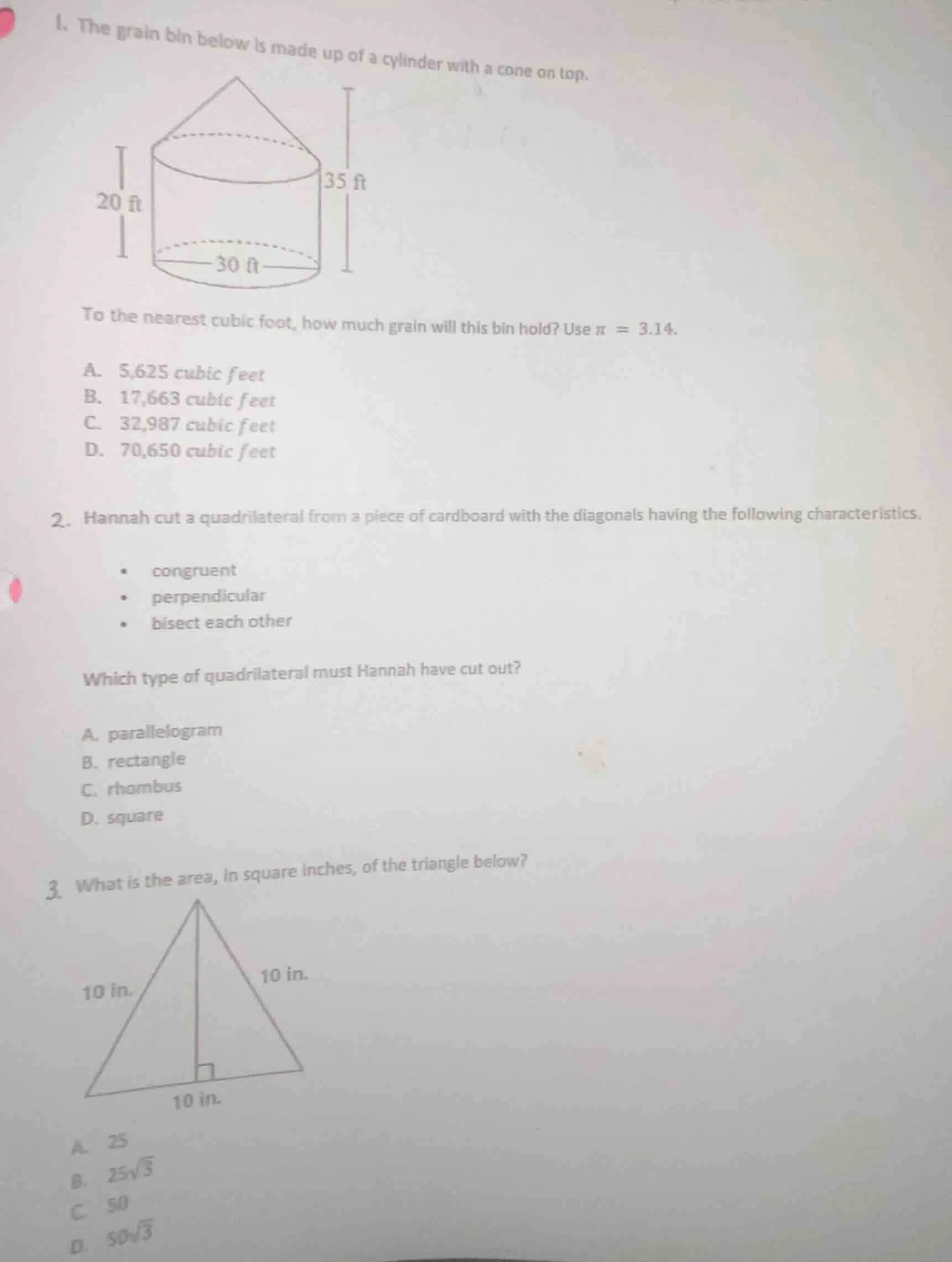
- the grain bin below is made up of a cylinder with a cone on top.
(image of a cylinder with a cone on top, labeled: cylinder height 20 ft, total height 35 ft, diameter 30 ft)
to the nearest cubic foot, how much grain will this bin hold? use \\( \pi = 3.14 \\).
a. 5,625 cubic feet
b. 17,663 cubic feet
c. 32,987 cubic feet
d. 70,650 cubic feet
- hannah cut a quadrilateral from a piece of cardboard with the diagonals having the following characteristics.
- congruent
- perpendicular
- bisect each other
which type of quadrilateral must hannah have cut out?
a. parallelogram
b. rectangle
c. rhombus
d. square
- what is the area, in square inches, of the triangle below?
(image of an isosceles triangle with two sides 10 in, base 10 in, and height drawn)
a. 25
b. \\( 25\sqrt{3} \\)
c. 50
d. \\( 50\sqrt{3} \\)
Problem 1
Step1: Find cylinder radius
The diameter is 30 ft, so radius $r = \frac{30}{2} = 15$ ft.
Step2: Calculate cylinder volume
Use $V_{cyl} = \pi r^2 h$.
$V_{cyl} = 3.14 \times 15^2 \times 20 = 3.14 \times 225 \times 20 = 14130$ cubic ft.
Step3: Find cone height
Total height is 35 ft, cylinder height 20 ft, so $h_{cone} = 35 - 20 = 15$ ft.
Step4: Calculate cone volume
Use $V_{cone} = \frac{1}{3}\pi r^2 h_{cone}$.
$V_{cone} = \frac{1}{3} \times 3.14 \times 15^2 \times 15 = \frac{1}{3} \times 3.14 \times 225 \times 15 = 3532.5$ cubic ft.
Step5: Sum volumes for total capacity
$V_{total} = 14130 + 3532.5 = 17662.5$ cubic ft.
Step6: Round to nearest cubic foot
$17662.5 \approx 17663$ cubic ft.
- A parallelogram has bisecting diagonals, but they are not necessarily congruent or perpendicular.
- A rectangle has congruent, bisecting diagonals, but they are not perpendicular.
- A rhombus has perpendicular, bisecting diagonals, but they are not necessarily congruent.
- A square has diagonals that are congruent, perpendicular, and bisect each other, matching all given characteristics.
Step1: Split triangle into two right triangles
The height splits the base into two 5 in segments.
Step2: Calculate triangle height
Use Pythagorean theorem: $h = \sqrt{10^2 - 5^2} = \sqrt{100 - 25} = \sqrt{75} = 5\sqrt{3}$ in.
Step3: Calculate total triangle area
Use $A = \frac{1}{2} \times base \times height$.
$A = \frac{1}{2} \times 10 \times 5\sqrt{3} = 25\sqrt{3}$ square inches.

Snap & solve any problem in the app
Get step-by-step solutions on Sovi AI
Photo-based solutions with guided steps
Explore more problems and detailed explanations
B. 17,663 cubic feet
---