QUESTION IMAGE
Question
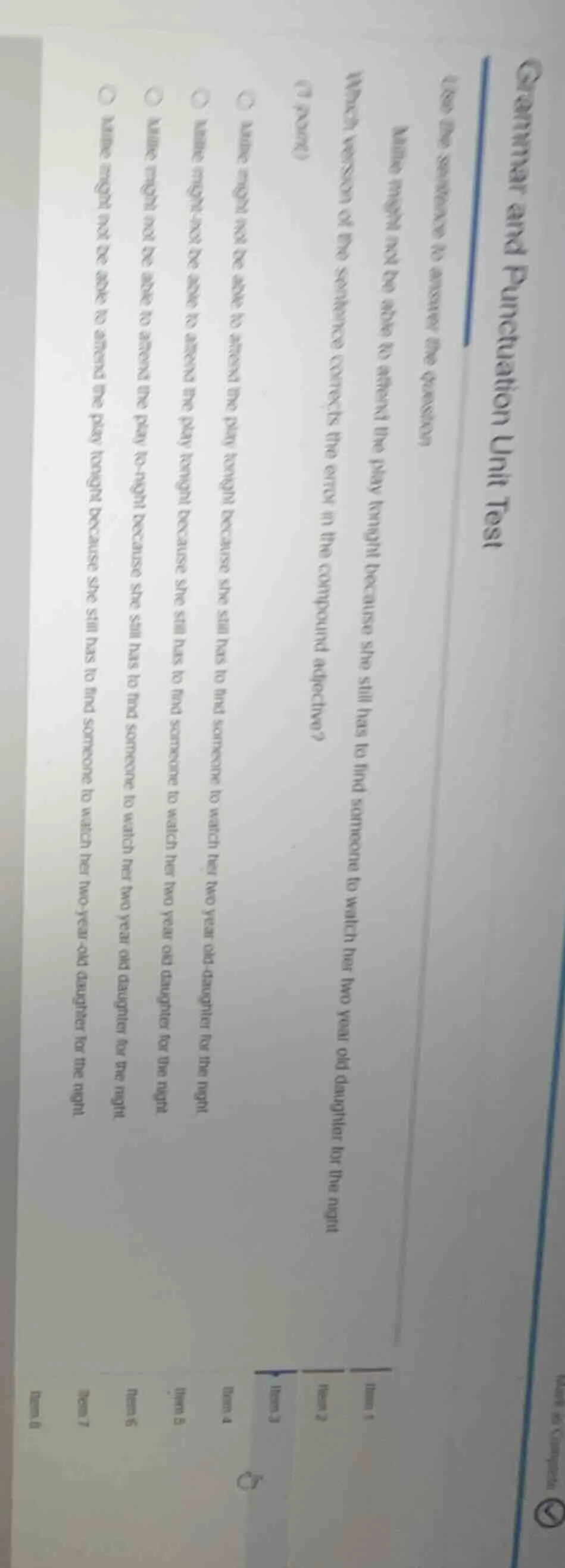
grammar and punctuation unit test (use the sentence to answer the question) which version of the sentence corrects the error in the compound adjective? (1 point) anne might not be able to attend the play tonight because she still has to find someone to watch her two year old daughter for the night. anne might not be able to attend the play tonight because she still has to find someone to watch her two year-old daughter for the night. anne might not be able to attend the play tonight because she still has to find someone to watch her two-year old daughter for the night. anne might not be able to attend the play tonight because she still has to find someone to watch her two-year-old daughter for the night.
To identify the error in the compound adjective, we recall the rule for compound adjectives with age: when using a number + unit + old as a compound adjective (e.g., two - year - old), hyphens are required between each part, and the noun (year) should be singular. Let's analyze each option:
- Option 1: "two year old - daughter" has incorrect spacing and lacks hyphens between "two" and "year" and "year" and "old". Also, the hyphen after "old" is misplaced.
- Option 2: "two year old daughter" lacks hyphens between "two" and "year" and "year" and "old".
- Option 3: "two year old daughter" (same as option 2) lacks hyphens.
- Option 4: "two - year - old daughter" follows the correct rule for compound adjectives (hyphens between each part of the number - unit - old structure, and "year" is singular). Wait, no, wait. Wait, the original sentence in the options (let's re - check the options as presented). Wait, the options are about which sentence corrects the error? Wait, no, the question is "Which version of the sentence corrects the error in the compound adjective?". The error in the original (from the context) is the compound adjective "two year old" which should be "two - year - old" (with hyphens and singular "year"). Now let's check the options:
Looking at the options (as per the image text):
- First option: "Annie might not be able to attend the play tonight because she still has to find someone to watch her two year old - daughter for the night." → Incorrect hyphen placement and missing hyphens between "two" - "year" and "year" - "old".
- Second option: "Annie might not be able to attend the play tonight because she still has to find someone to watch her two year old daughter for the night." → No hyphens, incorrect.
- Third option: "Annie might not be able to attend the play tonight because she still has to find someone to watch her two year old daughter for the night." → Same as second, incorrect.
- Fourth option: "Annie might not be able to attend the play tonight because she still has to find someone to watch her two - year - old daughter for the night." → This follows the correct compound adjective rule (hyphens between "two", "year", and "old", and "year" is singular). Wait, but in the options provided in the image (the fourth option in the list of radio buttons) is "Annie might not be able to attend the play tonight because she still has to find someone to watch her two - year - old daughter for the night." So this is the correct one as it uses the proper compound adjective "two - year - old" with hyphens and singular "year".

Snap & solve any problem in the app
Get step-by-step solutions on Sovi AI
Photo-based solutions with guided steps
Explore more problems and detailed explanations
The correct option is the one with "two - year - old" (the last radio button option: "Annie might not be able to attend the play tonight because she still has to find someone to watch her two - year - old daughter for the night").