QUESTION IMAGE
Question
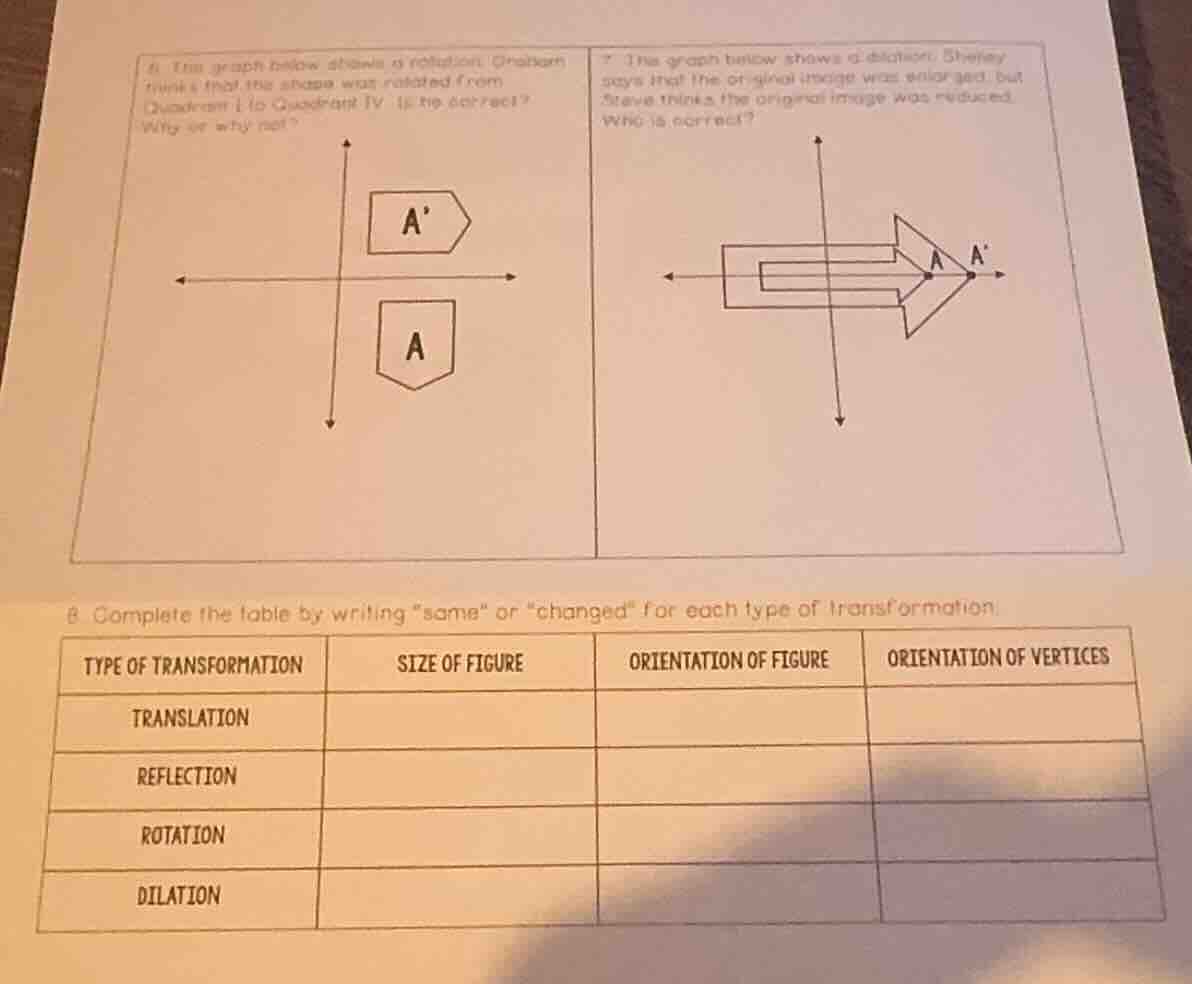
- the graph below shows a rotation. graham thinks that the shape was rotated from quadrant i to quadrant iv. is he correct? why or why not?
- the graph below shows a dilation. shelley says that the original image was enlarged, but steve thinks the original image was reduced. who is correct?
- complete the table by writing \same\ or \changed\ for each type of transformation.
| type of transformation | size of figure | orientation of figure | orientation of vertices |
|---|---|---|---|
| reflection | |||
| rotation | |||
| dilation |
Question 6
Step1: Recall Rotation Properties
Rotation is a transformation that turns a figure around a fixed point. The orientation (direction it faces) and position relative to quadrants change, but the shape and size remain the same.
Step2: Analyze Quadrants and Orientation
Quadrant I is where both x and y are positive. Quadrant IV is where x is positive and y is negative. The original figure A is below the x - axis (maybe Quadrant IV or on the y - axis side below x - axis), and A' is above the x - axis (Quadrant I). But rotation from Quadrant I to IV would mean turning the figure so that its orientation changes. However, looking at the shapes, A and A' seem to be a reflection (over the x - axis) rather than a rotation. For a rotation, the figure should be turned (e.g., 90, 180, 270 degrees), but here the top - bottom flip is a reflection. So Obaan is incorrect because the transformation looks like a reflection (over the x - axis) not a rotation from Quadrant I to IV. The orientation of A and A' (the direction the "point" of the shape is facing) and their position (A is below x - axis, A' above) suggest reflection, not rotation.
Step1: Recall Dilation Properties
Dilation is a transformation that changes the size of a figure. If the scale factor \(k>1\), the figure is enlarged; if \(0 < k<1\), the figure is reduced.
Step2: Analyze the Dilation
Looking at the original image (the larger arrow - like figure) and the image \(A'\) (the smaller arrow - like figure), the size of \(A'\) is smaller than the original. So the original image was reduced (since the image after dilation is smaller). So Steve is correct because dilation that makes the figure smaller is a reduction (scale factor between 0 and 1), while enlargement is when the scale factor is greater than 1.
Step1: Recall Translation Properties
Translation is a slide (movement) of a figure. It does not change the size, orientation of the figure (the direction it faces), or the orientation of the vertices (the order of the vertices around the figure).
Step2: Recall Reflection Properties
Reflection is a flip over a line. It changes the orientation of the figure (the direction it faces, like a mirror image) and the orientation of the vertices (the order of vertices is reversed in a sense, e.g., left - right flip), but the size remains the same.
Step3: Recall Rotation Properties
Rotation is a turn around a point. It changes the orientation of the figure (the direction it faces) and the orientation of the vertices (the order of vertices changes as the figure is turned), but the size remains the same.
Step4: Recall Dilation Properties
Dilation is a resize. It changes the size of the figure (enlarges or reduces), but the orientation of the figure and the orientation of the vertices (the relative order of vertices, the "shape" of the vertex order) remain the same (since it's a proportional resize).
Now, fill the table:
| TYPE OF TRANSFORMATION | SIZE OF FIGURE | ORIENTATION OF FIGURE | ORIENTATION OF VERTICES |
|---|---|---|---|
| REFLECTION | same | changed | changed |
| ROTATION | same | changed | changed |
| DILATION | changed | same | same |

Snap & solve any problem in the app
Get step-by-step solutions on Sovi AI
Photo-based solutions with guided steps
Explore more problems and detailed explanations
Obaan is incorrect. The transformation appears to be a reflection (over the x - axis) rather than a rotation. Rotation would involve turning the figure around a point, but here the figure seems to be flipped over the x - axis. The orientation and position change in a way consistent with reflection, not rotation from Quadrant I to IV.